
Coverage
Commercial Auto Insurance for Dumpster Rental Operators
The roll-off truck, the hook-lift, the hoist and the drivers — and the provisions that decide where the auto policy starts and where it hands back.
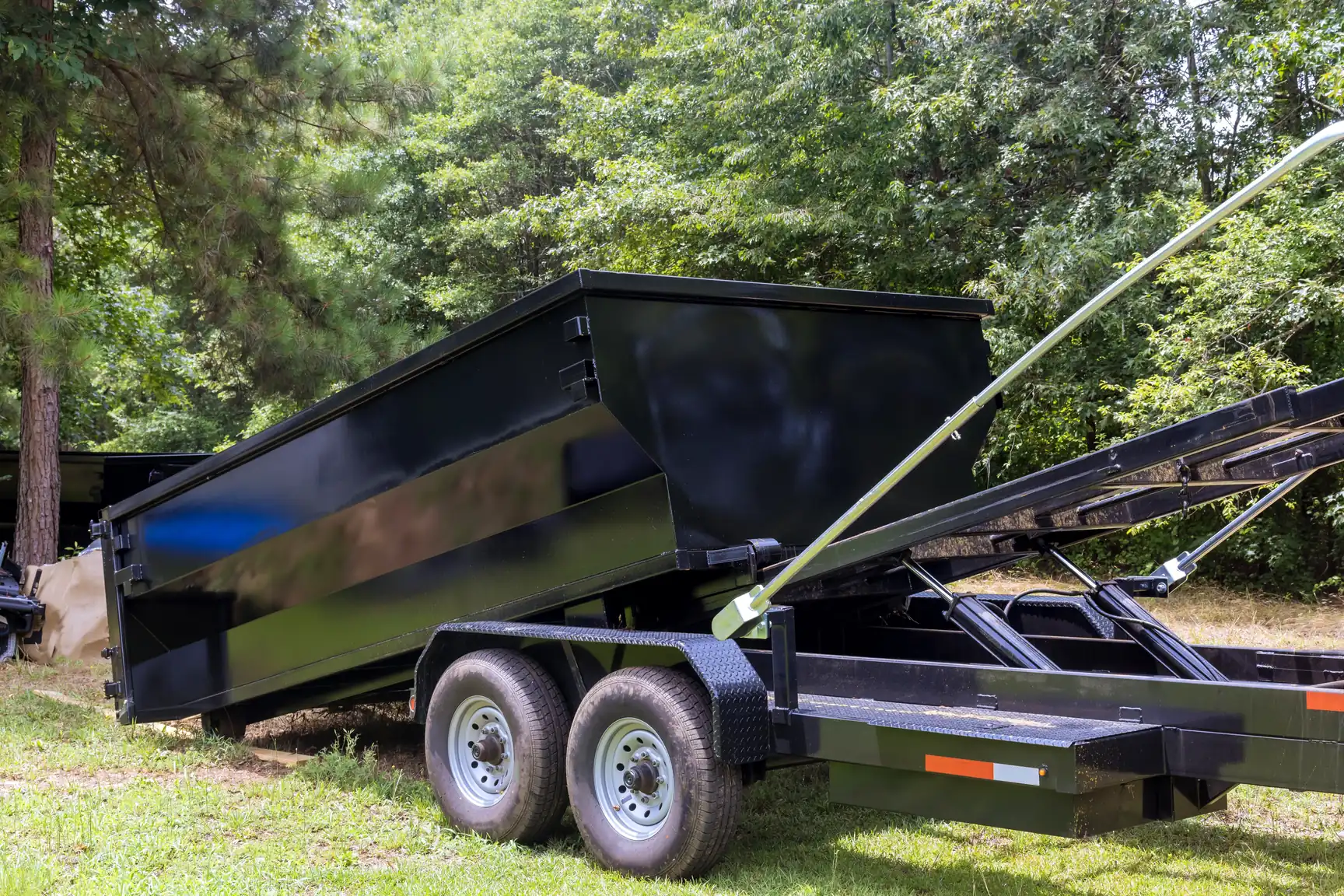
The short version of this coverage, repeated almost everywhere, is that the auto policy covers loading and unloading. We checked that against the document. The standard auto form in front of us does not use the phrase at all — neither word appears anywhere in it. The same sweep found the form’s ordinary vocabulary exactly where it belongs, which is how we know the search was reading the pages rather than missing them.
What the form uses instead is three differently drafted ideas: the handling of property, the movement of property by a mechanical device, and the use of a covered auto. The defined phrase everyone quotes lives on the other side of the seam, in the general liability form, inside the definition that decides what that policy is handing away.
This page is the truck half — the hoist and the hook-lift, the vehicles you borrow and the vehicles your people already own, the federal layer over a route, and the load itself. The general liability half is on its own page. Forms differ between carriers, and your own policy wording controls.
The phrase that is missing, and the phrase that is defined
We are careful about how we say this. Not that no auto policy anywhere prints those words — that the standard form we read does not, and a summary built on the phrase is built on something the form does not contain. Anyone with a copy can check it in about ninety seconds.
It still works out, for a structural reason. Commentary from IRMI describes the general liability form’s auto exclusion as a device for coordinating two concurrent policies — one on the business’s vehicles, one on its general liability — rather than a refusal to insure anything near a truck. Read that way it is a signpost: the risk was sent here on purpose. The same commentary reads the loading phrase on a complete-operations basis — the whole movement of goods, from taking the property up, through transport, to where it is finally put down.
That interlock is worked through on the general liability page. What the truck side owes you is how the auto form draws its own boundaries — and which policy responds to a given loss generally depends on the wording in force and on the facts.
A top-to-bottom flow along one container movement, read from the auto form’s side. Before the property is moved from where the operator accepts it, the auto form’s handling-of-property exclusion has not yet let go of it, so that front edge sits elsewhere. The movement itself, made by a hoist, cable or hook-lift attached to the truck, is outside the mechanical-device exclusion on that wording, so the auto policy typically takes it. After the property moves from the truck toward where it is finally delivered, the back edge is handed back. Work performed and completed is then outside the auto form under its own completed-operations exclusion. A separate exclusion about machinery on or attached to a vehicle is the one most likely to be raised against a hoist claim, and no source applies it to roll-off equipment. The wording in force decides. No figures are shown.
Attached devices, and the two edges of a container movement
The provision that matters most here is the one about mechanical devices. The standard auto form excludes injury or damage where a powered device moves the load — something pushed by hand is outside the exclusion — and then adds the words that carry the weight: “unless the device is attached to the covered auto.” A hoist, cable or hook-lift mechanism is attached to the truck. On that wording the exclusion does not reach it.
The form then draws a front edge and a back edge around the same movement. Its handling-of-property exclusion stops short of the property before it is moved from the place where the insured accepts it for movement onto the truck, and again after it is moved from the truck toward “the place where it is finally delivered.” That is a shorter span than the complete-operations reading on the general liability side. We are pointing at where the seam runs — not claiming it closes perfectly, and not claiming it leaves a gap; the wording alone settles neither.
At the other end the auto form carries its own completed-operations exclusion, reaching work performed by you or on your behalf and the materials furnished with it. The split is not only at the lift: the auto policy typically takes the movement and hands both ends back.
One more thing belongs here, because a clean promise without it would not be straight. The same form carries a separate exclusion addressed to the operation of certain machinery on, attached to, or part of a land vehicle — the provision most likely to be raised against a hoist claim. Reading its limbs against a road-going cargo truck is an argument, not a quotation, and no source we read applies it to roll-off equipment. We name the tension and stop there.
A two-column comparison of the two designation categories in the standard auto form that do most of the quiet work in this class. The first column is hired autos: the autos the business leases, hires, rents or borrows, such as a replacement truck during a breakdown or a short lease on a hook-lift, with vehicles hired from the operator’s own employees, partners or their households left out. The second column is non-owned autos: vehicles the business does not own or hire that are used in connection with the business, such as an employee driving to fetch parts; a personal auto policy generally offers no non-owned liability. Which categories a policy picked up is a declarations-page fact, and insurers vary. No figures are shown.
Trucks you borrow, and vehicles the business never sees
Two categories in the standard auto form do most of the quiet work in this class. Hired autos are, in its own words, “Only those autos you lease, hire, rent or borrow” — the replacement truck during a breakdown, a seasonal unit, a short lease on a hook-lift. The definition expressly leaves out vehicles hired from your own employees, partners, members or their households, so the owner who rents his personal truck back to the business sits outside that category.
Non-owned autos are vehicles the business does not own, lease, hire, rent or borrow that are “used in connection with your business,” and the form says in terms that this takes in vehicles owned by employees, partners and members while used in the business. A driver fetching parts, a dispatcher collecting lunch, an office manager going to the bank.
The plainest statement of why that matters comes from a county government writing to its own contractors, not from anyone selling insurance. Of personal auto policies as a class it says “Non-owned auto liability is not available,” and it works an example through: where a sole proprietor carrying a personal auto policy uses a sub-consultant to drive on his behalf, the guidance says he has no insurance for that sub-consultant’s accidents. Swap in an operator and a subcontracted hauler and it lands on this trade unchanged. That guidance also notes, in its own hedged words, that large trucks are usually not eligible under such policies.
These are designation categories, not automatic grants. Which a given policy picked up is a declarations-page fact, and insurers vary — some use the standard wording as published, some blend it with their own, some write their own.
Who picks up insured status while a container is moving
The standard auto form starts generous: anyone using a covered auto with your permission is an insured. Then it names the groups it will not extend that to — the owner of a vehicle you hired or borrowed; an employee driving a vehicle the employee or a household member owns; a partner or member for a vehicle owned by that person or their household.
In that same list is the one written for this exact moment: anyone outside your own circle of employees, partners, members, a lessee or borrower or their employees, “while moving property to or from a covered auto.” Customers help. Contractor crews direct, push, and occasionally decide they know where the can should go. On this wording a helpful customer does not pick up insured status from your auto policy by taking hold of the other end. That is the mechanic; how a claim resolves is not something a form can tell you.
The same list carries the distinction people get wrong about non-owned coverage. It generally protects the business’s liability arising from a vehicle the business does not own. It is not making the employee an insured on the employee’s own vehicle.
The federal layer, and which half of it reaches a local route
Everything in this section is federal, and we say so deliberately. State weight thresholds, state licensing variations, state registration and state financial-responsibility rules sit on top of the federal layer, differ from one another, and belong on our state pages.
The item operators get backwards most often is the scope. The federal commercial driver’s license rules say, in their own words, that they apply in interstate, foreign, or intrastate commerce. The general federal motor carrier safety rules are written for property transported in interstate commerce. Two different reaches, one paragraph. An operator who never crosses a line and concludes that none of it touches him is half right, and the half he is wrong about is the half with a license attached.
The thresholds are stated by rating, not by what a vehicle looks like. For the federal licensing rules the heavy straight vehicle group is a single vehicle with a gross vehicle weight rating of twenty-six thousand and one pounds or more; for the general federal safety rules the commercial motor vehicle definition begins at ten thousand and one pounds and is tied to use on a highway in interstate commerce. The federal class table sorts vehicles by that same manufacturer-specified rating into light, medium and heavy duty groups. We will not tell you which side of those lines your truck sits on; that varies by chassis. The manufacturer’s rating is on the vehicle’s own certification label and on its registration.
Three federal details earn a place on an insurance page. A license carries a restriction where the driver did not test on air brakes, so a properly licensed driver can still be barred from the truck he was hired to drive. A commercial motor vehicle subject to the federal safety rules must carry the carrier’s legal or trade name and its USDOT identification number. And the federal testing rules follow the licensing trigger: an employer who employs only himself as a driver must still run a random alcohol and controlled substances testing pool of two or more. That last is the obligation a one-truck operation is likeliest not to know it has, and underwriters in this class commonly ask about it.
One trap deserves stating as the regulation states it: the federal definition of interstate commerce also takes in transportation between two places inside a single state when it is part of trade or transportation originating or terminating outside it. Whether a particular haul qualifies is a question of fact.
What rides in the container is not what this coverage is for
This one has a clean answer and deserves a clean statement. The standard auto form excludes property damage to “property owned or transported by the insured,” or property in the insured’s care, custody or control. The debris in the can is property you are transporting. That liability coverage is written for injury to other people and damage to other people’s property, and the load is neither.
The document says the same from another direction: the word cargo appears in the whole form exactly once, inside a definition about something else. There is no cargo vocabulary in it because there is no cargo coverage in it. Coverage for the property being hauled is bought separately from auto liability — and federal law sorts the two the same way, carving cargo out of its public liability device by name and requiring a federal cargo filing of household goods carriers rather than of general property haulers. For a debris hauler that is a sourced negative: not a federal mandate, a commercial decision.
The load raises one more boundary. The standard auto form’s pollution exclusion reaches pollutants contained in property handled for movement onto or from the truck, and pollutants “being stored, disposed of, treated or processed in or upon” it. Both standard forms define pollutants in identical words, and both include the sentence “Waste includes materials to be recycled, reconditioned or reclaimed.” The recycling framing a debris business naturally uses does not move the material outside that definition on either policy. That exclusion carries carve-backs the pollution page owns.
And the containers: the physical damage side of an auto policy attaches to the covered autos, which are the trucks. Where your cans sit is a separate question, on the dumpster and equipment page.
The federal filing device that is commonly described backwards
Operators in this class are regularly told they need a federal filing. Two things are worth knowing first, and we describe the device by what it does rather than by what it is called.
First, the scope is narrower than the talk around it. On its face the federal financial-responsibility subpart applies to for-hire motor carriers operating vehicles transporting property in interstate or foreign commerce, with a separate limb reaching intrastate operation for hazardous materials, substances and wastes, and an exception for vehicles below the federal rating floor. Whether a container rental operation is a for-hire motor carrier is the question the whole test turns on, and nothing we read answers it for this trade. We will not tell you that you are one, and we will not tell you that you are not.
Second, the part usually stated backwards: the endorsement is a guarantee to the public, not extra protection for the business. It obliges the insurer to pay a final judgment against the insured for public liability from negligence in the operation, maintenance or use of covered vehicles, whether or not the particular vehicle is described in the policy — and then the insured agrees to reimburse the insurer for any payment the policy itself would not have required. It also excludes injury to the insured’s own employees and property transported as cargo. Two of the three things an operator worries about most are carved straight out of it. We describe the general effect of the federal rules rather than quoting current form text, because the current regulation no longer prints it.
Why this line goes to an agency that reads the forms
Nearly every question above resolves on a declarations page or on wording that differs between carriers — none of it on a web page. What an independent agency does here is ask while the policy is being built: which designation categories are on it, how the attached equipment is treated, where coverage for the load comes from, and whether the federal layer is in play at all. Cheap questions at quoting time, expensive ones at claim time.
This page describes the shape of standard wording and of federal rules as we read them. It does not interpret your policy. Your own policy wording, and the facts of a given loss, control.
Related coverage for dumpster rental operators
- General Liabilitygeneral liability
- Dumpster and Equipment Coverageinland marine
- Commercial Propertycommercial property
- Workers Compensationworkers compensation
- Pollution Liabilityenvironmental / pollution liability
States we serve · Dumpster Rental Insurance · Get a quote · Contact us
Primary sources
- Vehicle Weight Classes and Categories — U.S. Department of Energy — the federal class table, attributed to the Federal Highway Administration
Questions operators ask about the truck side
Does my auto policy cover loading and unloading?
The standard auto form we read does not use either word anywhere in it. It reaches that moment through differently drafted provisions — the handling of property, the movement of property by a mechanical device, and the use of a covered auto — while the defined phrase itself sits in the general liability form. Which policy responds to a given loss depends on the wording in force and on the facts, and your own policy language controls.
Is the hoist on my roll-off truck treated as part of the truck?
The standard auto form excludes damage where a powered device moves the load, leaving out anything pushed by hand, and then says the exclusion does not apply where the device is attached to the covered auto. A hoist, cable or hook-lift mechanism is attached. The same form also handles some truck-mounted machinery under a separate provision, so this is a question to put to your own policy and your agent rather than one a web page should close.
If I roll a loaded truck, is the debris in the can covered?
Generally not by the liability side of the auto policy. The standard auto form excludes property damage to property owned or transported by the insured. The load is property you are transporting, and the word cargo appears in that form exactly once, in a definition about something else entirely. Coverage for the property being hauled is bought separately from auto liability.
My driver runs to the parts store in his own pickup. Whose insurance is that?
That is the non-owned category in the standard auto form: vehicles the business neither owns nor leases but uses for its own work, expressly including employees’ own vehicles while used in the business. It protects the business’s own liability. On that wording it does not make the employee an insured on a vehicle he or a household member owns. Your declarations page shows which categories your policy actually picked up.
I never cross a state line. Do the federal trucking rules reach me?
Partly, and the half that reaches is the half with a license attached. The federal commercial driver’s license rules apply by their own terms in interstate, foreign or intrastate commerce. The general federal safety rules are written for interstate commerce — but the federal definition of interstate commerce also takes in a haul entirely inside one state when it is part of a journey that began or ends outside it. State requirements sit on top of the federal layer and differ; those belong on our state pages.
Do I need a federal filing on my trucks?
We will not tell you yes or no, because the federal test turns on a question nothing we read answers for this class. The federal financial-responsibility subpart reaches, on its face, a for-hire carrier operating in interstate or foreign commerce in a vehicle at or above the federal rating floor, with a separate limb for hazardous materials, substances and wastes in intrastate operation. Whether a container rental operation meets that description depends on how it is structured and where it runs.
Are my containers covered anywhere on the auto policy?
The physical damage side of an auto policy attaches to the covered autos — the trucks. Containers sitting on a customer’s driveway, stacked at the yard, or riding on a hook are a different question with a different answer, and we handle it on the dumpster and equipment page rather than stretching the auto policy over it.
Put the truck questions on the table before the policy is bound
Tell us how many trucks run, who drives them, whether anything is hired or borrowed, and where the route goes. We will come back with the questions an underwriter in this class actually asks.