
Dumpster Rental Insurance by State
Dumpster Rental Insurance in California
California decides almost everything in this trade by definition rather than by weight — what your truck is, what your work is, and who gets to say whether you can do it in a given city.
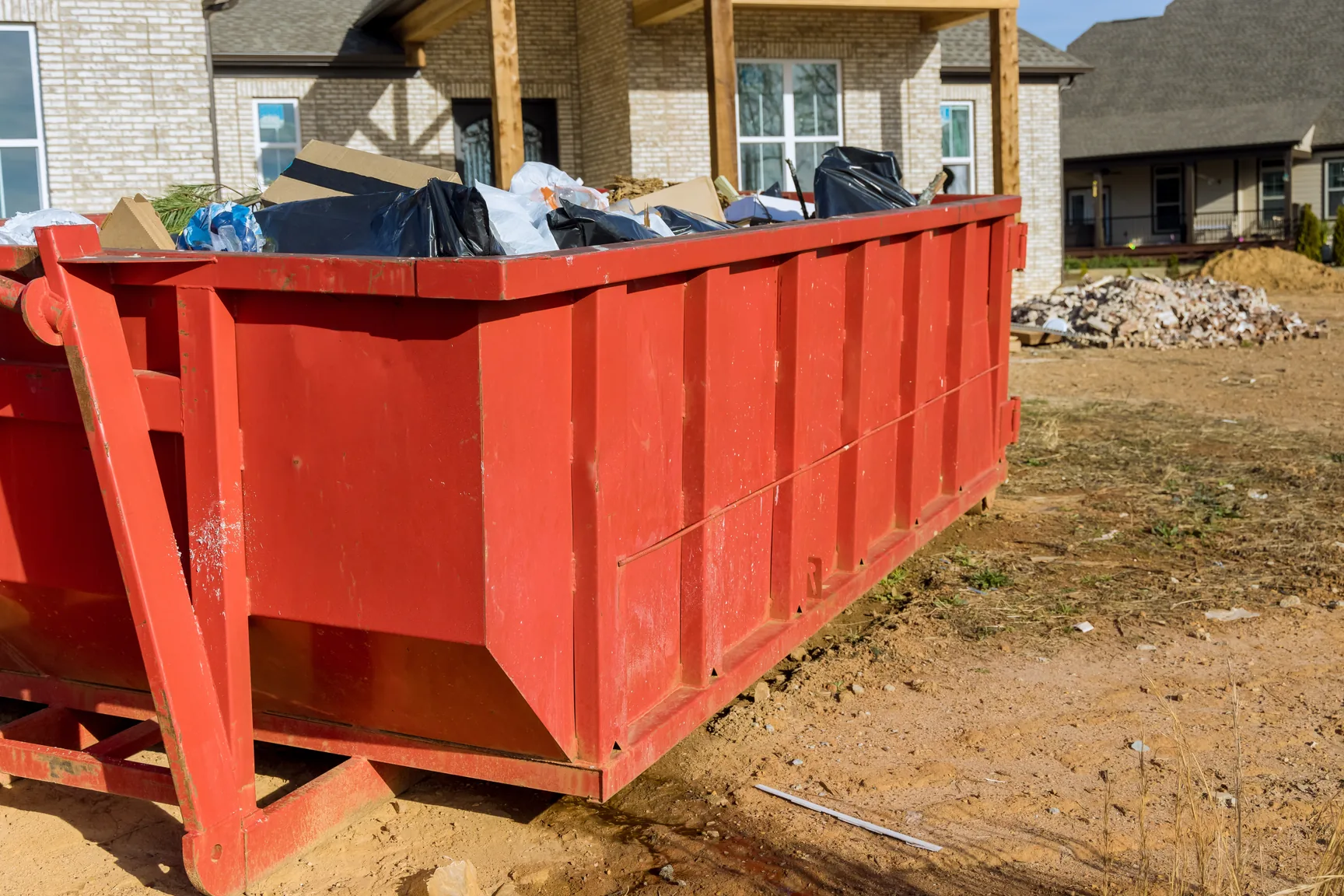
Where the container handoff falls between two policies
The moment the box goes down, or comes up, and something underneath it gives, sits exactly on the boundary between two policies that describe it in different language.
Take the property-damage half first. A split apron, a chewed curb, a lot rutted where the wheels sat. General liability forms typically carry exclusions for property in the insured’s care, custody or control and for that particular part of real property being worked on, and whether any given loss falls inside one of those exclusions turns on your exact form read against the exact facts. That is not something a web page settles.
The injury half is stranger, because two wordings describe one instant and disagree about it. The liability form defines "loading or unloading" for its own purposes, excluding injury and damage arising out of auto use and then folding loading and unloading into what use means. The auto form never uses the phrase — it reaches the same instant another way, and that way turns on whether the equipment moving the property was attached to the truck. Drafted to meet; the meeting point is not always where an operator expects it. Naming that point early is what gets it priced instead of litigated. Your own wording governs, and forms differ between carriers.
California is a useful state to learn this in, because California itself decides everything about this trade by definition rather than by intuition. What your truck is, whether your work is solid waste handling, and who has authority over it are all answered by defined terms sitting in three different codes. So is the question of whether your policy responds. The habit of reading the definition rather than the headline is the same habit in both places.
The California layer: definitions decide almost everything
California assigns the question to cities and counties, and says so in a statute.
A duty at the state level, not a license
California operates no statewide registration, license or permit that reaches a roll-off container operator hauling construction and demolition debris or municipal solid waste on an ordinary in-state route. It does license transporters in other streams — anyone who moves waste or used tires has to carry a current registration as a waste and used tire hauler, subject to a statutory exemption, and hazardous waste may not be moved at all without a registration from the state department — and roll-off hauling of nonhazardous debris or municipal solid waste is not among those classes. Both of those registrations are real and statewide, which is exactly why neither may be asserted onto this trade.
What California puts on a roll-off operator at the state layer is a duty rather than a credential, and it is discharged load by load.
“To enable disposal facility operators to provide that information, solid waste handlers and transfer station operators shall provide information to disposal facility operators on the origin of the solid waste that they deliver to the disposal facility.”
You are a solid waste handler for that purpose, because the code defines solid waste handling as “the collection, transportation, storage, transfer, or processing of solid wastes”, and defines a solid waste enterprise as a private business whose regular trade is the provision of those handling services. The duty is origin reporting at the gate. It is not applied for, and there is nothing to hang on the office wall.
There is one regime that looks like a registration and is not, for this operator, and it is worth stating carefully. California’s reporting regulations do require contract haulers to register and report. The trigger is in the rule, and it is a route rather than a volume of business.
“Contract haulers who haul 100 or more tons of materials described in subsection (a)(1) out-of-state per quarter”
Construction and demolition debris and solid waste are both on the reportable list, so the material is in scope. The route is what decides it, and the same regulation closes the question for an in-state operator explicitly, in its own list of activities that do not require registration.
“A contract hauler who hauls materials to a reporting entity inside the state. A contract hauler shall provide information to the reporting entity pursuant to section 18815.4 of this article.”
A California operator running California loads to California facilities is exempt from registering and owes information instead. A hauler running loads across a state line at that quarterly tonnage is a different question, and this page does not answer it. One caution we will state and not resolve: the agency’s own summary page lists contract haulers among the businesses that report, with no qualifier at all, while the regulation qualifies it twice. We are not going to tell you which of those governs your operation — read the rule against your own routes, and ask if it is close.
There is also an organics layer, and it sits at the local level. The agency says as much in its own summary: what a hauler must do locally turns on the kind of hauler it is; a jurisdiction has to make compliance with the organics article a condition of whatever authorization it grants for collecting organic waste; and a hauler has to obtain, and then keep, documentation showing the jurisdiction approved it for that work. But the footnote governing those lines carves this trade’s ordinary work out: haulers lawfully transporting construction and demolition debris in compliance with the state green building requirements are exempt from those requirements.
Two credentials, two agencies, one word doing double duty
This is the layer that actually gates the business, and the operating prohibition names both credentials in a single sentence.
“Except as provided in subdivision (b) and Section 34622, a motor carrier of property shall not operate a commercial motor vehicle on any public highway in this state, unless it has complied with Section 34507.5 and has registered with the department its carrier identification number authorized or assigned thereunder, and holds a valid motor carrier permit issued to that motor carrier by the department.”
Read that straight through and you will conclude one agency issues both. It does not. The motor carrier permit comes from the Department of Motor Vehicles; the carrier identification number comes from the Department of the California Highway Patrol. The word “department” means different agencies in the two divisions involved, and the provision that splits them sits in neither — it is a definition in the general part of the code. Anyone who reads the operating section without that definition in hand will name the wrong agency for at least one of the two credentials.
Now the threshold. There is a real number and it is ten thousand pounds. It is not this operator’s threshold, because the definition does not stop at the number.
“As used in this division, except as provided in paragraph (2), a ‘commercial motor vehicle’ means any self-propelled vehicle listed in subdivisions (a), (b), (f), (g), and (k) of Section 34500, any motortruck of two or more axles that is more than 10,000 pounds gross vehicle weight rating, and any other motor vehicle used to transport property for compensation.”
Three items. The second carries the weight. The third — “any other motor vehicle used to transport property for compensation” — carries none at all. A roll-off operator hauling a customer’s waste for money is inside the definition at any weight, and the code names that operator in terms as a for-hire motor carrier of property. An adviser who stops reading at the ten-thousand-pound clause will hand you a threshold California does not apply to your class.
The weight-based escapes confirm it from the other direction, because both are conditioned on the vehicle not being in commercial use: two-axle daily rental trucks under a 26,001-pound rating when operated in noncommercial use, and vehicles never operated in commercial use under the same rating. Neither is available to a hauler operating for compensation. And the chapter’s own exemption section is two lines long — certain registration-fee-exempt and specially described vehicles, and a household mover moving used office and institutional furniture under a household mover permit. A roll-off operator is neither.
The credential chain runs federal-first. Before a state carrier identification number can be assigned, the applicant has to go to the Federal Motor Carrier Safety Administration for a United States Department of Transportation number and enter it on the state application; the department may not assign its own number unless that federal number is on the application. That federal number is not a California credential; it is a federal registration California has placed in front of its own.
Then comes the subdivision a dumpster rental business actually feels, because it reaches the people who hire you.
“A person shall not contract with, or otherwise engage the services of, a motor carrier of property, unless that motor carrier holds a valid motor carrier of property permit issued by the department”
A carrier or a broker of construction trucking services may not subcontract until the contracted carrier provides certification of compliance, a copy of the permit accompanies the certificate, and both parties keep it on file until two years after the contract, or the period of service, comes to an end. When a general contractor asks for your permit before releasing a purchase order, they are complying with a statute that reaches them directly. Treat that request as a routine document your office produces, because a lapse in it does not only stop you — it stops the people who want to hire you.
Cities decide — and in California a city can decide exclusively
California sets no statewide roll-off placement or right-of-way permit. The statute begins by overriding other law and then hands the local agency the whole question.
“Whether the services are to be provided by means of nonexclusive franchise, contract, license, permit, or otherwise, either with or without competitive bidding, or if, in the opinion of its governing body, the public health, safety, and well-being so require, by partially exclusive or wholly exclusive franchise, contract, license, permit, or otherwise”
This sentence is not about placement at all. A California city may grant an exclusive franchise for solid waste handling, and solid waste handling is defined to include transportation. Whether a roll-off operator can work in a given California city can therefore turn on that city’s franchise arrangements. We answer that for no city: it is a flag and a citation, never a promise about a market. The Legislature went further than leaving the local layer alone — it wrote a savings clause preserving franchises, contracts, licenses and permits previously granted by a city or county.
Below the franchise question sits the ordinary one: what a city asks before a container may sit in its right of way. One city is worth walking through as an example, and only as an example. The City of San Diego states in its own published bulletin that a traffic control permit is required for a temporary storage container or dumpster that encroaches into the public right of way, including the sidewalk area, and the bulletin cites San Diego Municipal Code §129.0702 as the authority for that requirement (City of San Diego Information Bulletin 718, “How to Obtain a Traffic Control Permit for a Storage Container or Dumpster”, section I).
The bulletin also sets placement conditions in its own terms: no container goes in front of a painted curb, whether that curb marks a no-parking zone, a passenger loading zone or an accessibility parking zone; ten feet of clearance has to stand between the dumpster door and the nearest obstruction; twenty-five feet from the dumpster door to the alley or curb return; fifteen feet between the dumpster door and the fire hydrant; and at least three working days’ notice before placing the container. Every one of those figures is that city’s specification, quotable only with that city named, and none of them is a California rule.
We will go one step further and tell you what we are not asserting. The bulletin cites a code section for its requirement, and that section’s own text names neither a dumpster nor a storage container among its triggers. We are not going to paraphrase that section as an ordinance requiring a dumpster permit, and we are not going to reconcile the bulletin with it. What an operator can safely act on is the bulletin: the city publishes it, and it says what it says. What an operator should do everywhere else in California is ask the jurisdiction, because these rules are written one city at a time and they do not resemble each other.
Workers compensation: compulsory, competitive, and a fund inside the market
California compels it, and the only carve-out in the operative sentence is the state itself.
“Every employer except the state shall secure the payment of compensation in one or more of the following ways: (a) By being insured against liability to pay compensation by one or more insurers duly authorized to write compensation insurance in this state. (b) By securing from the Director of Industrial Relations a certificate of consent to self-insure either as an individual employer, or as one employer in a group of employers, which may be given upon furnishing proof satisfactory to the Director of Industrial Relations of ability to self-insure and to pay any compensation that may become due to his or her employees.”
Two routes for a private employer, and the first of them is an open market of admitted insurers. The Division of Workers’ Compensation within the Department of Industrial Relations administers the system, and the Director of Industrial Relations is the officer named for the self-insurance route.
California also has a state-created competitive fund, continued in existence by INS 11770(a) for the purpose of transacting workers compensation insurance. The word that matters there is transacting. A fund that transacts insurance sits inside the market as a competitor; a state that runs a monopoly does not have a competitor, it has a statutory channel. California is not such a state, and no monopolistic sentence belongs on this page. For a roll-off operation with a difficult loss history, the practical consequence is that there is one more lawful route open to you than you might assume — and it is a route your agent can discuss alongside the admitted market rather than instead of it.
We state the duty and the two routes and we state no floor at all. This state record does not carry the definitional sections on who is an employee and who is an employer, so no employee-count threshold and no exempt class appears here. An operation with drivers and helpers should assume it is inside the duty and confirm, rather than working from a number somebody half-remembers.
A panel for California in rows. Each row sets one thing the state requires beside the exposure that requirement leaves open and the coverage line that answers it. Hauler registration: State transporter credentials exist, but none reaches roll-off hauling. It leaves open a container placed on a customer’s property, and the driveway or curb it damages, which General Liability and Dumpster and Equipment Coverage answer. Intrastate motor-carrier authority: A state operating credential reaches for-hire hauling. It leaves open the roll-off truck at fault, and the container in transit, which Commercial Auto and Pollution Liability answer. Roll-off placement permits: Municipal — varies by city and town. It leaves open placement on the public right-of-way, and a struck pedestrian or vehicle, which General Liability answers. Workers compensation: Compulsory; private insurers, or a competing state fund. It leaves open a driver or yard hand hurt on the job, which Workers Compensation answers. Notes: A registration, permit or bond is a condition of operating, not insurance: it answers none of the exposures on the right, so no line is drawn from it. The conclusion reads: The registration is not the coverage — the program is. No figures are shown.
Where each policy earns its keep in California
Every line below exists for this trade generally. What follows each is the California reason it lands differently here.
The California losses we see repeat
These are patterns, not statistics, and we publish no loss figures we cannot source.
Surface damage leads. A container set on a decorative driveway, a paver apron or an older slab, left through a job, and lifting reveals what the weight did. Which side of the care, custody and control exclusion that falls on depends on the form and the facts, which is why the seam belongs in the quoting conversation rather than the claim call.
Right-of-way incidents come second and California cities are strict about them. A container encroaching into a sidewalk area, a clearance not held, a hydrant or a curb return too close, a notice period not given. Where a city publishes its conditions, those conditions are the yardstick a claim will be measured by — and a container placed against them is hard to defend even when nothing about the placement caused the loss.
Third is the credential failure that stops work without ever becoming a claim. A permit lapses, a certification is not produced when a contractor asks for it, or a subcontracting chain cannot document what the statute says it must document for two years. In California that failure reaches your customers as well as you, which is why it shows up as lost work rather than as a loss run.
Fourth is the disputed load. Something prohibited goes into a can on a job site and surfaces at the scale. Because California puts the origin duty on the handler at the gate, your own reporting is the first document anyone looks at.
California metros and their counties
Each is shown with the county it sits in. We are licensed across California and this list is not a service-area boundary.
- Los Angeles — Los Angeles County.
- San Diego — San Diego County. its own city bulletin is cited on this page as an example
- San Jose — Santa Clara County. the southern San Francisco Bay Area
- Fresno — Fresno County. the central San Joaquin Valley
- Sacramento — Sacramento County. the state capital
Nearby states we also write
California has exactly three land neighbors; the rest of its border is Mexico and the Pacific. Each state’s own law governs its own credentials, and nothing on this page crosses a line — least of all the workers compensation classification, which every state settles for itself.
California roll-off insurance FAQ
Do I need a California state license to haul construction debris or household waste?
Not as a statewide credential on an ordinary in-state route. California does license transporters in other waste streams — anyone transporting waste or used tires must hold a waste and used tire hauler registration, and transporting hazardous waste requires a registration from the state department — but roll-off hauling of nonhazardous construction and demolition debris or municipal solid waste is not among those classes. What California gives this trade instead is a duty at the gate and a real authorization at the city level.
I heard California makes contract haulers register with the waste agency. Is that me?
California does operate a state reporting registration that reaches contract haulers, and the registration trigger in the regulation is a quarterly tonnage hauled OUT of the state. The same regulation puts an in-state contract hauler — one whose loads go to a reporting entity within California — on its list of activities that do not require registration, and substitutes an information duty instead. A hauler running loads across a state line at that quarterly tonnage is a different question, and one this page does not answer. Check your own routes against the rule rather than against a summary of it.
My trucks are under 10,000 pounds. Does that keep me out of the permit?
No. The definition of a commercial motor vehicle is a three-item list. One item does turn on a 10,000-pound rating for a motortruck of two or more axles. But the third item is "any other motor vehicle used to transport property for compensation" and it has no weight in it at all. A roll-off operator hauling a customer’s waste for money is inside the definition at any weight, and the statute names that operator directly as a for-hire motor carrier of property.
Which agency issues what? I keep getting sent in circles.
Two credentials from two agencies, and the statute uses the same word for both. The motor carrier permit comes from the Department of Motor Vehicles. The carrier identification number the permit is conditioned on comes from the Department of the California Highway Patrol. The word "department" means different agencies in the two divisions involved, and the definition that splits them lives in a third place entirely. Anyone reading the operating section straight through will attribute both to one agency and name the wrong one for at least one of them.
Is a USDOT number a California requirement?
The number is federal, issued by the Federal Motor Carrier Safety Administration, and California does not create it. What California does is make it a precondition: a motor carrier required to obtain a state carrier identification number must first obtain the federal number and put it on the application, and the state may not assign its number unless the application includes it. So it is a federal registration that California has placed in front of its own.
My general contractor is asking for a copy of my permit. Why?
Because California puts the duty on them as well as on you. The statute bars anyone from engaging a motor carrier of property — by contract or by any other arrangement — where that carrier does not hold a valid permit from the department. A carrier or a broker of construction trucking services may not subcontract until the contracted carrier provides certification of compliance, with a copy of the permit accompanying it. Both parties keep the paperwork for the duration of the contract plus two years. The contractor is not being difficult; the statute reaches them too.
Can a California city simply stop me working there?
It can structure the market in a way that has that effect, and the statute says so expressly. The determination belongs to the local governmental agency — a county, a city, a district or another such body — and what it decides is how solid waste handling services get provided: by nonexclusive franchise, contract, license or permit, or, where its governing body considers that the public health, safety and well-being require it, by a franchise that is partly or wholly exclusive. Because solid waste handling is defined to include transportation, whether you can work in a given city at all can turn on that city’s franchise. We do not answer that for any city; ask before you quote a job in a jurisdiction you have not worked.
Do I need a permit to leave a container at the curb in California?
There is no statewide answer, because there is no statewide placement or right-of-way permit. It is set city by city. The City of San Diego, for example, states in its own published bulletin that a traffic control permit is required for a temporary storage container or dumpster that encroaches into the public right of way, including the sidewalk area, and its bulletin sets out clearance and notice conditions. Those are one city’s specifications and not California’s rule. Check each jurisdiction you place in.
This page reports California law as our own state research file records it. It is general information rather than legal advice, and it is not an opinion on what any policy covers — the wording you hold controls that, and carriers do not all write it the same way.
Related coverage for dumpster rental operators
- General Liabilitygeneral liability
- Commercial Autocommercial auto
- Dumpster and Equipment Coverageinland marine
- Commercial Propertycommercial property
- Workers Compensationworkers compensation
- Pollution Liabilityenvironmental / pollution liability
What it costs in California · States we serve · Dumpster Rental Insurance · Get a quote · Contact us
Primary sources
- VEH 34601 — what counts as a commercial motor vehicle — the three-item definition, and the item with no weight in it
- PRC 40059 — what a local agency may determine — the franchise power, including the exclusive form
- LAB 3700 — securing the payment of compensation — the two routes open to a private employer
- California Department of Insurance — the state insurance regulator
Talk to us about your California fleet
Tell us how many trucks and cans you run, which cities you place in, and whether any of your work crosses a state line. In California those three answers change the program more than the size of the fleet does.