
Dumpster Rental Insurance by State
Dumpster Rental Insurance in Oregon
One credential comes from the state and one comes from the town — and in some Oregon towns the work has already been allocated to somebody else. Here is how the layers stack.
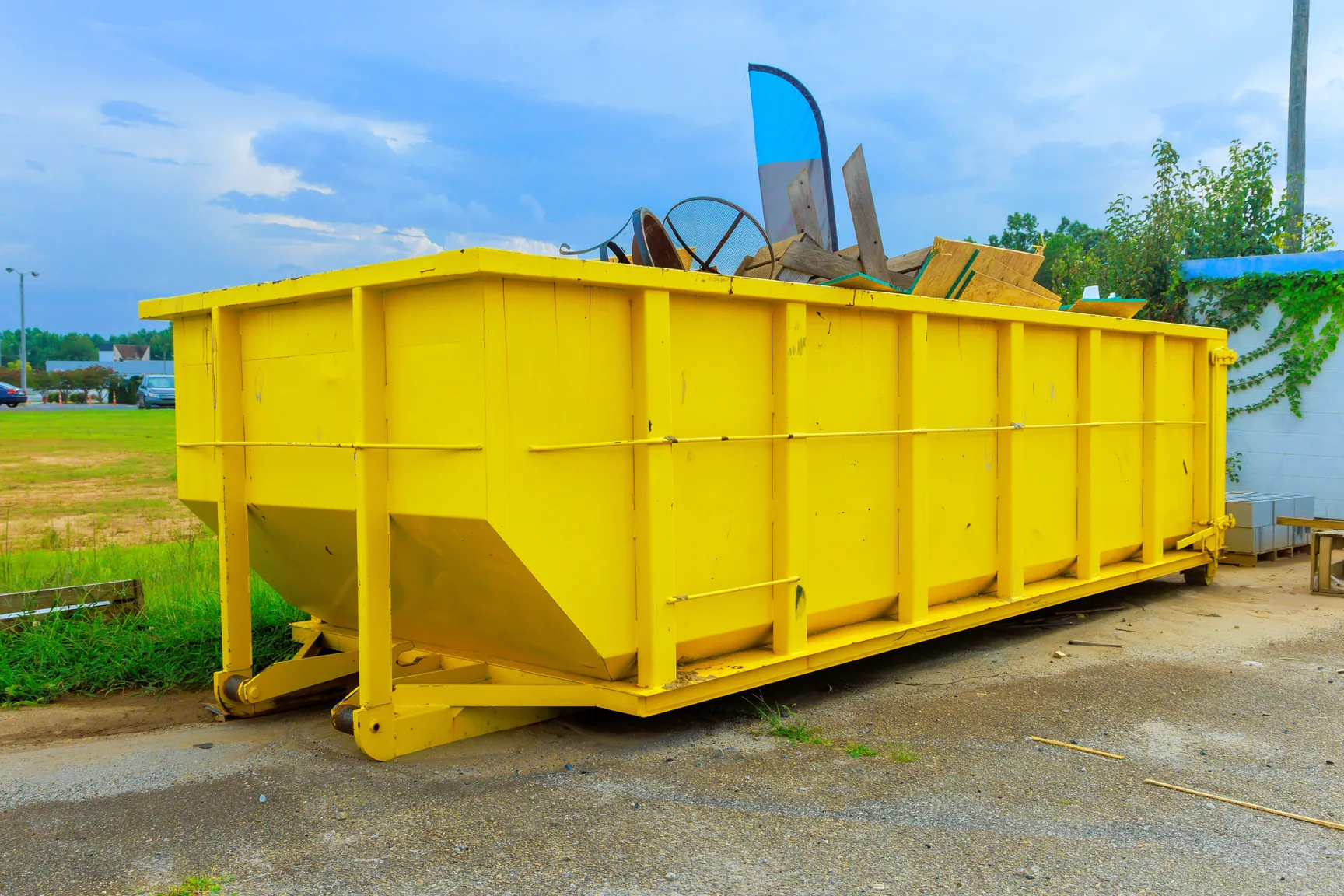
The seam a container crosses on every Oregon drop
Every delivery a roll-off business makes crosses a line between two policies. The general liability form treats loading or unloading as a defined term of its own. It generally excludes what arises out of the use of an auto, and then tells you that such use takes in loading and unloading. The standard auto form does not use that phrase. It gets to the same moment along a different path, and the part of that path that matters here turns on whether the machinery doing the lifting is attached to the truck or standing apart from it.
Then there is the ground. Placement damage — a split driveway, a rutted verge, a gouged parking bay, a curb chipped by a rail — is damage to property belonging to the person who hired you. A general liability form will typically carry two exclusions that bear on it — one for property held in the insured’s care, custody or control, and one for whichever part of the realty is under work. Whether a given placement loss lands inside or outside them is a question of exact wording against exact facts, and it is not one a web page can close.
What this page can do is show an Oregon operator where the join sits, because Oregon adds a wrinkle. A franchised jurisdiction may have allocated the collection work already, which means an operator can find itself subcontracting, sharing a site with a franchisee, or running a mixed book across towns with different rules. Each of those arrangements changes who is answering for a container at the moment it touches the ground. Ask the seam question at quoting time, while the schedule can still be shaped around the answer. Your own policy wording controls, and forms differ between carriers.
Oregon regulations and licensing: three answers, three layers
Oregon is one of the more layered states in this build, and the layers do different jobs. The state puts a permit on the truck. The state does not put a license on the hauling business. And it hands the collection credential to cities and counties, with power to make it exclusive. Taking those in turn:
The credential Oregon defines but does not require
There is no statewide Oregon license for a solid waste hauler. The architecture reaches this operator through definitions and through the sites it tips at, never through a document on the truck. ORS 459.005(3) defines collection service — and carves out the part of a business run under a vehicle dismantler certificate issued under ORS 822.110, an exclusion that is not evidence of a credential for this trade. Then comes the definition that decides the axis.
“a franchise, certificate, contract or license issued by a local government unit authorizing a person to provide solid waste management services”
Read that slowly. Oregon wrote the vocabulary for a municipal instrument into its own statute and then declined to impose one. The definition exists because state law needs the word in order to regulate rates, annexation, recycling opportunity and antitrust immunity around something the state itself does not mandate. Meanwhile ORS 459.205(1) puts the permit on the disposal site rather than on the hauler, and ORS 459.095(1) bars a local ordinance that conflicts with the environmental commission’s rules — which is a limit on local power rather than a state duty on you.
Oregon runs three programs that reach transporters, and a roll-off operator hauling construction, demolition or municipal solid waste falls inside none of them: the waste tire carrier permit created by ORS 459.712(1), the hazardous waste transporter authorization a receiving facility must check under ORS 466.055(7), and the certification and record-keeping duty ORS 459.405 places on a person carrying infectious waste for consideration. The tire permit is worth one more line, because its own exception proves the shape of the whole system: ORS 459.712(3)(a) exempts a solid waste collector working under a local license or franchise, and the definition at ORS 459.705(8) carves out the same person. Writing its one statewide carrier permit, the legislature described the ordinary waste hauler as somebody holding a local instrument.
One heading to ignore. ORS 459.992 is headed for criminal penalties and license suspension, which reads at a glance as though a solid waste license must exist somewhere. Its subsection (5) shows that the licenses it can suspend are liquor and agriculture licenses held by bottle-bill offenders. It is not evidence of a hauler credential and this page does not treat it as any.
The Oregon permit a for-hire carrier must hold
The transport side is positive, and it has no weight floor. The Commerce and Compliance Division of the state transport department issues the instrument; ORS 825.005(5) defines the department as the Department of Transportation.
“No person shall operate any motor vehicle, whether loaded or empty, on any highway in this state as a carrier in the transportation of persons or property without possessing, in addition to any license required by any other law, a valid certificate or permit from the Department of Transportation authorizing the proposed operation.”
Nothing in that sentence turns on how heavy the truck is. Two weight figures do appear in the chapter and both belong to a different class of operator. ORS 825.017(3) lifts the chapter off property carried by a private carrier in a vehicle or combination whose combined weight stays under 8,000 pounds, and the second is squarely limited in the same way.
“A person acting as a private carrier need not obtain a permit from the department for operating any vehicle or combination of vehicles with a combined weight of 26,000 pounds or less.”
A business that moves a customer’s waste for money is a for-hire carrier under ORS 825.005(7), and the private carrier at ORS 825.005(11) is somebody whose transport is incidental to a primary enterprise that is not transport. For a dumpster rental business, transport is the enterprise. Neither exemption is therefore available at any weight. The same figure of 26,000 pounds turns up a third time at ORS 825.022(1), where it decides which sections apply — the liability insurance section and the weight-mile tax sections do not reach a combination at or below it — and ORS 825.100 is not in that list. So the number governs which duties attach, never whether the permit is needed. One more figure to keep in its own lane: the 10,000 pound line on the agency’s requirements page belongs to the federal layer, where a USDOT number and unified carrier registration enter. It is not Oregon’s intrastate threshold.
On issue, ORS 825.102(1) requires the department to grant the permit to an applicant it is satisfied can comply with the chapter and the rules, and ORS 825.102(2) requires refusal where the financial responsibility and safety requirements are not met. The permit cannot be transferred (ORS 825.102(4)), and it can be suspended or revoked for losing safety compliance, losing financial responsibility, or failing to report or pay (ORS 825.102(5)). ORS 825.160(1) forbids operating as a motor carrier without public liability and property damage insurance in force, at minimum limits the department sets by rule, and ORS 825.162(1) adds cargo insurance before a permit issues, subject to the waiver at ORS 825.162(2). The statute delegates the amounts to rule and states no figure, so neither does this page.
Portland’s commercial collection permit, and what a franchise can do
Oregon sets no statewide rule for placing a container, obstructing a street or collecting from a site. Those live city by city and county by county, and the state layer is a grant of power rather than a floor.
“It is the intent of the Legislative Assembly that a city or county may displace competition with a system of regulated collection service by issuing franchises which may be exclusive if service areas are allocated.”
That is the risk ORS 459A.085(3) creates. The local question may be whether the work is already spoken for, and not only which permit to obtain. ORS 459A.085(7) lets the franchising body prescribe the quality, character and rates of collection service, so in a franchised town the price may be set by ordinance rather than by the market, and ORS 459.085(2)(a) lets a county license disposal sites as an alternative to franchising at all. There is also a regional tier: ORS 459.005(15) and (18) put a metropolitan service district inside the definition of a local government unit, and Portland’s own code requires franchisees and permittees to comply with that district’s ordinances alongside city and state law. No such ordinance was retrieved for this page and none is described. And in Marion County, ORS 459.125(1)(c) lets the county board require anyone collecting or transporting solid waste to use county or county-designated facilities, with ORS 459.125(1)(d) allowing its licenses or franchises to be exclusive. Salem sits in Marion County and is a market on this page. That is a Marion County rule and it is not an Oregon rule.
One city is read here as an example. Portland runs two instruments, and the one that matters to a commercial roll-off business is the permit.
“No person may provide commercial collection of solid waste, compostables and recyclable material within the City without having a currently valid commercial collection permit from the Bureau of Planning and Sustainability, except as provided in Section 17.102.220.”
The same subsection makes the permit annual, running from 1 July to 30 June, and states that neither spending money nor the passage of time gives a permittee any vested or property right in it. Residential work is franchised instead, under Sec. 17.102.140, and the two must not be collapsed into one. The exceptions at Sec. 17.102.220 are where this trade actually lives. A builder moving debris from its own demolition, construction or remodeling job is outside the permit; a firm subcontracted purely to collect and carry that construction waste is brought back inside it and made liable for the associated hauling fees. The city also exempts waste collected outside its boundary, landscapers and similar trades moving waste from their own work, persons carrying only tires under the state program, and persons collecting recyclables or compostables from non-residential customers — although not commercial food scraps. One practical rule that catches new arrivals: Sec. 17.102.080 keeps refuse off the streets of the bounded downtown district except between 10 p.m. and 10 a.m., or with specific authorization. That is a restriction on the truck rather than on the box.
How an Oregon employer secures workers compensation
Oregon is compulsory, and it is a competitive market with a state-chartered corporation sitting in it rather than a monopoly. The duty is expressed as assurance given to a named director, and the statute lays out the two ways of qualifying in a single sentence.
“Every employer subject to this chapter shall maintain assurance with the Director of the Department of Consumer and Business Services that subject workers of the employer and their beneficiaries will receive compensation for compensable injuries as provided by this chapter and that the employer will perform all duties and pay other obligations required under this chapter, by qualifying: (a) As a carrier-insured employer; or (b) As a self-insured employer as provided by ORS 656.407.”
The first of those routes runs through the ordinary market. ORS 656.005(14) defines the insurer for these purposes to take in the statutory corporation, any insurer authorized under ORS chapter 731 to transact the line here, and a claims agent whom the director assigns under ORS 656.054. A privately owned authorized insurer sits squarely inside that definition, which is the regulatory signature of a competitive state. We name no insurer on this page and describe the corporation by its statutory role only.
Two honest limits. ORS 656.017(2) directs that the state as an employer insures its own workforce through the statutory corporation; that is a rule about the state and it says nothing about a private operator’s placement. And no exempt class was retrieved for this page. The chapter’s reach turns on the phrase about being subject to it, and the sections that define that reach were not read in this run, so this page asserts no exemption and no headcount floor rather than inventing one.
A panel for Oregon in rows. Each row sets one thing the state requires beside the exposure that requirement leaves open and the coverage line that answers it. Hauler registration: State transporter credentials exist, but none reaches roll-off hauling. It leaves open a container placed on a customer’s property, and the driveway or curb it damages, which General Liability and Dumpster and Equipment Coverage answer. Intrastate motor-carrier authority: A state operating credential reaches for-hire hauling. It leaves open the roll-off truck at fault, and the container in transit, which Commercial Auto and Pollution Liability answer. Roll-off placement permits: Municipal — varies by city and town. It leaves open placement on the public right-of-way, and a struck pedestrian or vehicle, which General Liability answers. Workers compensation: Compulsory; private insurers, or a competing state fund. It leaves open a driver or yard hand hurt on the job, which Workers Compensation answers. Notes: A registration, permit or bond is a condition of operating, not insurance: it answers none of the exposures on the right, so no line is drawn from it. The conclusion reads: The registration is not the coverage — the program is. No figures are shown.
What each coverage does on an Oregon route
Oregon asks for evidence of insurance in two places — the state permit and, in a permitted or franchised jurisdiction, the local instrument — so the schedule gets read by somebody other than you. Taking them one at a time:
For the wider picture before the state detail, start with our dumpster rental insurance overview.
Common Oregon claims in this trade
No numbers here; the record sources no severity or frequency figures for this state and we do not manufacture them. These are the recurring shapes.
Counties and cities in our Oregon markets
We write dumpster rental and roll-off operators across Oregon. The markets below are listed, each with the county it sits in. No population or volume figure is attached to any of them, because the record sources none and §14 forbids inventing one.
Two of those carry a warning already given above and repeated because it is easy to lose. Portland appears twice on this page, once as a market and once as the named municipal example, and those are separate uses. Salem appears as a market only; the statutory series that reaches its county is not Oregon’s general law, and nothing written as an Oregon rule should be illustrated with Salem.
Nearby states we also write
Nothing established on this page travels across a state line. Each neighbor runs its own statute, its own agencies and its own answer on all three questions, and each page below is written from that state’s own record.
Questions Oregon operators ask — FAQ
Does Oregon issue a statewide license to a roll-off hauler?
It does not, and the way it declines to is unusual. ORS 459.005(10) defines the credential for collection service and defines it as something a local government unit hands out, while ORS 459.005(15) sets out what counts as such a unit — a city, a county, a metropolitan service district, a sanitary district or authority, a county service district, a regional air quality authority. Three defined terms describe this business and its license, and no section of ORS chapter 459 or 459A orders the operator to hold one.
Which transporters does Oregon actually credential, if not mine?
Three classes, none of them this one. ORS 459.712(1) creates the waste tire carrier permit, issued by the environmental agency. ORS 466.055(7) obliges a receiving facility to check that a hazardous waste or PCB transporter is authorized. ORS 459.405 puts a written certification and record duty on anyone carrying infectious waste for consideration, which is a duty rather than a credential. Hauling construction, demolition or municipal solid waste in a roll-off box is outside all three.
Can an Oregon city stop me operating there altogether?
In a franchised jurisdiction, effectively yes. ORS 459A.085(3) lets a city or county displace competition by franchising, and lets the franchise be exclusive where service areas have been allocated. So the first question in a new Oregon town is whether the work has already been given to somebody else, and not only which permit to apply for. ORS 459.085(2)(a) also lets a county license disposal sites as an alternative to franchising service, so two counties may reach the same trade by different instruments.
Do I need a transport permit from the Oregon transport department for a 20,000 pound truck?
Yes. ORS 825.100 states the prohibition without any weight figure in it. The two weight numbers in that chapter both belong to private carriers: 8,000 pounds at ORS 825.017(3) and 26,000 pounds at ORS 825.108(2). A business hauling a customer’s waste for compensation is a for-hire carrier under ORS 825.005(7), and private carriage under ORS 825.005(11) reaches only transport that is incidental to some other primary enterprise. Hauling is the enterprise, so neither exemption is available at any weight.
Is the Oregon instrument I apply for called a certificate or a permit?
A permit, and the distinction is not cosmetic. ORS 825.005(3) defines a certificate as the authority issued under ORS 825.110, which is the household goods section, and ORS 825.005(10) lists the sections a permit comes from. ORS 825.102(6) closes the loop by forbidding a permit for household goods transport and routing that trade to the certificate instead. An operator who asks for a certificate has asked to be regulated as a moving company.
What has to be in place before Oregon will issue that permit?
Ability to comply with the chapter and the department’s rules, under ORS 825.102(1), with denial required under ORS 825.102(2) where the financial responsibility and safety requirements are not met. ORS 825.160(1) bars operating as a motor carrier until public liability and property damage insurance is in effect, at minimum limits set by rule under ORS 825.160(2). ORS 825.162(1) adds cargo insurance before issue, which ORS 825.162(2) allows the department to waive for commodities not subject to material damage in ordinary transport. The statute sets no dollar figure, so this page states none.
What does Portland require on top of the state permit?
A commercial collection permit from its planning and sustainability bureau, annual and running from 1 July to 30 June, under Portland City Code Sec. 17.102.210 A — which also states that nothing gives a permittee vested or property rights in it. Residential collection is a separate instrument entirely: Sec. 17.102.140 makes that a city franchise. The two are not interchangeable and an operator should not collapse them.
The Portland code exempts builders moving their own debris. Does that cover me?
Not if you are the hauler. Sec. 17.102.220 B exempts a contractor employed to demolish, construct or remodel while moving waste created by that work — and then, in the same paragraph, brings back in any subcontracted service engaged purely to collect and carry construction waste, which the code says must be a current commercial permittee and pay the associated fees. A builder shifting its own job’s debris is outside; a hauling firm hired to shift it is inside.
This page reports Oregon law as our own state research file records it. It is general information rather than legal advice, and it is not an opinion on what any policy covers — the wording you hold controls that, and carriers do not all write it the same way.
Start an Oregon dumpster rental insurance quote
Tell us the jurisdictions you serve, whether any of them is franchised, what the fleet is and who rides on it. We will line the six coverages up against the permit conditions that actually apply to you. Your own policy wording controls.
Related coverage for dumpster rental operators
- General Liabilitygeneral liability
- Commercial Autocommercial auto
- Dumpster and Equipment Coverageinland marine
- Commercial Propertycommercial property
- Workers Compensationworkers compensation
- Pollution Liabilityenvironmental / pollution liability
What it costs in Oregon · States we serve · Dumpster Rental Insurance · Get a quote · Contact us
Primary sources
- Oregon DEQ — Solid Waste Permits — the environmental agency’s own list of what it permits: disposal sites, waste tire carriers and waste tire storage sites
- ORS chapter 825 — Motor Carriers — the prohibition at 825.100, the for-hire permit at 825.102, and the private-carrier exemptions at 825.017 and 825.108
- ODOT Commerce and Compliance Division — motor carrier requirements — the division that issues the permit; the 10,000 pound figure on this page belongs to the federal layer, not to Oregon
- Portland City Code, Chapter 17.102 — the commercial collection permit, its exceptions, the residential franchise and the downtown transport hours
- ORS chapter 656 — Workers’ Compensation — the assurance duty at 656.017(1) and the definition at 656.005(14) that makes this a competitive market
- Oregon Division of Financial Regulation — the insurance regulator; Oregon has no Department of Insurance, and this division sits inside a wider department