
Dumpster Rental Insurance by State
Dumpster Rental Insurance in Florida
Florida credentials places, not trucks — so the permit that matters comes from your county, and the number of axles under your truck can decide what your policy has to carry.
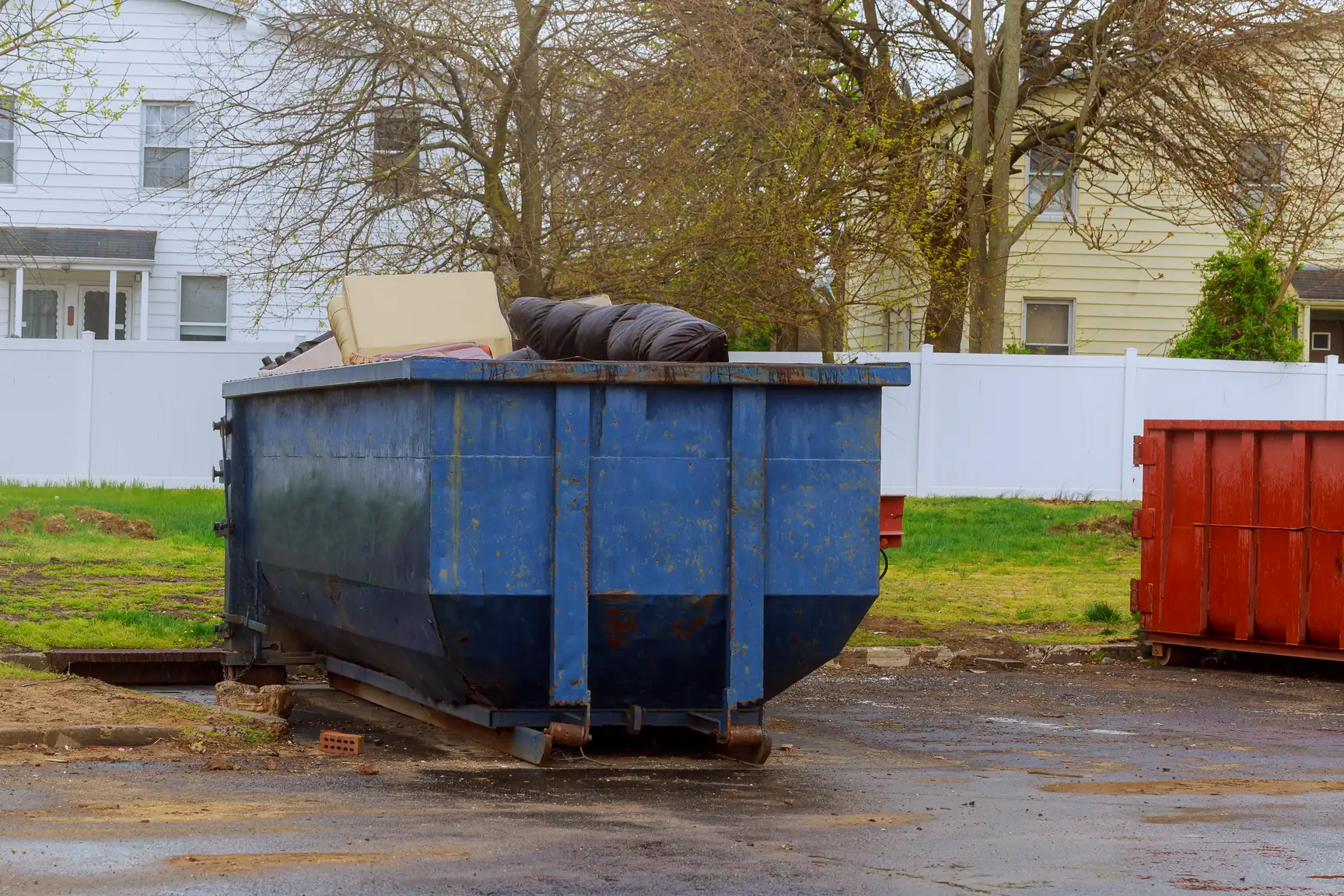
The few seconds that decide which policy pays
The short window either side of a container coming off a truck is where a loss can fall between two policies. The reason is not carelessness. It is that two policies you already own describe that window differently.
Start from the auto side. The standard auto wording never says "loading or unloading" at all; it arrives at that instant by another route, and the route turns on whether the equipment shifting the property was attached to the truck. Your liability wording, meanwhile, treats the phrase as a term it defines itself — excluding injury and damage arising out of auto use, then folding loading and unloading into what use means. Two documents drafted to meet at one point, and the meeting point is not always where an operator expects it.
The second half of the problem is the surface underneath. A split apron, a chewed curb, a rutted plaza lot — placement damage is the routine loss here, and it is a property claim rather than an injury one. Whether a given loss lands inside a liability carve-out for property in your care, custody or control, or for the particular part of realty being worked on, depends on which words are in your form and on what actually happened. We are not going to pretend a web page can settle that. Naming the seam while there is still time to do something about it is the useful part. Your own wording governs, and forms differ from market to market.
Florida adds a wrinkle, and it is a legal one rather than a matter of local surfaces: Florida keys an additional liability insurance requirement to the shape of your truck rather than to what it weighs. If your trucks run three axles, that sentence probably reaches you. It is set out in full below.
Florida’s regulatory layer for a roll-off business
Florida is a state where the intuitive answer and the correct answer diverge.
Florida permits places, not trucks
Florida operates no statewide solid waste hauler, collector or transporter registration, license or permit that reaches a roll-off container operator hauling construction and demolition debris or municipal solid waste. What the state credentials is the facility.
“A solid waste management facility may not be operated, maintained, constructed, expanded, modified, or closed without an appropriate and currently valid permit issued by the department.”
The defined term is a disposal area, a volume reduction plant, a transfer station or a materials recovery facility — a place, never a truck. That is the whole shape of Florida’s solid waste program as it touches this trade.
It would be wrong, though, to tell a Florida operator that nothing applies, because Florida does run transporter credentials — the environmental department registers waste tire collectors, used oil transporters and hazardous waste transporters, and biomedical waste transporters are licensed by the Department of Health — and roll-off hauling of construction and demolition debris or municipal solid waste is not among those classes. Those four classes are the contrast that makes the negative a measured finding. The statute was swept for it: across the whole of the relevant chapter, the phrase “registered with the department” occurs exactly once and belongs to the waste tire collector, and “register annually with the department” occurs exactly once and belongs to used oil. The state’s waste-transporter denominator in that chapter is two, and neither is this class.
There is one trap here sharp enough to deserve its own paragraph, because read at its opening sentence it appears to catch every hauler in the state.
“Any person who handles, purchases, receives, recovers, sells, or is an end user of recovered materials or post-use polymers shall annually certify to the department on forms provided by the department.”
It does not catch this operator, and both reasons sit outside that sentence. The first is the defined term: recovered materials are limited to metal, paper, glass, plastic, textile and rubber that carry a known recycling potential, can feasibly be recycled, and have already been source separated, diverted or pulled out of the solid waste stream to be sold, used or reused as raw material — and the statute closes by saying that recovered materials as described are not solid waste. A container of mixed debris run to a landfill is not recovered materials, so the certification does not attach. The second is that the same subsection lets the department exempt by rule persons who handle or sell recovered materials as an activity incidental to their normal primary business.
The converse is live and should not be lost. An operator who source-separates clean metal, cardboard, glass, plastic, textile or rubber and sells it on for reuse may be handling recovered materials, and the certification may then reach that activity. We state where the boundary sits; we do not tell any particular operator which side of it their business falls on.
No state operating authority — a federal number and a frozen rulebook
Florida issues no intrastate operating authority for a property carrier, and it has no general economic-regulation chapter for motor carriers at all. That absence matters practically, because the nearby chapter number an adviser is likely to reach for is titled “WRECKER OPERATORS” and is about tow trucks from end to end. The Florida material this trade actually touches lives in the traffic-control chapter for safety, the motor vehicle licenses chapter for the commercial-motor-vehicle definition, the commercial-vehicle tax chapter for the qualified-motor-vehicle definition, and the insurance chapter for an additional liability requirement.
What Florida does instead is adopt the federal rules wholesale into intrastate commerce, with a date attached.
“Except as otherwise provided in this section, all owners and drivers of commercial motor vehicles that are engaged in intrastate commerce are subject to the rules and regulations contained in 49 C.F.R. parts 382-386 and 390-397, as such rules and regulations existed on December 31, 2023.”
That closing date is part of the rule. Florida adopts a frozen snapshot of the federal text for intrastate operations while interstate operators are subject to the same parts as they currently stand — so interstate and intrastate in Florida are not always the same rule on the same day. The practical credential that follows is a USDOT number, and that number is a federal registration obtained from the Federal Motor Carrier Safety Administration. Florida issues no number of its own. The state agency administering all of this is the Department of Highway Safety and Motor Vehicles, which performs the duties assigned to the federal Field Administrator under the federal rules and receives the communications those rules would otherwise direct to Washington.
The exemption every operator asks about reads as follows, and it has three catches.
“A person who operates a commercial motor vehicle having a gross vehicle weight, gross vehicle weight rating, and gross combined weight rating of less than 26,001 pounds solely in intrastate commerce and who is not transporting hazardous materials in amounts that require placarding pursuant to 49 C.F.R. part 172 is exempt from subsection (1). However, such person must comply with 49 C.F.R. parts 382, 392, and 393 and 49 C.F.R. ss. 396.3(a)(1) and 396.9.”
First, the conjunction is “and”, not “or” — gross vehicle weight and gross vehicle weight rating and gross combined weight rating must all be under the figure. Second, it is an exemption from one subsection, and the same sentence keeps four federal obligations alive: controlled substances and alcohol testing, driving of commercial motor vehicles, parts and accessories necessary for safe operation, and two specific inspection provisions. Exempt does not mean unregulated. Third — and this is a Florida fact that does not travel from any neighboring state — this exemption contains no for-hire carve-out at all.
Now a requirement that can turn on the shape of the truck as well as what it weighs. Florida requires additional liability insurance for commercial motor vehicles and qualified motor vehicles operated on its roads.
“Commercial motor vehicles as defined in s. 320.01 and qualified motor vehicles as defined in s. 207.002 operated upon the roads and highways of this state must be insured with the following minimum levels of combined bodily liability insurance and property damage liability insurance in addition to any other insurance requirements”
The trigger is not only weight. The commercial-motor-vehicle definition reaches a vehicle that “has a gross vehicle weight of 26,001 pounds or more, or has three or more axles regardless of weight, or is used in combination when the weight of such combination exceeds 26,001 pounds gross vehicle weight”, and the qualified-motor-vehicle definition carries the same three-or-more-axles limb. Three axles regardless of weight is the phrase that matters to this trade. A three-axle roll-off truck is inside both definitions on the axle count alone. We publish the mechanic and not the figures: the specific dollar minimums belong in a conversation about your own fleet, not on a page where they will be read as applying to a truck they do not.
The county is where the permit actually lives
Florida sets no statewide roll-off placement or right-of-way permit and no statewide hauler permit. What it sets is a statutory frame inside which counties and municipalities do the credentialing themselves — a frame that expressly preserves a local government’s power to bar an uncertified operator from doing business in its jurisdiction and to franchise collection, and a separate section that regulates competition between a local government and private companies in solid waste collection. That second section only makes sense in a state where the collection layer is local, which it is. One caution: that frame is a fence with gates in it rather than a mandate, and its subject is recovered materials rather than solid waste generally. It does not mean Florida requires local franchising.
Local solid-waste permitting in Florida is common, and it differs sharply from one jurisdiction to the next. One county is worth walking through as an example — and only as an example, never as Florida’s rule and never generalized to another Florida county or city.
“It shall be unlawful for any person to remove, collect or transport any solid waste or recyclable material over the streets or public right-of-way within any unincorporated, incorporated, or any unincorporated area annexed by an existing municipality of the County, without first applying for and receiving the appropriate solid waste permit from the Department to carry on such a business.”
The permit class that applies is the general one, and it reaches anyone whose business is collecting, removing or transporting solid waste. And the code says plainly that its permits are in addition to any other permits, registration or occupational license required by federal, state or local law — so satisfying the county does not discharge anything else.
What is striking about this county code is how much of it is an integrity review. The applicant, and any person with a financial, controlling or managerial interest in it, must “be of good moral character”. The application carries a penal history — a record of all convictions and the reasons for them — and fingerprints, “a full set of which, for each of such persons shall accompany the application”. It asks whether the applicant has run a collection business elsewhere under a franchise, permit or license, and whether any such authority has ever been revoked or suspended and why. It asks for every piece of equipment to be described in full, by type and by count.
Then it reaches your insurance directly, and this is the sentence to take to your agent.
“The applicant for a permit shall maintain insurance as specified herein and shall furnish a public liability policy to the Department and also file with the Department a certificate of insurance for all policies written in the applicant’s name. This certificate shall provide that the policies contain an endorsement requiring that the Department shall be furnished with ten (10) days' written notice by registered mail prior to cancellation or material changes in the policies.”
Comprehensive general liability in the applicant’s own name covering its operations, vehicle liability covering each vehicle used in the business for general permit holders, and an endorsement that obliges the insurer to warn the county before cancellation or material change. The dollar amounts are deliberately not reproduced here — one county’s figures printed on a state page get read as the state’s. There is a self-haul exemption, and it is narrow: it covers commercial or multi-family establishments hauling the trash or recyclable material of their own tenants or occupants, which does not reach a company hauling other people’s waste.
One more thing about this code is worth knowing precisely because we are not going to resolve it. The operative prohibition was amended in 2025 and reaches any person in incorporated and unincorporated areas alike, while the chapter’s own definition of a private hauler still speaks of transporting for hire within any unincorporated area. Those two do not line up. We quote the prohibition; we do not assert how the county reconciles the two, and neither should anything else you read.
Workers compensation: two routes, and no state fund
Florida compels it in the statute’s own terms, and offers exactly two methods.
“Every employer shall secure the payment of compensation under this chapter: (a) By insuring and keeping insured the payment of such compensation with any stock company or mutual company or association or exchange, authorized to do business in the state; (b) By furnishing satisfactory proof to the Florida Self-Insurers Guaranty Association, Incorporated, created in s. 440.385, that it has the financial strength necessary to ensure timely payment of all current and future claims individually and on behalf of its subsidiary and affiliated companies with employees in this state and receiving an authorization from the department to pay such compensation directly.”
An authorized carrier, or qualified self-insurance vetted by an association of self-insurers and authorized by the department. Both are private-market routes, and Florida operates no state workers compensation fund. The Division of Workers’ Compensation within the Department of Financial Services administers the system.
We state the duty and the two methods and we state no floor at all. This state record does not contain the section defining which employers and which employments the chapter covers, so no employee-count threshold and no exempt class appears on this page. A roll-off operation with drivers and helpers should assume it is inside the duty and confirm with the division or with us, rather than working from a number somebody half-remembers.
One Florida oddity worth knowing when you go looking for help: the state splits insurance oversight across two bodies and neither is called a department of insurance. The Office of Insurance Regulation regulates insurers, rates and forms. The Department of Financial Services handles consumer services, agent and agency licensing, and workers compensation. Which door you knock on depends on the question.
A panel for Florida in rows. Each row sets one thing the state requires beside the exposure that requirement leaves open and the coverage line that answers it. Hauler registration: State transporter credentials exist, but none reaches roll-off hauling. It leaves open a container placed on a customer’s property, and the driveway or curb it damages, which General Liability and Dumpster and Equipment Coverage answer. Intrastate motor-carrier authority: State motor-carrier rules attach at a vehicle threshold. It leaves open the roll-off truck at fault, and the container in transit, which Commercial Auto and Pollution Liability answer. Roll-off placement permits: Municipal — varies by city and town. It leaves open placement on the public right-of-way, and a struck pedestrian or vehicle, which General Liability answers. Workers compensation: Compulsory; bought from private insurers. It leaves open a driver or yard hand hurt on the job, which Workers Compensation answers. Notes: A registration, permit or bond is a condition of operating, not insurance: it answers none of the exposures on the right, so no line is drawn from it. The conclusion reads: The registration is not the coverage — the program is. No figures are shown.
Reading the six coverages against Florida
Every line below exists for this trade generally. What follows each is the Florida reason it lands differently here.
How Florida roll-off losses actually happen
These are patterns, not statistics, and we publish no loss figures we cannot source.
Surface damage leads, and Florida surfaces are the reason. Pavers, shell drive, thin slab over sand, an irrigation line closer to the surface than anyone expected. The can sits for a week and the damage is visible when it lifts. Which side of the care, custody and control exclusion that falls on depends on the form and the facts — the reason the seam belongs in the quoting conversation.
Wind is second and it is particular to this state. An empty or part-filled container is a large light object.
Third is the disputed load. Something prohibited goes into a can and surfaces at the scale. Because Florida’s permit sits on the facility rather than on you, the facility is the party with a credential at risk, and the conversation comes back down the chain quickly.
Fourth is the permit loss that never gets filed as a claim. A certificate lapses, a mid-term change goes unreported to a county that required notice of it, or a policy is rewritten and the endorsement obliging notice does not carry over. In a jurisdiction that ties the permit to the insurance, that is a permit problem before it is anything else, and it stops trucks.
Florida metros where roll-off demand concentrates
Each is shown with the county it sits in. We are licensed across Florida and this list is not a service-area boundary.
- Miami — Miami-Dade County.
- Jacksonville — Duval County. northeast Florida
- Tampa — Hillsborough County. the west coast
- Orlando — Orange County. central Florida
- Fort Lauderdale — Broward County. the southeast metro between Miami-Dade and Palm Beach
Nearby states we also write
Florida touches exactly two states, which makes this the shortest such list in the build. Each state’s own law governs its own credentials, and nothing on this page crosses a border.
Florida roll-off insurance FAQ
Does Florida license me to haul construction debris or household waste?
Not at the state level. Florida permits solid waste management facilities — landfills, transfer stations, materials recovery and processing sites — and the permit attaches to the place rather than to the truck or the company that pulls the container. Florida does register transporters in three other waste streams, and a fourth sits at a different department, but roll-off hauling of construction and demolition debris or municipal solid waste is not one of those classes.
Which transporter classes does Florida actually register?
The environmental department registers waste tire collectors, used oil transporters and hazardous waste transporters; biomedical waste transporters are licensed by the Department of Health. Those four are the contrast classes — they are the proof that the answer for roll-off work was measured against the statute rather than assumed from silence. If your work ever crosses into tires, used oil, hazardous waste or biomedical waste, you are in a different regime and should ask before you take the load.
Do I need Florida intrastate operating authority?
Florida issues no intrastate operating authority for a property carrier. There is no general economic-regulation chapter for motor carriers in Florida — an author or adviser reaching for a low-300s chapter number will land in the wrecker-operator chapter, which is about tow trucks. What Florida does instead is adopt the federal safety rules into intrastate commerce, and the practical credential is a USDOT number, which is a federal registration obtained from the Federal Motor Carrier Safety Administration rather than anything Florida issues.
My trucks are under 26,001 pounds. Does that exempt me?
Partly, and the sentence has three catches. The exemption turns on three separate figures: actual gross weight, the gross vehicle weight rating, and the gross combined weight rating. The statute joins them with "and", so every one of them has to be under 26,001 pounds, not just one. It is an exemption from one subsection only. And the same sentence keeps four federal obligations alive, covering drug and alcohol testing, driving of commercial motor vehicles, parts and accessories necessary for safe operation, and specific inspection provisions. Exempt in Florida does not mean unregulated.
Why does my three-axle truck change my insurance requirement?
Because Florida writes an additional liability insurance requirement keyed to definitions that do not depend only on weight. A commercial motor vehicle is defined to include one that has three or more axles regardless of weight, and the qualified-motor-vehicle definition carries the same three-axle limb. A three-axle roll-off truck is inside both on axle count alone, whatever it weighs on the day.
Which federal rules apply to me — the current ones?
For intrastate operation, Florida adopts the federal parts as they existed on December 31, 2023. The date is part of the rule, not a footnote. Interstate operators are subject to the same parts as they currently stand, which means interstate and intrastate in Florida are not always the same rule on the same day. If an adviser quotes you a federal requirement, it is worth asking which of those two they are reading.
Where does the permit I actually need come from?
Your county or municipality. Florida sets no statewide roll-off placement permit and no statewide hauler permit; what it sets is a statutory frame inside which local governments do the credentialing themselves. Miami-Dade County, for example, makes it unlawful to remove, collect or transport solid waste or recyclable material over its streets or public rights-of-way without first obtaining the appropriate solid waste permit from the county department. Local rules differ sharply from one jurisdiction to the next, so check the ones you actually work in.
Is a county permit ever tied to my insurance staying in force?
It can be, and where it is, the tie is tight. In the Miami-Dade example the applicant must maintain insurance, furnish a public liability policy and file a certificate of insurance, and the certificate must carry an endorsement requiring the department to be given ten days written notice by registered mail before cancellation or material change. That is not a filing you make once. It means your carrier has an obligation running to the county, and a quiet mid-term change can become a permit problem.
This page reports Florida law as our own state research file records it. It is general information rather than legal advice, and it is not an opinion on what any policy covers — the wording you hold controls that, and carriers do not all write it the same way.
Related coverage for dumpster rental operators
- General Liabilitygeneral liability
- Commercial Autocommercial auto
- Dumpster and Equipment Coverageinland marine
- Commercial Propertycommercial property
- Workers Compensationworkers compensation
- Pollution Liabilityenvironmental / pollution liability
What it costs in Florida · States we serve · Dumpster Rental Insurance · Get a quote · Contact us
Primary sources
- FDEP — Solid Waste Section — what the state permits, and what it does not
- F.S. 316.302 — commercial motor vehicles; safety regulations — the adoption of the federal rules and the intrastate exemption
- F.S. 440.38 — security for compensation — the two methods every employer must use
- Florida Office of Insurance Regulation — the regulator of insurers, rates and forms in Florida
Get your Florida quote moving
Tell us how many trucks and cans you run, how many axles are under them, and which counties you pull permits in. Those three answers change the shape of a Florida program more than anything else you could tell us.