
Dumpster Rental Insurance by State
Dumpster Rental Insurance in Alabama
Alabama is one of the states where the answer is yes: state law requires a permit before anyone collects and transports solid waste, and the office that issues it is your county health department. Then a license, then a bond.
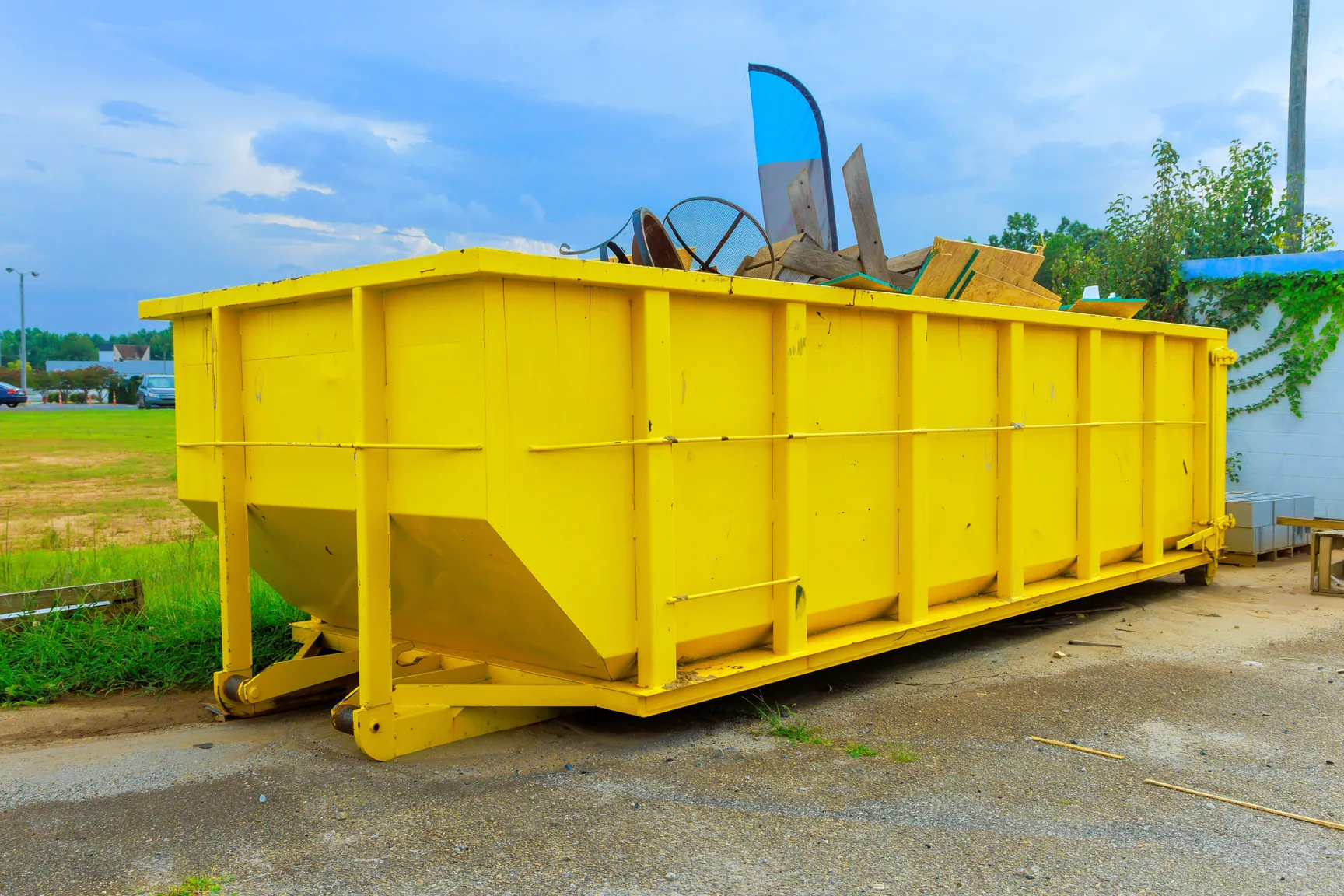
Alabama splits the container question across two liability forms
Alabama does require a credential before anybody collects and transports solid waste here, and it is issued by your local board of health rather than by any state office. That means the first thing to get right is the level of government you are dealing with. Below: the permit, the annual license and the bond that sit on top of it, the intrastate authority question, and the placement rules — which are municipal, and which in one large Alabama city are not a permit at all. First, though, the seam between the two policies that answer when a container goes wrong.
Both liability forms have something to say about a container coming off a truck, and the losses that go unpaid in this trade tend to land between them. The general liability form carries its own defined term for loading or unloading, and it generally excludes injury and damage arising out of the use of an auto — then tells you that use takes in loading or unloading. The standard auto form does not use the phrase at all. It reaches the same moment by a different road, and the branch that matters to a hoist operator turns on whether the device moving the property is attached to the truck.
The other half is damage to the customer’s own property: the driveway that fails under a loaded can, the curb clipped on the way out, the parking surface scored where the hoist set down. Whether a placement loss sits inside or outside a liability form’s exclusions for property in the insured’s care, custody or control, and for that particular part of real property being worked on, depends on the precise wording and the precise facts. No web page settles that. This one shows an Alabama owner where the seam runs, so the question is asked while a quote is being built.
Alabama gives that seam a second job, because one Alabama city has written the placement duty straight into its ordinance and put half of it on the hauler rather than the customer. Where a code forbids setting a container on a surface that does not meet the city’s requirement, a placement decision is a compliance decision as well as a coverage one — and whoever is driving that morning makes both.
Alabama regulations and licensing for a roll-off operator
Three things stack here, and they are issued by three different bodies. A permit from a county health department under a statewide rule; an annual license from the county commission or the municipal governing body, with a bond behind it; and, separately, intrastate authority from the Public Service Commission if you are carrying property for compensation between Alabama points.
The permit Alabama requires, and the office that issues it
The rule is made by the Alabama Department of Public Health and published as a chapter of the Alabama Administrative Code, and it opens by reaching anyone, public or private, who collects or transports solid waste. Then it does the operative work:
“Permitting. No person shall collect and transport solid waste, until he has applied for and received a Solid Waste Collector permit from the LHD. Persons who transport solid waste but are not engaged in the door-to-door collection of solid waste generated within the state shall apply for and receive a Solid Waste Transporter Permit in lieu of a Solid Waste Collector Permit from the LHD before beginning such activity.”
The LHD is defined in the same chapter, in four words, as a county health department — so the credential is issued by your local board of health, under a rule the state wrote, on the state department’s own application form. That form carries a blank for the county health department and a blank for the LHD permit number, which is as clear a statement as you will get of how the two levels divide the work. Anyone naming the state environmental agency as the issuer here is wrong twice over: that agency’s own permit table runs to landfills and to three transporter classes — hazardous waste and used oil, scrap tire, and medical waste — with no solid waste transporter entry in it.
You are inside the rule by definition rather than by argument:
“Collector -- a person who collects and transports solid waste or scrap tires, generated by others for monetary compensation or other considerations.”
And the waste stream is inside it too. Alabama’s definition of solid waste names construction and demolition debris in its own enumerated list, alongside garbage, rubbish, ash and sludge from treatment, water supply and air pollution control facilities, plus any other discarded materials — the rule at r. 420-3-5-.03(54) and the statute at Ala. Code § 22-27-2(34) say the same thing. No inference is needed to get a construction clean-out load inside this scheme.
Which of the two permits an LHD issues to a roll-off operator is genuinely unresolved on the text, and this page will not pick one for you. The Collector permit is the default; the Transporter permit goes to people carrying solid waste who are not doing door-to-door collection of waste generated in the state. Dropping and pulling containers is not door-to-door collection in the ordinary sense, which points one way, while the Collector definition above fits a roll-off operator exactly, which points the other. Nothing retrieved for this record decides it. Ask the county health department that would issue it.
What the permit carries is worth knowing before you apply. It authorizes collection or transport only within a set boundary or designated jurisdiction, so the geography of your credential is drawn locally. It comes from the LHD in each county where you operate a collection facility, renewable annually by the first of October, and one LHD may honor another’s but need not. The application wants your vehicle flushing, cleaning and maintenance method, how the resulting wastewater is disposed of, a spill clean-up plan, a standby-equipment plan, evidence of a performance bond or other assurance satisfactory to the governing body, and a site plan — signed and notarized. Operating duties follow: waste travels in vehicles the LHD has approved, goes to an approved facility, and does not sit in a collection vehicle for more than a day.
On top of that sits a statutory license, and the verb matters. Ala. Code § 22-27-5(b) makes governing bodies establish and collect annual license fees from firms in this trade — shall, not may — which is what turns a local option into a statewide mandate. Section 22-27-5(c) then chains the two together: no license is granted and no fee collected without a permit from the state or county health department, renewable annually when licenses fall due; the permit rests on performance and can be revoked for cause; and no license is granted without a performance bond satisfactory to the governing body. Permit, then license, then bond, in that order.
Two asymmetries in that statute are recorded here rather than smoothed over. Section 22-27-5(b) reaches agencies collecting and disposing of solid wastes, and disposal is a defined term at § 22-27-2(9) describing what a landfill does; collection is not defined at all. On a strict reading a hauler who only collects and delivers to a permitted landfill does not itself dispose. And § 22-27-5(c) names the state or county health department while the rule names the LHD. The credential this page leans on is the health department permit, whose own definitions leave no doubt who issues it or who it reaches.
Intrastate authority, and the carve-out that is only about rates
Alabama’s authority threshold is not a weight at all. The Motor Carrier Act’s definitions were swept for pounds and for weight and return nothing on either; what triggers the chapter is the activity. Ala. Code § 37-3-5 bars a non-exempt motor carrier from operating for compensation on any Alabama highway except in accordance with the chapter, and declares every such carrier subject to the commission. Then the specific requirement:
“No common carrier by motor vehicle subject to the provisions of this chapter shall engage in intrastate commerce on any highway in this state unless there is in force with respect to such carrier a certificate of public convenience and necessity issued by the commission”
Hold yourself out to the general public and you are a common carrier under § 37-3-2(3), so that certificate is yours to obtain; work under special or individual contracts and the contract-carrier route at § 37-3-2(6) is the one. Proof of liability insurance, and for a property carrier proof of cargo insurance, are filed and maintained. The tariff filing and the annual report do not attach: the commission states both as duties of household goods carriers and non-charter passenger carriers, and a property carrier of waste is neither.
The one number Alabama sets for itself sits in the safety act instead, and the record is emphatic that it be written exactly as drafted:
“COMMERCIAL MOTOR VEHICLE. Any self-propelled or towed vehicle used on the highways in commerce to transport passengers or property if the vehicle meets any of the following: a. It has a gross weight rating or gross combination weight of more than 10,000 pounds, whether operated interstate or intrastate.”
The closing words make that Alabama’s own figure rather than a federal one arriving by reference, and § 32-9A-1(1)b reinforces it by defining commerce to take in traffic that begins and ends inside the state. Section 32-9A-2(a)(1) then attaches the federal motor carrier safety regulations — federal rules administered by the FMCSA, a federal agency, and adopted into Alabama law rather than written by it. The Unified Carrier Registration program the commission also administers is, by its own description, for carriers in interstate commerce; it is not an intrastate credential.
Now the trap, and it names something close enough to your vehicle to be dangerous:
“No motor carrier who transports property exclusively in open-top dump truck and trailers without pneumatic loading and unloading devices shall be subject to any provisions of this chapter which require the filing of tariffs, schedules of charges, contracts, or the establishment or participation in any published rates. Nothing contained herein, however, shall exempt any motor carrier providing service in vehicles from complying with all other provisions of this chapter, unless otherwise provided by this chapter.”
The second sentence is the whole subsection. It is a carve-out from rate and tariff filing and from nothing else, and it does not touch the authority requirement above. Whether it even reaches a roll-off hoist truck carrying an open container is unresolved on the text and unresolved in this record. A second exemption is more likely to matter commercially: § 37-3-4(a)(1)b exempts vehicles for hire operating wholly inside a city or incorporated town or its police jurisdiction, or between contiguous towns or cities. A great deal of roll-off work never leaves one such area. Whether a particular operation stays inside that exemption is a fact about your operation rather than a fact about Alabama, so this page presents it and does not apply it to you.
Placement in Alabama is municipal, and one city simply forbids it
Alabama sets no statewide placement or right-of-way permit. Placement, screening and surfacing are municipal, and cities differ even on whether there is a permit to apply for. The state layer points outward twice: the health department’s own rule preserves the power of municipal and county governments and solid waste authorities to impose more stringent requirements, and Ala. Code § 22-27-3(a)(2) lets a county commission or municipal governing body require mandatory participation in its own collection system. Note the overlap with the permit section above — in Alabama the municipal layer is not only a placement layer, it is also one of the two issuing layers for the credential itself.
Huntsville is recorded here as one city’s own code and nothing more, and it was chosen because it is a prohibition rather than a permit:
“It shall be unlawful for the dumpster owner and the person in charge of the premises to place or locate a dumpster, except for dumpsters placed by the city or a contractor acting on the city’s behalf, on any right-of-way or easement of the city.”
There is nothing to apply for. An offending container is moved by the hauler, and removed permanently where no other position is available. The rest of § 22-87 splits duties between customer and hauler, and the hauler’s half is the placement itself: the premises must provide a concrete or asphalt surface of sufficient size, and it falls to the hauler to see the container is put and kept on it, and never to set one down where that surface is absent. Screening divides the same way — the duty to screen belongs to the premises, and the hauler must not leave a container where screening or a written hardship waiver is missing, or outside the screened area. Access ways crossing a city right-of-way must be paved to take the collection vehicle’s maximum gross weight. Enforcement is by a sworn officer or the city’s code enforcement section.
One Huntsville section joins the placement layer and the permit layer in a single sentence. Section 22-42 obliges a construction or demolition contractor to provide on-site containers for the debris a site produces, to have the waste removed continuously rather than left standing beyond a month, and — where the contractor arranges collection — to have it done by a solid waste collector in a vehicle the city has licensed, with disposal at a facility permitted to take that waste type.
What this example does not show, stated rather than glossed. A whole-code search of the current Huntsville code returns exactly one hit for roll-off, and it is about a wrecker in the traffic chapter rather than a container. There is no Huntsville roll-off right-of-way permit to describe, so none is described, and the absence was measured rather than assumed. It must not be generalized to any other Alabama city, in either direction.
Buying workers compensation as an Alabama employer
Alabama workers compensation is compulsory above a floor the statute states in its own words, and the catchlines above the securing sections are the first trap. Sections 25-5-8(a) and (b) are captioned as an option to insure risks and an option to self-insure, so an owner skimming headings concludes coverage is optional. The option is between the two methods, not between securing and not securing: § 25-5-8(c) requires an employer subject to the chapter to file evidence of compliance.
Both routes are private. Section 25-5-8(a) lets an employer subject to the chapter insure and keep insured its liability with an insurance corporation, association or organization, including one a group of employers has formed to carry these risks — provided Alabama’s insurance commissioner has first given written approval to the contract and plan of business, and has authorized that insurer to write workers compensation here under it. Section 25-5-8(b) is the alternative: an employer electing not to insure gives the secretary satisfactory proof of financial ability to pay compensation directly, and on that proof may operate as a self-insurer. Approval and authorization sitting with the state insurance regulator is the shape of a competitive state, not a monopolistic one.
The floor is at Ala. Code § 25-5-50(a). The article does not reach an employer of a domestic employee or of a farm laborer; an employer of someone whose employment is casual and outside the usual course of the business; or, in any one business, an employer regularly having less than five employees. That last exemption is then cut back for on-site work putting up new detached single-family dwellings — a carve-out about residential construction itself, which must not be stretched to a roll-off operator simply because roll-off work serves construction sites. The same subsection covers very small municipalities as employers, which is a different question entirely, and it lets an exempt employer accept and become subject to the article voluntarily.
A panel for Alabama in rows. Each row sets one thing the state requires beside the exposure that requirement leaves open and the coverage line that answers it. Hauler registration: A hauler credential, issued by your local board of health. It leaves open a container placed on a customer’s property, and the driveway or curb it damages, which General Liability and Dumpster and Equipment Coverage answer. Intrastate motor-carrier authority: A state operating credential reaches for-hire hauling. It leaves open the roll-off truck at fault, and the container in transit, which Commercial Auto and Pollution Liability answer. Roll-off placement permits: Municipal — varies by city and town. It leaves open placement on the public right-of-way, and a struck pedestrian or vehicle, which General Liability answers. Workers compensation: Compulsory; bought from private insurers. It leaves open a driver or yard hand hurt on the job, which Workers Compensation answers. Notes: A registration, permit or bond is a condition of operating, not insurance: it answers none of the exposures on the right, so no line is drawn from it. The conclusion reads: The registration is not the coverage — the program is. No figures are shown.
Six lines of coverage on an Alabama roll-off operation
What each line is asked to do in Alabama specifically.
- General Liability — the third-party half of the seam: someone hurt around a container, or property damaged by where it stood and how it arrived. In Alabama a placement decision can also be an ordinance question, which makes the wording of these exclusions worth reading before the first drop.
- Commercial Auto — the roll-off or hook-lift truck: driving it, hoisting with it, and the loading and unloading the auto form reaches by its own route. If you hold a certificate under § 37-3-10(a), proof of liability and cargo cover is filed and maintained with the commission.
- Dumpster and Equipment Coverage — inland marine on the containers, which stand on somebody else’s ground. In Alabama they also have to stand on a surface the ordinance may specify, which is a placement question with an equipment consequence.
- Commercial Property — the yard, the office, the contents and whatever is stacked there overnight. The permit contemplates a collection facility and asks for a site plan of it, so the yard is a place Alabama law has already looked at.
- Workers Compensation — driver and helper injury: the hoist, the tarp, the walk-around, the lift. Alabama’s route runs through § 25-5-8, with the § 25-5-50(a) band deciding when the obligation starts.
- Pollution Liability — what the load turns out to contain. The permit application wants a spill clean-up plan and a wastewater disposal method in writing, which tells you how the state thinks about this exposure.
For the whole class in one place, the Dumpster Rental Insurance hub covers it.
Recurring Alabama roll-off losses
Patterns rather than statistics; no figure is attached to any of them because none was sourced. Placement damage leads. A can set on a residential driveway never built for the loaded weight, a curb clipped leaving a tight lot, a parking surface scored where the hoist bit — and in Alabama, sometimes a container that should never have been where it was at all, because the ordinance put the surfacing and screening duty on the hauler as well as on the customer.
Then the ordinary ones. Injury clusters on the tarp, the walk-around and the moment somebody handles a container that has not moved in a fortnight. Something leaves the box on the way to the landfill and becomes a highway incident. And an administrative lapse — a permit not renewed by the autumn deadline in one of the counties you work — becomes a commercial problem quickly, because the office that issued the paper is the one that reviews it.
Alabama metros and roll-off markets
Five Alabama markets, with the county each one sits in. Nothing here carries a population, a permit count or a market-size estimate — this state’s research sourced none, and a number somebody made up would be worse than no number at all.
Huntsville
Madison County. North Alabama’s anchor metro, and the one city whose container ordinance is described on this page — where the right-of-way rule is a prohibition rather than a permit.
Birmingham
Jefferson County. Central Alabama’s largest metro and the densest concentration of commercial and demolition work in the state.
Montgomery
Montgomery County. The state capital, and the seat of the commission that issues intrastate motor carrier authority.
Mobile
Mobile County. The Gulf Coast port metro, with the storm-season clean-up cycle that comes with the coast.
Tuscaloosa
Tuscaloosa County. West-central Alabama, with the renovation and turnover pattern of a university city.
Nearby states we also write
Three of Alabama’s four neighbors are linked below, all inside the licensed footprint. Alabama’s answer on this page — state law requires it, a county office issues it — is Alabama’s alone, and describing any neighbor as having a state registration, or as having no requirement, on the strength of what is written here would be wrong twice over. Read each state on its own page.
Alabama dumpster rental insurance FAQs
Does Alabama actually require a permit before I can haul a roll-off container?
Yes, and this is one of the states where the answer is a plain yes. Ala. Admin. Code r. 420-3-5-.10(1) bars collecting and transporting solid waste without a permit, and the body that issues it is your local board of health — r. 420-3-5-.03(34) defines the LHD as a county health department. State law makes the rule; the county office hands over the paper.
Which of the two Alabama permits applies to a roll-off operation?
The rule provides a Solid Waste Collector permit as the default and a Solid Waste Transporter permit for people who carry solid waste without doing door-to-door collection of waste generated in the state. A roll-off operator arguably sits on either side of that line, and nothing retrieved for this record decides which one an LHD issues. Ask the county health department that would be issuing it, and do not assume.
Is there an Alabama license on top of the health permit?
There is. Ala. Code § 22-27-5(b) makes governing bodies establish and collect annual license fees from firms collecting and disposing of solid waste, and the verb on the governing body is shall rather than may. Section 22-27-5(c) then chains the two: no license is granted and no fee collected without a health department permit, and no license is granted without a performance bond satisfactory to the governing body.
Does my roll-off truck need intrastate authority from the Public Service Commission?
If you hold yourself out to the general public as carrying property for compensation between Alabama points, Ala. Code § 37-3-10(a) requires a certificate of public convenience and necessity from the commission; operating under special or individual contracts puts you on the contract-carrier route at § 37-3-2(6) instead. The exemptions section was swept for garbage, refuse, waste, trash and rubbish and returns nothing on any of them.
I run open-top containers. Doesn’t the Alabama dump truck exemption cover me?
Read the whole subsection. Ala. Code § 37-3-4(c) exempts a carrier hauling exclusively in open-top dump trucks and trailers from the rate and tariff provisions, and its second sentence says expressly that nothing in it exempts anyone from the rest of the chapter. It is not an exemption from the authority requirement. Whether it reaches a roll-off hoist truck carrying an open container is not something this record resolves.
Does Huntsville issue a permit for putting a container on the street?
No — it forbids it. Huntsville Code of Ordinances § 22-87(b)(1)a makes it unlawful for the hauler, and for whoever is in charge of the premises, to put a container on a city right-of-way or easement, with an exception only for containers the city or its contractor places. There is nothing to apply for. That is one city’s rule and must not be read across to any other Alabama city.
When does Alabama workers compensation become compulsory for my crew?
Ala. Code § 25-5-50(a) sets the band. The article does not reach an employer of a domestic employee or a farm laborer, casual employment outside the usual course of the business, or — in any one business — an employer regularly having less than five employees. That last exemption is cut back for on-site work on new detached single-family dwellings, which must not be stretched to a roll-off operator merely because the work serves construction sites. An exempt employer may still elect in.
This page reports Alabama law as our own state research file records it. It is general information rather than legal advice, and it is not an opinion on what any policy covers — the wording you hold controls that, and carriers do not all write it the same way.
Show us how the Alabama work is set up
Which counties you hold permits in, what the trucks are, who is on them, and how much of the week is construction and demolition against commercial clean-out. We will read the policy wording against the work, and where an answer belongs to a county health department or to a city ordinance we will say so instead of guessing.
Related coverage for dumpster rental operators
- General Liabilitygeneral liability
- Commercial Autocommercial auto
- Dumpster and Equipment Coverageinland marine
- Commercial Propertycommercial property
- Workers Compensationworkers compensation
- Pollution Liabilityenvironmental / pollution liability
What it costs in Alabama · States we serve · Dumpster Rental Insurance · Get a quote · Contact us
Primary sources
- Alabama Department of Public Health — Solid Waste and Septage — the state department that writes Chapter 420-3-5 and publishes the application the county health department issues against
- Alabama Public Service Commission — Motor Carrier Section — the commission’s own statement of what intrastate authority is and who needs it
- ADEM — Permitting and Registration — the environmental agency’s own permit table, which carries three transporter classes and no solid waste hauler among them
- Alabama Department of Insurance — the regulator that must approve a workers compensation plan and authorize the insurer under Ala. Code § 25-5-8(a)