
Dumpster Rental Insurance by State
Dumpster Rental Insurance in Georgia
Two Georgia agencies reach a roll-off operation, every city reaches the box once it touches a street, and the policies you buy have to be read against both.
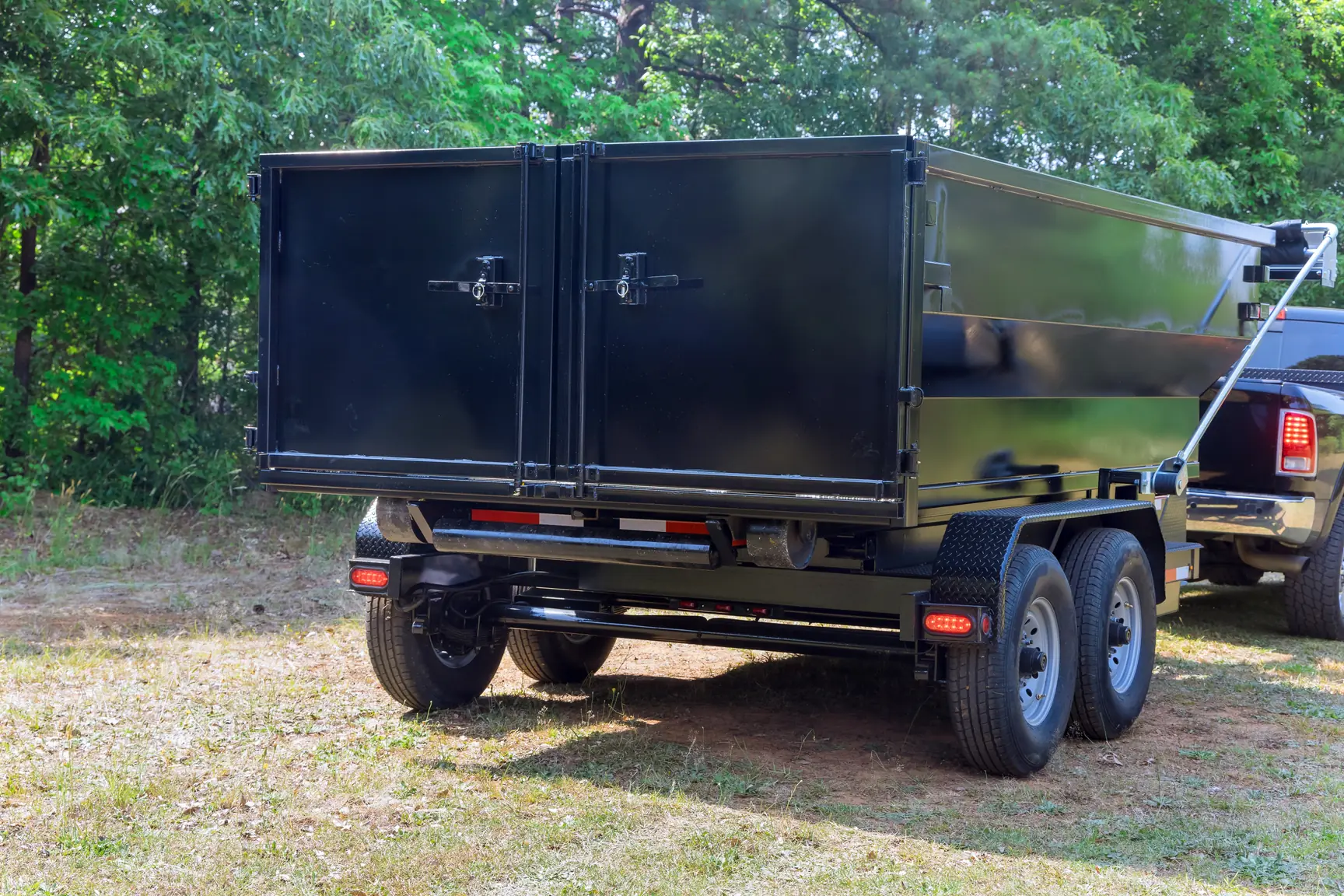
The seam a Georgia hauler feels at claim time
A dumpster rental business ends up holding two liability policies, and both of them have something to say about the few seconds while a container is coming off the chassis or going back onto it. That overlap is where the uninsured losses in this trade tend to sit, and it is the first thing worth understanding before any Georgia regulator enters the picture.
The general liability form supplies its own meaning for loading and unloading. It then pushes injury and damage arising out of the use of an auto outside the policy, and folds loading and unloading into what using an auto means. The standard auto form arrives at the same moment by a different route, and the route that matters here turns on whether the device doing the moving was attached to the truck. Cable, hoist and hook-lift gear on a roll-off chassis is attached. A forklift a customer’s crew drove up to the box is not. The two forms were drafted to meet, and where they meet is not always where an operator expects.
The other half of the seam is damage to the property the box was resting on. In Georgia that is a cracked driveway on a Cobb County renovation, a scored curb on a Savannah side street, a gouged apron behind a Macon warehouse, or a lawn pressed into ruts after three wet days. A general liability form typically carries exclusions for property in the insured’s care, custody or control and for that particular part of real property being worked on. Whether a placement loss lands inside or outside those turns on the language in force and on the facts of the particular drop, and no web page settles that.
What this page can do is show you where the seam runs across your operation, so the question gets asked while a submission is being built rather than after a claim file is open. Your own policy wording controls, and the forms in use differ from one carrier to the next.
Georgia regulations and licensing
Georgia is a two-agency state with a third layer underneath it. An environmental agency credentials the hauling service, a public-safety agency registers the truck, and every city and county decides for itself what a container may do once it touches a public street. The three are separate instruments and none of them stands in for another.
Georgia’s statewide solid waste credential
The credential that reaches a roll-off operation is issued by the state, by the Department of Natural Resources through its Environmental Protection Division. The rules define the officer who issues it as the Director of that Division, and the subject rests its authority on O.C.G.A. § 12-8-20 and the sections following it.
The reason a truck operator is inside a rule that keeps saying facility sits in a definition. Ga. Comp. R. & Regs. r. 391-3-4-.01(80) describes the regulated activity this way:
“the storage, collection, transportation, treatment, utilization, processing, or disposal of solid waste, or any combination of such activities”
Collection and transportation are named in that list, so an operator who sets a box down, fills it and hauls it away is doing a regulated thing by the plain words. Rule 391-3-4-.02(1) then makes it unlawful to do that without a permit, with a short set of carve-outs — two statutory exemptions and the permit-by-rule route. Rule 391-3-4-.06(1) supplies the route: collection operations are deemed to hold a solid waste handling permit once the conditions in the two following paragraphs are satisfied, and the operator’s own part of that is a single act.
“Within 30 days of commencing solid waste handling activities which are covered under a permit-by-Rule, notification must be made to the Director of such activity. Notification shall be made on such forms as are provided by the Director. Persons failing to notify the Director of such activities shall be deemed to be operating without a permit.”
Read the last sentence twice. The notification is not paperwork that trails the work; it is the thing that makes the permit exist. An operator who never sent it is in the same position as one that never had a permit at all.
The seven conditions at r. 391-3-4-.06(3)(a)1. through 7. are all about equipment and conduct rather than about a site. Vehicles or containers carrying garbage and similar putrescible material have to be covered, substantially leakproof, durable and easy to clean; they have to be cleaned frequently and kept in repair; loads have to be handled and moved so that nothing falls, leaks or spills, and covered where covering is what prevents blowing; regulated quantities of hazardous waste stay out unless the hazardous waste statute is satisfied; wash water has to be dealt with; the collector carries responsibility for complying with local rules and ordinances about collection systems; and collected material may go only to a permitted facility authorized to take that waste type. Every one of those is a duty an underwriter can ask you about, because every one of them is also a loss driver.
Georgia intrastate motor carrier registration
The second credential is a registration with the Department of Public Safety, held by its Motor Carrier Compliance Division. It is not a certificate and it is not a grant of authority to carry a particular commodity; it is a registration that DPS grounds on the motor carrier and commercial vehicle definitions in O.C.G.A. § 40-2-1 and § 40-1-1.
The trap here is the weight figure, and it has caught people. DPS describes the registration class in two limbs. One limb is the ordinary commercial vehicle line, which the rulebook sets at a rating or actual weight of 10,001 pounds or more. That number is the federal commercial-vehicle line at 49 CFR 390.5, reaching Georgia intrastate work because DPS adopted the federal parts by reference and reads references to interstate commerce as covering intrastate commerce too. It is not a figure Georgia chose on its own. The second limb is the one that matters to a small operator:
“A ‘Lightweight Commercial Vehicle’ means a motor vehicle which does not meet the definition of a commercial motor vehicle and which, in the furtherance of a commercial enterprise: … (B) Is used to transport property for compensation”
A roll-off operator moving a customer’s waste for money is carrying property for compensation. So the registration reaches the operation at any weight. A truck under the pound figure has not escaped anything — it has moved onto the lighter limb, where rulebook 1-390.50 gives it a shorter list of safety parts and 1-390.21(h)(2) gives it a different marking duty. An operator running solely inside the state marks its identification number with the letters GA after it, per 1-390.21(h)(1).
DPS states the package it wants: the application, a notarized affidavit under O.C.G.A. § 50-36-1, a copy of a secure and verifiable document under O.C.G.A. § 50-36-2, and proof that within the previous twelve months the applicant completed a motor carrier operations and safety seminar authorized by the Commissioner. A for-hire carrier also has to have evidence of public liability and property damage cover filed with DPS by the insurance company rather than by an agent, on the state’s prescribed filing. The agency is blunt that a registration is not live until every item has landed and the fees are paid — which is a scheduling fact for anyone planning a first haul around a start date.
One name collision is worth closing here. A DPS certificate is a different credential entirely, and the certificate subjects under Ga. Comp. R. & Regs. Ch. 570-38 run to household goods, passengers, limousines, transportation network and taxi services, and nonconsensual towing. There is no property-carrier class among them. A waste hauler carries property, and Georgia does not certificate intrastate property carriers.
Where Georgia puts the placement question
Georgia sets no statewide roll-off placement or right-of-way permit. Placement standards, street occupancy and container marking are written by individual cities and counties, and they differ from one to the next. What Georgia does statewide is fold that local compliance into the state credential: the fifth of the seven collection conditions puts responsibility on the collector for complying with local rules, regulations and ordinances governing waste collection systems. An operator that ignores a city ordinance has not only crossed that city — it has stepped outside a condition of its own permit by rule.
One municipality is named here as an example and nothing more. Atlanta is used because its code could be read in full with a dated edition banner, which is a retrieval outcome rather than a preference, and none of it may be generalized to any other Georgia city.
“Permit required. It shall be prohibited and it shall be unlawful for any person to place or maintain a dumpster in the public right-of-way unless such person shall first obtain a dumpster permit from the department of transportation.”
Atlanta’s definition of the container is broad, and it names construction and demolition debris first, so a job-site box in that city is squarely inside it. The part an operator gets backward is who the code is talking to. The ordinance separates the person who leases the container and causes it to be set down from the person who owns it, and the application provision speaks to the first. But the prohibition above is written against anybody who places or maintains a container in the right-of-way, and the person who places it is the driver. So the customer is the natural applicant and the operator is squarely inside the prohibition — which is exactly why the two of them should settle in writing who is pulling the permit before the box goes down. The ordinance does not say the owner has to be the permittee, and nothing here says so either.
The application form has to ask for the applicant’s contact details, how many containers are wanted at the location, the street address next to it, the intended use and how long the occupancy will run. Issuance is conditioned on the applicant showing the transportation commissioner that private property cannot take the containers, and on a finding that a sidewalk placement will not create a safety hazard, disrupt traffic on foot or in vehicles, or damage property. There is a hard stop on the term:
“Duration of permit. Duration of a dumpster permit shall not be more than six months.”
There is also an insurance condition, and it is worth reading carefully because of what it does not do. No permit issues until the applicant has shown the transportation commissioner evidence of insurance indemnifying and holding the city harmless, furnished by an insurer the city finds satisfactory, naming the city and its officers, employees and agents as additional insureds, and kept in force the whole time the container sits in the right-of-way. The ordinance sets no dollar amount at all — it hands the amount to the city’s risk manager. No limit, premium or cost may be taken from it, here or anywhere else. The penalty provision runs to revocation or suspension, a daily fine and a jail term, and that is one city’s schedule rather than a Georgia rule.
Paying for a hurt driver in Georgia
Georgia is a competitive workers compensation state. Coverage is bought from private insurers authorized to write it here, there is no state fund anywhere in the material, and the State Board of Workers’ Compensation administers the system rather than underwriting it. The board states the duty and its floor in its own words:
“Every employer, individual, firm, association, or corporation, regularly employing three or more persons, part-time or full time, shall provide workers’ compensation insurance coverage. Exempted officers of corporations or exempted members of limited liability companies shall not reduce the number of employees for this purpose.”
Two things about that sentence. The second half is the one that catches owner-operators who have structured around it: taking an exemption for an officer or a member does not shrink the head count the first half is measuring. And a payroll under the board’s figure is not a conclusion that you do not need the cover. It says what the law compels and says nothing about what a general contractor’s insurance requirements, a landfill’s gate rules, a commercial lease or a lender will compel.
There are two ways to discharge the duty. An employer buys a policy from a company licensed to write the line in Georgia, or it qualifies as a self-insurer, which means applying to the board with three years of audited financial statements and a non-refundable application fee payable to the state’s self-insurers guaranty trust fund. For a business running a handful of trucks the second route is theoretical. The board also sends questions about rates and premiums away from itself and to the Office of Insurance and Safety Fire, which is the regulatory shape of a competitive state rather than a monopolistic one.
A panel for Georgia in rows. Each row sets one thing the state requires beside the exposure that requirement leaves open and the coverage line that answers it. Hauler registration: A hauler credential, issued by the state. It leaves open a container placed on a customer’s property, and the driveway or curb it damages, which General Liability and Dumpster and Equipment Coverage answer. Intrastate motor-carrier authority: A state operating credential reaches for-hire hauling. It leaves open the roll-off truck at fault, and the container in transit, which Commercial Auto and Pollution Liability answer. Roll-off placement permits: Municipal — varies by city and town. It leaves open placement on the public right-of-way, and a struck pedestrian or vehicle, which General Liability answers. Workers compensation: Compulsory; bought from private insurers. It leaves open a driver or yard hand hurt on the job, which Workers Compensation answers. Notes: A registration, permit or bond is a condition of operating, not insurance: it answers none of the exposures on the right, so no line is drawn from it. The conclusion reads: The registration is not the coverage — the program is. No figures are shown.
Six coverages, read against a Georgia route
The program under a Georgia roll-off operation is six lines, and each one changes shape slightly once the rules above are in the room.
The hub page at dumpster rental insurance puts the six together as one program rather than six purchases.
What actually goes wrong on a Georgia drop
These are patterns, not statistics, and no frequency or severity figure appears on this page because none was sourced for it.
A loaded box goes back on the rails and the wheels track across a residential driveway that was poured thin, or the rails dig a line across an apron on the way up. The repair estimate is still a claim with an exclusion argument attached to it. The same loss on a city street in Atlanta drags a second question behind it, because a right-of-way permit came with an indemnity running to the city.
Then there is the overhead strike. A cable hoist raises a box under a service drop or a limb on a narrow Savannah lot, and the loss is somebody else’s utility equipment plus the time everyone on the street spends without power. Georgia’s older intown neighborhoods and its coastal streets both produce this one.
There is the box that moves after the driver has gone. A container on a slope, on gravel, or on a surface that softens after two days of rain travels a few feet in the night and finds a parked car or a fence. The driver is not there, the customer says it was set badly, and the argument about care and control starts.
A renovation box comes back with paint, solvent or something that belongs in a regulated stream, and the transfer station finds it at the scale. That is a pollution question, a contract question with the customer, and in Georgia it also touches the collection condition about hazardous quantities and the one about tipping only at a facility authorized to take that waste type.
And there is the injury on the ground. A helper tarping a load, a driver stepping off a chassis onto a wet apron, a hand between a door and a frame. That is the workers compensation side, and it is the loss type that decides an operator’s experience rating long before any liability claim does.
Georgia roll-off markets
The unit these markets sit inside is the county. No population, permit-volume or market-size figure is written here because none is in the record, and geography is not a claim about availability — Georgia is one of the 48 states this agency is licensed in, which is what makes these markets writable.
Nearby states we also write
Georgia touches five states and all five are inside the licensed footprint. Three are linked here; the answers on the other side of each line are their own, and nothing verified about Georgia carries across.
Georgia dumpster rental insurance FAQ
Does Georgia make me hold something before I haul a customer’s roll-off box?
Yes, and it is issued by the state. The Environmental Protection Division treats collection operations as holding a solid waste handling permit once the operator has notified the Director, and the rules set seven conditions that attach to the vehicles and containers rather than to a site. Ga. Comp. R. & Regs. r. 391-3-4-.02(1), r. 391-3-4-.06(1), (2) and (3)(a)1.–7.
My truck is under the weight line. Am I outside the Georgia intrastate registration?
No. The Department of Public Safety runs its intrastate registration on two limbs, and the second one reaches a vehicle that carries property for compensation whatever it weighs. A lighter truck moves from one limb to the other; it does not fall out of the program. DPS Transportation Rulebook 1-390.5, 1-390.50 and O.C.G.A. § 40-1-1.
Who is supposed to pull the Atlanta dumpster permit, me or the customer who rented the box?
Atlanta writes the two roles separately. The person who leases the container and causes it to be put where it goes is the one the application provision speaks to, while the prohibition reaches anybody who places or keeps a container in the public right-of-way — which is the driver. Settle it in writing before the box goes down. City of Atlanta Code § 138-61(a)(2), (a)(3), (b) and (c).
Does the state permit by rule let me set a container in a Georgia city street?
It does not. They are different instruments from different governments, and the record is explicit that neither stands in for the other. Georgia goes further and makes obeying the city a condition of the state credential itself, so ignoring an ordinance puts the state side at risk too. Ga. Comp. R. & Regs. r. 391-3-4-.06(2) and (3)(a)5.
I have two people on the payroll in Georgia. Where does that leave workers compensation?
The State Board of Workers’ Compensation states the duty at three or more persons regularly employed, part-time or full time, and says exempted corporate officers and exempted limited liability company members do not reduce that count. Below the board’s figure the compulsion the board describes has not been shown to reach you — which is a different statement from saying nothing else will. General contractors, landfill gate rules, leases and lenders set their own requirements.
What is the consequence in Georgia of never sending that notification in?
The rule answers it directly rather than leaving it to inference: an operator that fails to notify is treated as operating without a permit. That is the sentence quoted on this page, and it is why the notification is the operative act rather than a formality. Ga. Comp. R. & Regs. r. 391-3-4-.06(2).
Will general liability pay for a Georgia driveway my truck cracked on delivery?
Sometimes, and the wording decides it. General liability forms typically carry exclusions for property in the insured’s care, custody or control and for that particular part of real property being worked on, and a placement loss can land on either side of those depending on the facts and the exact language in force. This is the question to put to an underwriter while the quote is open.
Does Georgia issue waste haulers a motor carrier certificate?
No. The certificate classes the Department of Public Safety administers are household goods, passengers, limousines, transportation network and taxi services, and nonconsensual towing. A waste hauler moves property, and Georgia does not certificate intrastate property carriers — the intrastate registration is the credential that reaches it. Ga. Comp. R. & Regs. Ch. 570-38 and r. 570-38-2-.03(1).
This page reports Georgia law as our own state research file records it. It is general information rather than legal advice, and it is not an opinion on what any policy covers — the wording you hold controls that, and carriers do not all write it the same way.
Put a Georgia submission in front of an underwriter
Tell us how many trucks and cans you run, which counties you drop in, whether you work in a city right-of-way, and whether your notification and your intrastate registration are both in place. Those four answers change the shape of a Georgia quote more than anything else on an application. Nothing on this page is legal advice or a statement of what your policy covers; the wording in force on your own policy controls.
Related coverage for dumpster rental operators
- General Liabilitygeneral liability
- Commercial Autocommercial auto
- Dumpster and Equipment Coverageinland marine
- Commercial Propertycommercial property
- Workers Compensationworkers compensation
- Pollution Liabilityenvironmental / pollution liability
What it costs in Georgia · States we serve · Dumpster Rental Insurance · Get a quote · Contact us
Primary sources
- Ga. Comp. R. & Regs. Chapter 391-3-4 — Solid Waste Management — the permit-by-rule route and the seven collection conditions
- Georgia Department of Public Safety — Intrastate Motor Carrier registration — the two registration limbs and the application package
- State Board of Workers’ Compensation — employer information — the duty, the two routes and where rate questions go