
Dumpster Rental Insurance by State
Dumpster Rental Insurance in Pennsylvania
Pennsylvania is one of the states that does authorize the truck — per vehicle, with a sticker on it — and then leaves the container on the ground entirely to the municipality. Both halves, with citations.
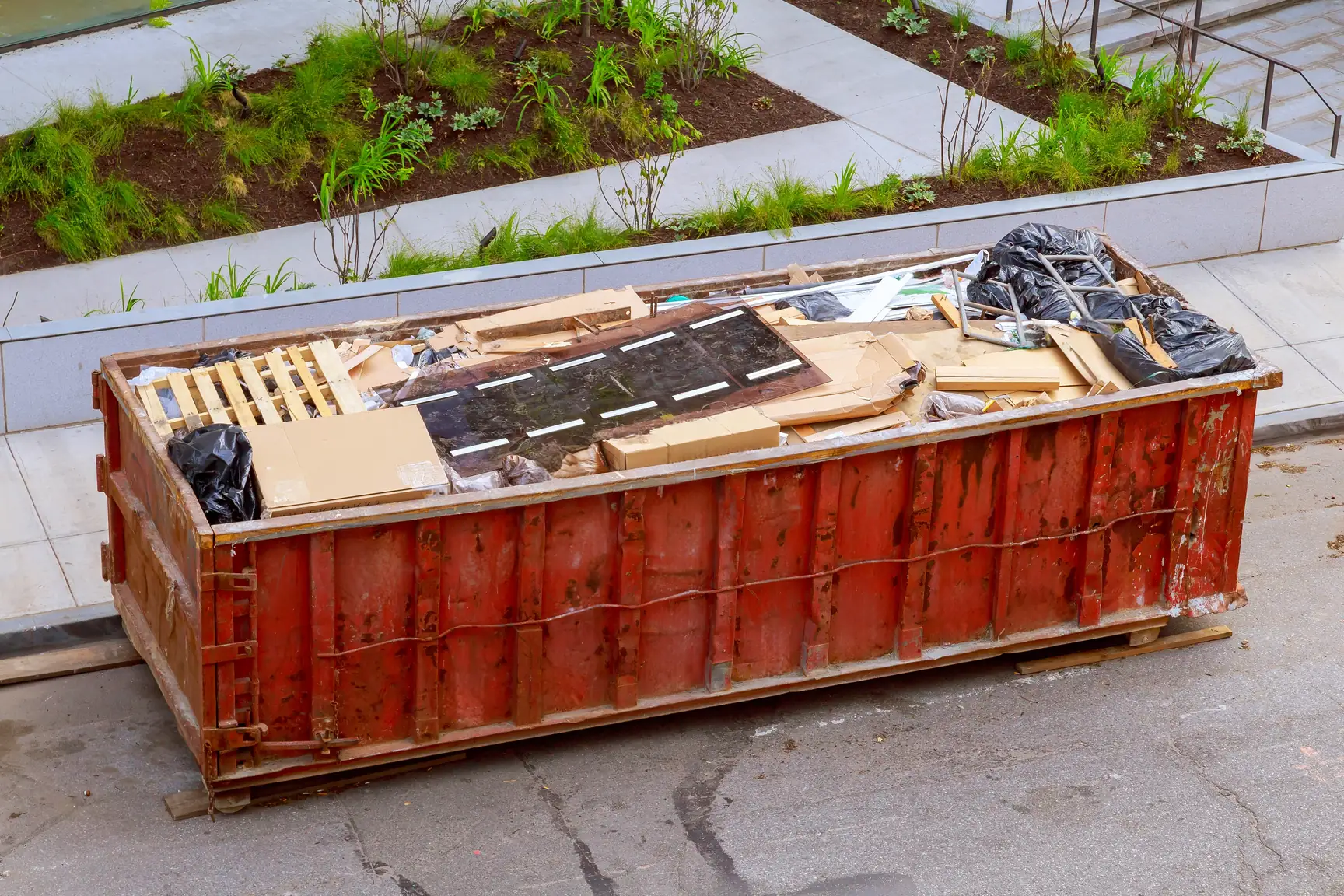
Pennsylvania sits at one end of the range this brand writes across. The Commonwealth authorizes the vehicle that moves waste, issues a sticker for every truck, tractor and trailer in the fleet, and stops a landfill or transfer facility taking a load from a vehicle that has not got one. Then, at the point where the container actually touches a customer’s ground, it steps back entirely and leaves the question to whichever municipality the job sits in.
That split is the thing to understand before quoting a container business here. The state layer is real, it is per-vehicle, and losing it does not produce a letter in three weeks — it produces a refused tip at the gate the same morning. The local layer is where the driveway, the curb and the street get decided, and it is written differently in every city. Everything below carries its own citation, and where the retrieved record left a question open, this page leaves it open too.
Common Pennsylvania container placement and loading-seam risks
The uninsured losses in this class cluster at a seam between two policies that both have something to say about the same moment. The liability form uses loading and unloading as a defined term and generally sends injury and damage arising out of the use of an auto across to the auto policy. The auto policy never uses that phrase; it arrives at the same moment along a different path, and the path that matters here turns on whether the device shifting the property is attached to the truck. The forms are written to meet, and where they meet is not always where an operator assumes.
Then there is the customer’s own property, which in this Commonwealth means a great deal of old paving and a great many narrow sets. A container on a Pittsburgh alley apron, a driveway in a Lehigh Valley development, a curb cut on a nineteenth-century Philadelphia block: general liability forms typically carry exclusions for property in the insured’s care, custody or control and for that particular part of real property being worked on. Whether a placement loss is inside or outside those exclusions depends on the exact wording and the exact facts. We do not settle it here. We do make sure the question is asked while the program is being built, not after the surface has already failed. The operator’s own policy language controls, and forms differ between carriers.
Pennsylvania regulations and licensing for waste transporters
Three separate bodies reach a container operation in Pennsylvania, and they are answering three different questions: who may move the waste, who may put a truck of that size on the road, and who may occupy the street the container stands on.
Pennsylvania’s waste transportation authorization
This is a state credential, issued by the state, and the prohibition that creates it is short:
“It shall be unlawful for a transporter to operate a waste transportation vehicle without obtaining written authorization from the department.”
Read alone, that sentence has no boundaries at all — it says nothing about weight, waste type or how often the truck runs. Every limit sits in the definitions one section earlier, and one of them hops out of the chapter entirely. The transporter is the owner of the vehicle, expressly not a driver who is not the owner. And the vehicle is defined like this:
“‘Waste transportation vehicle.’ Public and private motor carrier vehicles and waste trailers, as defined in this chapter, regularly used in transporting municipal or residual waste to a processing or disposal facility in this Commonwealth.”
Three links have to hold for a container operator and all three were checked. The vehicle term is borrowed from the vehicle code, where the first paragraph describes a truck, truck tractor or combination at the intrastate figure set out below; a waste trailer qualifies at a registered weight “in excess of 10,000 pounds”. On waste, the environmental department publishes that municipal waste disposal facilities are construction and demolition waste landfills as well as municipal waste landfills, and that processing facilities include transfer facilities — so a debris pull to either is inside the program. On frequency, the department glosses regular use as transport “in furtherance of a business”, which is a commercial container operation by description.
What follows is per-vehicle rather than per-company. Stickers are issued for each truck, truck tractor and waste trailer, one on the left front side of the truck or tractor and one on the back of the truck or trailer, with a copy of the authorization kept in the vehicle (§ 6204(c)). A final authorization lasts a year and renews on a filing ninety days ahead of expiry (§§ 6204(g) and 6204(h)). Enforcement runs from the receiving end as well: § 6203(b)(2) stops a processing or disposal facility accepting municipal or residual waste from a vehicle with no valid sticker, so a lapse shows up as a truck turned round at the gate.
A separate set of duties reaches the same operator with no credential attached at all. Under 25 Pa. Code Chapter 285, Subchapter B, a daily operational record rides in the cab naming the county and state the load came from, the hauler, the transfer facility and the ultimate disposal facility, and the weight or volume, kept for five years (§ 285.217). The load takes a water-resistant, securely fastened cover (§ 285.211(a)). And the owner’s name, business address and the waste type go on in six-inch lettering, which the regulation places “on the roll-off box or trailer” rather than on the cab door (§ 285.218).
One caution about exemptions. Chapter 62 contains no exemption section. The transportation exemptions relied on in practice are published by the environmental department on its own program page, and § 6209 — headed “Construction of chapter” — is about liberal construction rather than about carve-outs. An exemption here may be attributed to the department. It may not be attributed to the Act.
Intrastate motor-carrier duties in Pennsylvania
Safety and the weight figure belong to the transportation department: 67 Pa. Code Chapter 231 substitutes that department’s name into the federal parts it borrows and is issued under 75 Pa.C.S. §§ 4704 and 6103. Economic operating authority is a different agency’s question and is dealt with below. The two figures that matter are set out together in one definition, and they have to be kept together or neither is safe to rely on:
“‘Motor carrier vehicle.’ (1) A truck, truck tractor or combination having a gross vehicle weight rating, gross combination weight rating, registered gross weight, registered combination weight or actual gross weight of 17,001 pounds or more. (2) A truck, truck tractor or combination engaged in interstate commerce and having a gross vehicle weight rating, gross combination weight rating, registered gross weight, registered combination weight or actual gross weight of 10,001 pounds or more.”
The higher figure is the intrastate one and it is Pennsylvania’s own; the lower one is the federal figure reproduced in Pennsylvania law for interstate work. 67 Pa. Code § 231.8(1)(i) modifies the federal commercial motor vehicle definition to carry the same intrastate figure. Saying the Pennsylvania threshold is the lower number is wrong, and saying a truck beneath the higher number is exempt in Pennsylvania stops being true the moment it crosses a state line.
The chapter incorporates the federal drug and alcohol, safety fitness, general, driver qualification, driving, equipment, hours and inspection parts by reference (§§ 231.1(a) and 231.7), and it reaches more operators than a for-hire test would: § 231.2(b) applies it to carriers of property or passengers in intrastate commerce whether they are common, contract or private carriers, so hauling your own material does not put you outside it. One provision is worth naming because it cuts against the assumption an author usually brings: the federal motor carrier identification report is, in this chapter’s words, “deleted in its entirety” (§ 231.8(4)). Nothing retrieved here establishes an affirmative Pennsylvania intrastate safety registration, so this page does not imply one — and the federal section that deletion points at has itself since moved, which is a second reason to describe the mechanic rather than the paperwork.
Operating authority is the commission’s question. A certificate of public convenience is required under 66 Pa.C.S. §§ 1101 and 1102, and the commission states plainly that you cannot operate in the Commonwealth until you receive one. But the definition of a common carrier by motor vehicle at 66 Pa.C.S. § 102 contains a carve-out that lands squarely on this trade, and it is the unresolved line in this field:
“Any person or corporation who or which uses, or furnishes for use, dump trucks for the transportation of ashes, rubbish, excavated and road construction materials. This paragraph does not include the use or furnishing of five-axle tractor trailers.”
The commission’s own published exemption material tracks that language, and separately distinguishes waste from materials being recycled on the basis that recyclable material has value. Whether a particular roll-off configuration is inside or outside the carve-out, and how the five-axle sentence reads against a roll-off tractor and trailer, was not resolved by anything retrieved for this page. Two other entries on the commission’s exemption list — incidental transport for a non-transportation business, and an owner carrying property to himself — describe neither a container-rental operator hauling a customer’s waste for money, and this page does not offer them as a way out.
Placement permits in Pennsylvania are municipal
Pennsylvania sets no statewide placement permit and no statewide right-of-way permit for a container, whether it goes on a customer’s own ground or on a city street. The waste chapter and the operational rules govern the vehicle, the load and the record; none of them addresses where a box may be set down. There is, however, a genuine statewide bar in this area:
“Notwithstanding anything to the contrary in this chapter, the Solid Waste Management Act or the Municipal Waste Planning, Recycling and Waste Reduction Act, no county and no municipality may implement a municipal waste or residual waste transportation authorization or licensing program after the effective date of this chapter.”
What that closes off is a local program authorizing or licensing the transportation of waste; the Commonwealth took that field for itself when it created the state authorization. What it does not close off, on the face of the text, is a local license or permit attached to a container, to its placement, or to occupancy of a street. This run found no case, opinion or agency statement drawing that line, so this page does not draw it either — and it will not tell you that any particular ordinance survives or fails the bar.
Philadelphia is the one municipality read in full here, offered as an example of a city’s own code rather than as a Pennsylvania rule, and never generalized to Pittsburgh, Allentown, Harrisburg, Erie or anywhere else. Its license is unusual in a way that matters to a rental operator, because it does not stop at the curb:
“shall place or maintain on private property or in the public right-of-way, or lease for the purpose of placement on private property or in the public right-of-way, a construction dumpster for any purpose unless a construction dumpster license specifically applicable to such dumpster has been issued by the Department of Licenses and Inspections.”
The duty is the container owner’s: § 11-610(3) has the owner obtain the license by giving the licensing department identifying information about the box, and a radio-frequency medallion carrying the license number and the licensee’s name and telephone number comes back with it. A container in the street then takes a second credential from a different department — a right-of-way permit from the streets department under § 11-610(4), with reflectors or similar warning devices on equipment left in the right-of-way, and a discretionary exemption where the equipment sits inside a protected site already covered by a general closure permit. Unlicensed and unpermitted boxes in the right-of-way may be seized under § 11-610(8), and a violation notice may be served by posting it on the equipment itself.
One definitional trap in the same code will catch an author who is not watching. Under § 11-610(1)(b) a construction dumpster is a container larger than a household trash can used in connection with demolition, construction, cleaning, painting, building repair or a similar process and serviced by a private waste hauler — and it excludes anything licensed under the ordinary dumpster section. That other section runs against the user rather than the supplier: the person who makes use of the dumpster is the licensee, and a business that services it is only the provider. The same noun carries the duty to opposite parties in two sections of one code. The annual license fee is published in the ordinance and is deliberately not reproduced here; one municipality’s price reads like the state’s.
How each Pennsylvania statement above was verified
The three scope links in the authorization section — the vehicle, the waste and the frequency — were each checked separately rather than assumed from the prohibition, because the prohibition itself carries none of them. The weight figures were taken from the vehicle code and the safety rule as written, in their own terms, and are not rounded or converted. The commission carve-out is quoted rather than summarized precisely because its exact words are what leave the question open. And every place this page says something is unresolved, that is a finding from the retrieval run, not a hedge added for comfort.
Securing workers compensation under the Pennsylvania Act
Pennsylvania is a competitive market that also operates a state-created insurance fund, which is not the same thing as a monopolistic state: the private market is open on the face of the statute. Section 305(a)(1) of the Workers’ Compensation Act tells every employer liable under the Act to pay compensation that it “shall insure the payment of compensation”, and offers three ways to do it — the Commonwealth’s own fund, any insurance company or mutual association or company authorized to write the liability here, or the route that reads like an exemption and is not. An employer “exempted by the department from such insurance” is a self-insurer, approved on proof of financial ability, and Section 305(a)(2) conditions that approval on a bond or other security; a group approved to pool its liabilities is treated the same way.
So the word exemption in that sentence releases an employer from buying insurance. It never releases one from securing compensation. No exempt class and no employee-count floor was retrieved in this run — the coverage-scope sections were not read — so this page affirms only that no exemption reaching a container operator was found, and does not claim the Act contains none. Our workers compensation page covers how the payroll and class-code side of that is presented to a market.
A panel for Pennsylvania in rows. Each row sets one thing the state requires beside the exposure that requirement leaves open and the coverage line that answers it. Hauler registration: A hauler credential, issued by the state. It leaves open a container placed on a customer’s property, and the driveway or curb it damages, which General Liability and Dumpster and Equipment Coverage answer. Intrastate motor-carrier authority: Not verified at the state level. No connector is drawn for this row. Roll-off placement permits: Municipal — varies by city and town. It leaves open placement on the public right-of-way, and a struck pedestrian or vehicle, which General Liability answers. Workers compensation: Compulsory; private insurers, or a competing state fund. It leaves open a driver or yard hand hurt on the job, which Workers Compensation answers. Notes: A registration, permit or bond is a condition of operating, not insurance: it answers none of the exposures on the right, so no line is drawn from it. Intrastate motor-carrier authority is not verified at the state level for this operator, so no line is drawn from it. The conclusion reads: The registration is not the coverage — the program is. No figures are shown.
What each policy does for a Pennsylvania container operation
Six policies do the work, and the program page explains how they are assembled. In this Commonwealth each has a particular job.
Common Pennsylvania roll-off claims we see at pattern level
No numbers, because none are recorded for this state. These are the shapes.
The surface underneath. A box goes on paving that will not carry it loaded and the paving fails. The dispute that follows is about wording, not photographs: care, custody and control on one side, the particular part being worked on for the other, and two policies each pointing at the other.
The moment of transfer. A container shifts on the hoist, a cable lets go, a box catches a low wire or an overhang on a tight urban set. This is the exact instant the loading and unloading language exists for, which is why it is the instant the forms have to have been read for.
The gate. A load is refused, or a sticker has lapsed, or the daily record in the cab does not match what is on the truck. The cost is a lost day and a re-handled load rather than a liability claim — but it is a Pennsylvania-specific operational exposure that follows directly from the per-vehicle shape of the authorization.
The contents. A renovation box comes back with something the customer did not declare on the order, and the argument moves to who pays for sorting, re-handling or clean-up. It is the reason pollution cover is treated as structural in a debris business rather than as an extra.
Pennsylvania roll-off markets
These are the Pennsylvania markets the record names, anchored on the county each one sits in. No population, landfill-tonnage, building-permit or market-size figure is recorded for any of them, and none is written here.
Philadelphia
Philadelphia County — The municipality read in full for this page, and an unusual one: its construction dumpster license attaches to the container owner and reaches private driveways, not only the street, with a separate street permit from a second department on top.
Pittsburgh
Allegheny County — Steep-street delivery, tight alley sets and heavy renovation stock. The state authorization and the safety chapter travel here unchanged; the placement question does not, and has to be read out of the city code.
Allentown
Lehigh County — Lehigh Valley warehouse and residential build-out, where a haul to a transfer facility sits inside the state authorization just as a haul to a landfill does.
Harrisburg
Dauphin County — The seat of the environmental department that issues the authorization and of the commission that issues operating authority, which makes it the market where the paperwork questions get answered fastest.
Erie
Erie County — Lake-effect winters, a long demolition and rebuild cycle, and a fleet that has to hold its authorization stickers current through a season when a refused tip at the gate costs a whole day.
Nearby states we also write
Pennsylvania touches six states, more than any other state in this wave, and all six are inside the licensed footprint. Three are linked here so the page does not carry six near-identical links. Nothing verified above travels with a link — the authorization, the weight figures and the transportation bar are Pennsylvania’s, and each neighbor’s own page governs its own facts. That applies with particular force to the workers compensation paragraph, which describes this Commonwealth’s arrangement and no one else’s.
Pennsylvania dumpster rental insurance FAQs
Does Pennsylvania require a license to haul waste in a roll-off truck?
It requires a written authorization, and it is issued by the state. Under the Waste Transportation Safety Act at 27 Pa.C.S. § 6204(a), a transporter may not operate a waste transportation vehicle without written authorization from the environmental department. The definitions at § 6202 are where the scope actually lives: the transporter is the owner of the vehicle rather than a driver who is not the owner, and the vehicle has to be one regularly used for carrying municipal or residual waste into a Commonwealth facility that processes it or disposes of it.
Is a Pennsylvania construction-debris load inside the waste transportation program?
On the department’s own published description, yes. It states that municipal waste disposal facilities include construction and demolition waste landfills, and that processing facilities include transfer facilities. So a pull of construction debris to a permitted landfill or to a transfer station is municipal waste for this program. The department also glosses “regularly used” as transport done commercially or in furtherance of a business, which describes a commercial container operation by definition.
How does the Pennsylvania authorization actually work on the truck?
Per vehicle. 27 Pa.C.S. § 6204(c) has the department issue stickers for each truck, truck tractor and waste trailer, one displayed on the left front side of the truck or truck tractor and one on the back of the truck or the trailer, with a copy of the authorization riding in the vehicle. A final authorization runs a year and renews on a filing made ninety days before it expires under §§ 6204(g) and 6204(h). It is also enforced at the gate: § 6203(b)(2) stops a facility accepting waste from a vehicle without a valid sticker.
What is the Pennsylvania intrastate weight threshold for my truck?
Seventeen thousand and one pounds, as the rule and the vehicle code both state it — 67 Pa. Code § 231.8(1)(i) modifies the federal commercial motor vehicle definition to that figure for intrastate work, and 75 Pa.C.S. § 102 sets the same figure for a motor carrier vehicle. The paired interstate figure in that same definition is lower, and it is the federal number reproduced in Pennsylvania law. Both belong together: a truck under the intrastate figure is not outside the rules the moment it crosses a state line.
Do I need operating authority from the Pennsylvania commission as well?
That is a separate question from safety and it is genuinely unresolved for this class. The commission issues a certificate of public convenience under 66 Pa.C.S. §§ 1101 and 1102, and the definition of a common carrier by motor vehicle at 66 Pa.C.S. § 102 carves out those who use or furnish dump trucks to carry ashes, rubbish and excavated or road construction materials, while pulling five-axle tractor trailers back in. Whether a given roll-off configuration lands inside or outside that carve-out was not resolved by anything retrieved here. Ask the commission.
Can a Pennsylvania borough make me get a local hauler license?
Not a waste-transportation one. 27 Pa.C.S. § 6203(c) bars any county and any municipality from implementing a municipal or residual waste transportation authorization or licensing program after the chapter took effect — the Commonwealth took that field in 2002. What is not barred on the face of that text is a local license or permit attaching to a container, to where it is placed, or to occupancy of a street. This page does not draw the line between the two, because nothing retrieved here draws it.
Who has to hold the Philadelphia dumpster license — me or my customer?
It depends which section of the city code is in play, and the answer flips. The construction dumpster license at Philadelphia Code § 11-610(3) is obtained by the owner of the container, which is the rental operator. The ordinary dumpster license at § 10-722 runs the other way: the person who makes use of the dumpster is the licensee and the business servicing it is merely the provider. One word, two sections, opposite duty-holders. Read both before assuming.
Is workers compensation compulsory for a Pennsylvania container operation?
Yes. Section 305(a)(1) of the Workers’ Compensation Act tells every employer liable to pay compensation to insure that payment, and the wording that looks like an exemption is really a third route: an employer exempted by the department is a self-insurer, and Section 305(a)(2) conditions that on a bond or other security. No exempt class and no employee-count floor was retrieved for this page, so none is asserted here in either direction.
This page reports Pennsylvania law as our own state research file records it. It is general information rather than legal advice, and it is not an opinion on what any policy covers — the wording you hold controls that, and carriers do not all write it the same way.
Why Pennsylvania roll-off operators choose to read the wording first
Because in this Commonwealth the state layer is enforced at the landfill gate and the local layer changes at every municipal line. Send us your fleet, your authorization status and the municipalities you set boxes in, and we will build the submission around what actually applies.
Related coverage for dumpster rental operators
- General Liabilitygeneral liability
- Commercial Autocommercial auto
- Dumpster and Equipment Coverageinland marine
- Commercial Propertycommercial property
- Workers Compensationworkers compensation
- Pollution Liabilityenvironmental / pollution liability
What it costs in Pennsylvania · States we serve · Dumpster Rental Insurance · Get a quote · Contact us
Primary sources
- 27 Pa.C.S. Chapter 62 — Waste Transportation Safety Act — The chapter that creates the authorization, the per-vehicle stickers, the facility acceptance ban and the bar on local transportation licensing programs.
- Municipal and residual waste transportation safety program — The environmental department’s own program page. The transportation exemptions relied on in practice are published here, not in the statute.
- 67 Pa. Code Chapter 231 — motor carrier safety — The intrastate safety chapter, its modified vehicle definition, the list of incorporated federal parts and the deletion of the federal identification report.
- 75 Pa.C.S. § 102 — definitions, vehicle code — Where the paired intrastate and interstate weight figures for a motor carrier vehicle are set out together.
- 25 Pa. Code Chapter 285 — municipal waste transportation — The operational duties that reach the same operator with no credential attached: the daily record in the cab, the cover, and the lettering on the box.
- Philadelphia Code § 11-610 — construction dumpsters — One municipality’s own rules, read in full. An example of how a Pennsylvania city may split placement across two licenses and a permit.
- Pennsylvania Insurance Department — The insurance regulator for the Commonwealth.