
Dumpster Rental Insurance by State
Dumpster Rental Insurance in Maryland
Maryland runs two waste transporter credentials and neither of them is yours. Hauler licensing here is set by counties and municipalities. Here is how the two layers fit together, and where your policies meet them.
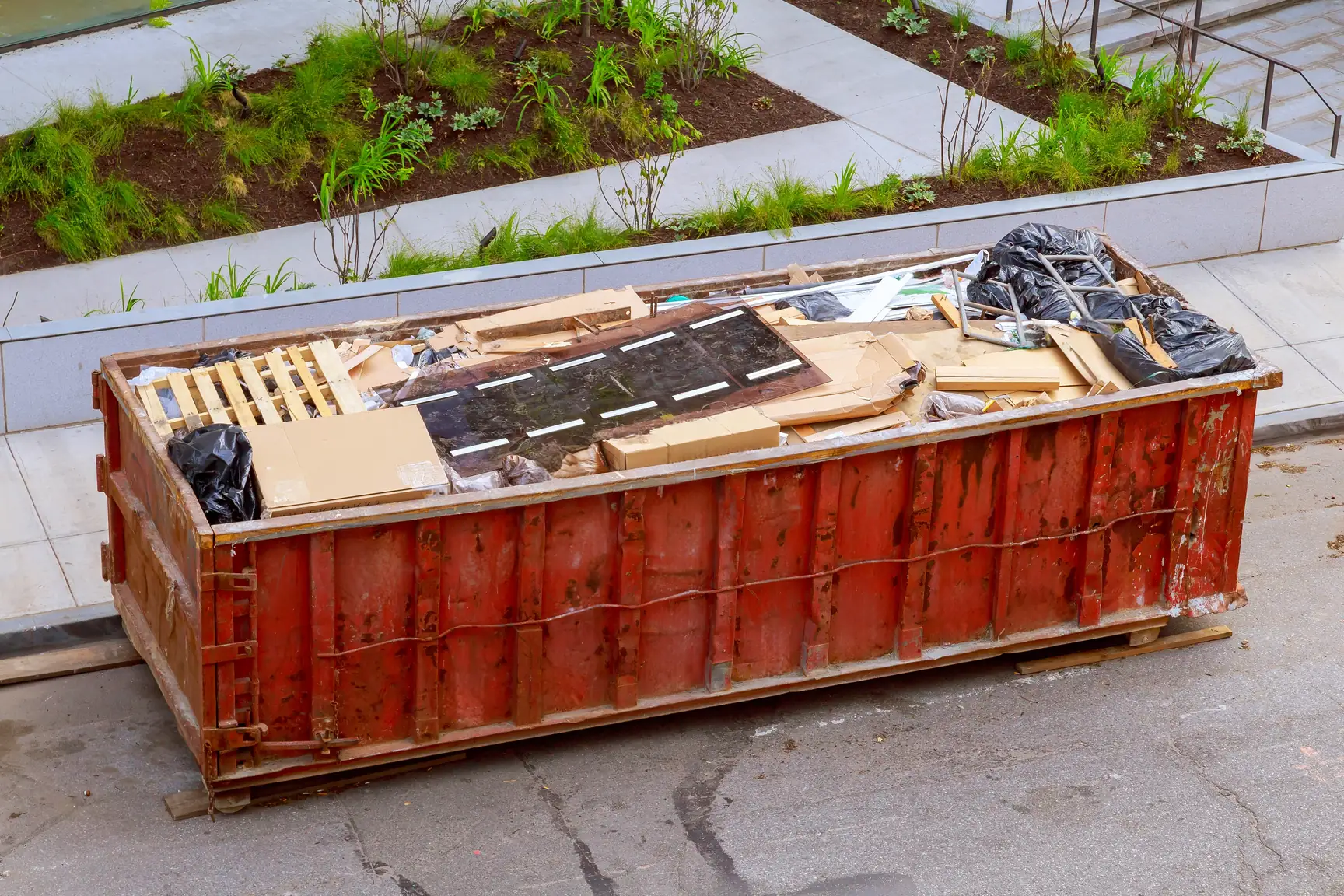
What a Maryland container drop asks of two different policies
Maryland does not license roll-off haulers at state level. Hauler licensing is set by individual counties and municipalities, and Maryland counties are the operating governments for solid waste. This page takes the state layer first, then the county layer, then the workers compensation question, and it opens with the seam between the two liability policies that do the heavy lifting in this trade.
Both of those policies have something to say about a container coming off a truck, and the uninsured losses in this class tend to gather in the space between them. The general liability form treats loading or unloading as a term it defines for itself, and it generally excludes injury and damage arising out of the use of an auto — then says that use includes loading or unloading. The standard auto form never uses the phrase. It arrives at the same moment by another route, and the one that matters to a hoist operator turns on whether the device shifting the property is attached to the vehicle.
The second half of the seam is damage to what the customer already owns: the driveway that gives under a loaded can, the curb the wheels take on the way out, the surface a hoist scores. General liability forms typically carry exclusions for property in the insured’s care, custody or control and for that particular part of real property being worked on, and whether a placement loss lands inside or outside those exclusions depends on the exact wording and the exact facts. Nothing on a web page settles it. What this page can do is put the question in front of a Maryland owner early enough that it gets asked at quoting time.
Maryland regulations and licensing for a roll-off hauler
Three layers are live. Two transporter credentials in the Environment Article, neither of which reaches this waste stream; a body of intrastate safety and financial-responsibility regulation on the truck; and the county programs, where the licensing actually happens.
The two transporter credentials Maryland does run
Saying flatly that Maryland requires nothing would be false: it runs two, and naming them is how you know the negative was measured rather than assumed. The first reaches controlled hazardous substances:
“A person may not transport any controlled hazardous substance from any source in this State or to any controlled hazardous substance facility in this State unless: (1) The person holds a hauler certificate; and (2) A vehicle certificate has been issued for the transporting vehicle.”
Env. § 7-201(k) defines the hauler certificate as the Department’s permission for a person to be a controlled hazardous substance hauler. Nonhazardous construction and demolition debris and municipal solid waste are not controlled hazardous substances, so a roll-off operator carrying either is outside that section. The second credential reaches a different stream again:
“Beginning on July 1, 1992, each scrap tire hauler shall: (1) Be licensed by the Department to transport scrap tires from scrap tire collection facilities to scrap tire recyclers; (2) Apply for a scrap tire hauler’s license on a form provided by the Department”
Env. § 9-201(h) fixes that class on a person who transports scrap tires as part of a commercial business. A roll-off box of mixed debris is not a scrap tire load. So: two statewide transporter credentials, and roll-off hauling of construction, demolition or municipal solid waste is in neither of them.
That is only half an answer, and stopping there would leave a Maryland owner with a dangerously comfortable impression. The Environment Article does not require counties to run a hauler program, and it does not delegate one to them — the county programs rest on county law. But they exist, as Montgomery County’s code shows. The state answer is a negative; the county answer is a separate question, and the county section further down this page is the one to read twice.
One section in the same article looks, from its heading alone, as though it permits refuse disposal generally, and an owner who reads only the heading will write a false sentence into their own compliance file. Env. § 9-204(a) scopes the section to water supply systems, sewerage systems, refuse disposal systems for public use and certain solid waste acceptance facilities, and § 9-204(d) carries the operative duty: a permit from the Secretary before a person installs, materially alters or materially extends one of those systems. It is a construction permit for a facility. It says nothing about a truck.
No Maryland operating authority, and two thresholds that are Maryland’s own
This is the finding rather than a gap in the research: Maryland issues no intrastate operating authority for a property carrier. What attaches intrastate is safety regulation and financial-responsibility regulation, adopted by the Motor Vehicle Administration jointly with the Department of State Police under Transp. § 25-111(f)(2)(i) and enforced through the Commercial Vehicle Enforcement Division. Md. Code, Transportation § 11-102 is where the Administration gets its name.
The first Maryland figure sits in the rulemaking power itself:
“the Administration may adopt regulations as are necessary for the safe operation of vehicles that: (i) Exceed a gross vehicle weight rating of 10,000 pounds”
Subsection (f)(2) then fixes the reach any such regulation must have. It must cover vehicles over that rating which the federal safety rules already govern, and it must also cover vehicles over it which those federal rules do not govern — but only where the Maryland regulation says in terms that it applies to them. Section 25-111(g) puts the duty on the carrier and the driver to comply whenever such a vehicle is on a Maryland highway, and § 25-111(k) directs the Administration to require physical examinations of intrastate commercial drivers. The second figure sits somewhere else and does a different job:
“shall apply to the following vehicles: (1) For–hire vehicles engaged in intrastate commerce that exceed a gross vehicle weight rating of 26,000 pounds and are designed to carry property”
A roll-off truck hauling a customer’s container for compensation is a for-hire vehicle designed to carry property, so that is the subsection which reaches it for financial-responsibility purposes. Both figures are Maryland’s own, set in Maryland’s own subsections. The substantive content they pull in is federal — the parts of 49 C.F.R. named at Transp. § 25-111(f)(2)(ii) and the Part 387 rules at § 25-111.1(a), administered by the FMCSA, which is a federal agency — and none of that federal material may be described as Maryland’s own rulemaking. Enforcement runs both on the highway and at your premises, where § 25-111(h)(2) reaches driver qualification files, hours-of-service records, drug and alcohol testing records and insurance records.
A fence worth stating plainly: this page cites the Maryland statute and says nothing about the content of any particular regulation adopted under it. No Maryland regulation was retrieved for this record, and a regulation is not a source for a live requirement until its own authority has been checked.
And then the name collision, which is the sharpest trap in the Maryland file. Maryland does issue something called a motor carrier permit. It comes from the Public Service Commission and it is not yours:
“Except as provided in subsection (b) of this section, a motor carrier permit is required for a passenger motor vehicle used in the transportation of persons for hire.”
Passengers. A sweep of the whole Public Utilities Article for household goods returns nothing, and every occurrence of motor carrier in that article sits in the passenger-side sections or their cross-references. An owner who finds the application form and files it will be wrong by an entire article of the Code.
The practical upshot for a Maryland roll-off operation is short, and it is worth writing down before anyone starts filling in forms. There is no state authority to apply for. What the state asks is that the trucks, the drivers and the records meet the intrastate standards above, and that a for-hire property vehicle over the § 25-111.1(b)(1) rating carries the financial responsibility that section requires. Everything else that looks like a license in Maryland is either somebody else’s waste stream or somebody else’s level of government.
The county layer is where a Maryland hauler is licensed
Maryland sets no statewide placement permit, no right-of-way obstruction permit for containers and no hauler license. Placement standards and hauler licensing belong to individual counties and municipalities and they differ from one to the next. In Maryland the layer is primarily a county layer rather than a city layer: Maryland counties are the operating governments for solid waste.
Montgomery County is recorded here as one county’s own code and nothing more:
“Solid waste must not be collected or transported in the County except by a licensed collector or hauler.”
Section 48-19(a)(3) puts the duty on the person. Nobody may run a solid waste collection or transport business there until the Director has issued them a license, and the renewal falls due before the current one lapses, on the final day of the preceding month. The two carve-outs at § 48-19(a)(2) are narrow and were read in full — someone moving their own waste to an approved acceptance facility in a closed or tightly covered vehicle, and an already-licensed collector moving waste sealed in boxes or bags on a similarly covered open flat-body truck. Neither reaches a contractor hauling a customer’s container for compensation. Section 48-19(c) lets the Director waive license conditions for an applicant working exclusively in solid waste excluding garbage, which is a waiver of conditions and not of the license.
Section 48-20 then registers the trucks. For each vehicle a licensee uses, the Director issues a registration card carrying the owner’s name, the vehicle description and serial number and a registration number, and with it a metal tag the county furnishes: it stays readily visible on that truck and does not move to another without the director’s prior written approval. Subsection (b) means no vehicle is registered until it has been inspected. If you are quoting a Maryland book of business, that inspection-and-tag cycle is a scheduling fact as much as a compliance one.
What is deliberately not here. What was retrieved and verified for Montgomery County is a licensing and vehicle-registration regime, not a container-placement or right-of-way regime. No Montgomery County placement standard was retrieved for this record, so this page states no Maryland placement example rather than inventing one from a neighboring county. Ask your own county before the first container goes down.
One further tension is recorded here rather than resolved, because both texts are live. Transp. § 25-101.1(b) bars a county or municipality from requiring registration or licensing of a vehicle or driver beyond what the Maryland Vehicle Law requires, and from making or enforcing rules on subjects that law covers. Read alone that looks as though it voids the county vehicle-tag regime. It does not follow, and this page does not say it does: the prohibition opens with a saving clause for any public general law whose scope this research did not settle, the bar runs to vehicle and driver registration rather than to a solid waste business license, and § 25-101.1(c) and (d) carry further exceptions that were read but not exhausted. This page describes the county license. It does not assert that Maryland preempts it, and it does not assert that the license survives preemption.
Securing workers compensation under Maryland law
Maryland workers compensation is compulsory, and the statute states it as a list of ways to comply rather than a list of ways out. Md. Code, Labor and Employment § 9-402(a) requires each employer to secure compensation for all covered employees by one of five routes: insurance with an authorized insurer; a governmental self-insurance group under § 9-404; a self-insurance group of private employers meeting Title 25, Subtitle 3 of the Insurance Article; individual self-insurance under § 9-405; or the arrangement the Education Article makes for county boards of education and private noncollegiate institutions.
For a private commercial employer only three of those are live: the ordinary insurance market, a private-employer self-insurance group, or individual self-insurance. The other two reach public and educational bodies. That shape — private placement with self-insurance alongside it, and no state fund in the list — is what a competitive state looks like read off its own statute. Maryland’s classification was re-derived here from § 9-402 rather than inherited from any list.
The opening words of § 9-402(a) make the section subject to subsections (b) through (f), and those four are worth knowing about so nobody mistakes them for an exemption. They reach jurors, officers and enlisted members of the organized militia of the State, recipients of public assistance who are covered employees, and volunteer fire and rescue members in three named counties. They do not remove coverage; they direct it to a particular insurer, and none of the four is a private commercial employer. No employee-count floor is recorded in this research and none is supplied here. The Maryland Workers’ Compensation Commission administers the system.
A panel for Maryland in rows. Each row sets one thing the state requires beside the exposure that requirement leaves open and the coverage line that answers it. Hauler registration: State transporter credentials exist, but none reaches roll-off hauling. It leaves open a container placed on a customer’s property, and the driveway or curb it damages, which General Liability and Dumpster and Equipment Coverage answer. Intrastate motor-carrier authority: State motor-carrier rules attach at a vehicle threshold. It leaves open the roll-off truck at fault, and the container in transit, which Commercial Auto and Pollution Liability answer. Roll-off placement permits: Municipal — varies by city and town. It leaves open placement on the public right-of-way, and a struck pedestrian or vehicle, which General Liability answers. Workers compensation: Compulsory; bought from private insurers. It leaves open a driver or yard hand hurt on the job, which Workers Compensation answers. Notes: A registration, permit or bond is a condition of operating, not insurance: it answers none of the exposures on the right, so no line is drawn from it. The conclusion reads: The registration is not the coverage — the program is. No figures are shown.
Six coverage lines against a Maryland roll-off book
What each line is asked to do in Maryland specifically.
- General Liability — the third-party half of the seam: someone hurt around a container, or property damaged by where it sat and how it arrived.
- Commercial Auto — the roll-off or hook-lift truck: driving it, hoisting with it, and the loading and unloading the auto form reaches by its own route. Transp. § 25-111.1 is the subsection that puts a financial- responsibility floor under an intrastate for-hire property vehicle above its stated rating.
- Dumpster and Equipment Coverage — inland marine on the containers, because the insured asset stands on somebody else’s ground. A Maryland fleet is also a fleet of individually registered and tagged vehicles in at least one county, which makes the schedule worth keeping accurate.
- Commercial Property — the yard, the office, the contents and whatever is stacked there overnight. Env. § 9-204 is the reminder that the moment a yard becomes a facility, a different body of Maryland law starts asking questions.
- Workers Compensation — driver and helper injury: the hoist, the tarp, the walk-around, the lift. Maryland’s route to it is the five-way securing section at L.E. § 9-402(a).
- Pollution Liability — what the load turns out to contain. Maryland’s hazardous-substance hauler certificate exists precisely because some loads are a different legal category, and the risk for a roll-off operator is finding that out at the scale rather than at the site.
For the whole class in one place, the Dumpster Rental Insurance hub covers it.
What goes wrong repeatedly on Maryland routes
Patterns, not statistics; no figure is attached to any of them because none was sourced. Placement damage is the first: a can set on a driveway never built for the loaded weight, a scored curb on a tight residential street, a surface gouged where the hoist bit. Those are the losses nearest the care, custody and control exclusions, which is why the seam opens this page.
Maryland geography writes its own second pattern. Long runs between the Eastern Shore and the western counties put more highway miles under a loaded truck than a compact route does, and a load that shifts or sheds over that distance is a highway incident before it is a claim. Older housing stock in the Baltimore corridor produces the third: rehabilitation and demolition loads that contain more than the customer described, and that get weighed and inspected somewhere other than the job.
Then the ordinary ones. Injuries cluster on the tarp, the walk-around and the moment someone handles a container that has not moved in a fortnight. A county compliance question — an untagged truck, a lapsed license, an inspection missed — turns into a commercial problem quickly, because the county that licensed you is also the county that can stop you.
One more that is specific to how this state is governed. Because the licensing sits with counties, a Maryland operator’s exposure is sensitive to paperwork moving out of step with the fleet: a truck added mid-season and never registered, a tag left on a vehicle that has been sold, a renewal that lapsed while the work carried on. None of that is an insured loss in itself. All of it is the kind of detail that turns an ordinary claim into a difficult one, and all of it is the kind of detail an underwriter would rather hear about from you than discover later.
Major Maryland roll-off markets
Five markets with the county each sits in. Nothing here carries a population figure, a permit count or a market-size estimate: this state’s research sourced none. They are geography and cross-link anchors, and nothing more than that.
Baltimore
Baltimore City. An independent city, and not part of Baltimore County — two separate jurisdictions that an outsider merges at their peril.
Silver Spring
Montgomery County. Sits in the county whose collector and hauler license is described further up this page.
Frederick
Frederick County. The anchor city of north-central Maryland, with the growth corridor running south from it.
Annapolis
Anne Arundel County. The state capital, on the Chesapeake, where waterfront and historic-district work sets its own constraints on where a container may stand.
Salisbury
Wicomico County. The anchor city of the Eastern Shore, which the Chesapeake separates from the rest of the state.
Nearby states we also write
Three of Maryland’s four state neighbors are linked below, all inside the licensed footprint. They do not agree with Maryland and they do not agree with each other: one of them operates a statewide waste-transporter authorization that does reach this trade, which is the opposite of the answer on this page. Nothing verified about Maryland travels across a state line, so read each state on its own page.
Maryland dumpster rental insurance FAQs
Is there a Maryland state license for hauling roll-off containers?
No. Maryland runs two transporter credentials in the Environment Article and neither reaches this trade: a hauler certificate for controlled hazardous substances under Env. § 7-249, and a scrap tire hauler license under Env. § 9-228(h). Nonhazardous construction debris and municipal solid waste are neither. Hauler licensing in Maryland is set by counties and municipalities, and Montgomery County’s collector and hauler license is the example described on this page.
If the state does not license me, does that mean nobody does?
It does not. Maryland counties are the operating governments for solid waste, and hauler licensing is set by individual counties and municipalities. Montgomery County is the example described on this page. Start with the county your containers sit in, not with the state.
Does Maryland issue an intrastate operating authority for my trucks?
Not for a property carrier. What attaches intrastate is safety regulation and financial-responsibility regulation under Md. Code, Transportation § 25-111 and § 25-111.1, formulated by the Motor Vehicle Administration jointly with the Department of State Police. There is no Maryland certificate or permit to carry solid waste for hire.
I found a Maryland motor carrier permit application. Do I need one?
Almost certainly not. That permit comes from the Public Service Commission and Pub. Util. § 9-201(a) ties it to a passenger vehicle carrying persons for hire. A property carrier of solid waste holds no Maryland motor carrier permit and no Maryland operating authority of any kind.
Which Maryland weight figure applies to my roll-off truck?
Two figures do two jobs and each is bound to its own subsection. Transp. § 25-111(f)(1)(i) sets the gross vehicle weight rating above which the Administration may adopt safety regulations. Transp. § 25-111.1(b)(1) sets the higher gross vehicle weight rating at which the financial-responsibility rules reach for-hire intrastate vehicles designed to carry property, which is the subsection that speaks to a roll-off truck.
What does Montgomery County want before I collect there?
Montgomery County Code § 48-19(a)(3) makes the Director’s license a precondition of running a solid waste collection or transport business there, and renewal falls due on the final day of the month preceding expiry. Section 48-20 then registers each vehicle, issues a card and a metal tag that stays visible and does not move between trucks, and requires inspection before registration. Other Maryland counties write their own rules.
How does a Maryland employer secure workers compensation?
Md. Code, Labor and Employment § 9-402(a) lists five ways an employer may secure compensation for covered employees. For a private commercial employer the live ones are insurance with an authorized insurer, a self-insurance group of private employers under the Insurance Article, or individual self-insurance. It is compulsory, and the list is a list of routes rather than of exemptions.
This page reports Maryland law as our own state research file records it. It is general information rather than legal advice, and it is not an opinion on what any policy covers — the wording you hold controls that, and carriers do not all write it the same way.
Tell us which Maryland counties you work
That is the first question here, and it is the one that shapes everything after it: which counties, what the trucks are, who is on them, and which licenses and vehicle tags you already hold. We will read the policy wording against the work and say plainly where an answer belongs to a county rather than to the state.
Related coverage for dumpster rental operators
- General Liabilitygeneral liability
- Commercial Autocommercial auto
- Dumpster and Equipment Coverageinland marine
- Commercial Propertycommercial property
- Workers Compensationworkers compensation
- Pollution Liabilityenvironmental / pollution liability
What it costs in Maryland · States we serve · Dumpster Rental Insurance · Get a quote · Contact us
Primary sources
- Maryland General Assembly — Environment Article — the article carrying both transporter credentials Maryland does run, at Env. § 7-249 and Env. § 9-228(h)
- Maryland General Assembly — Transportation Article — the safety and financial-responsibility sections at Transp. § 25-111 and § 25-111.1
- Montgomery County — hauler and collector licensing — the county example described on this page, which is one county’s program and not a Maryland rule
- Maryland Insurance Administration — the state regulator for the insurers writing these policies