
Dumpster Rental Insurance by State
Dumpster Rental Insurance in New York
New York registers a roll-off operator directly: a waste transporter registration issued by the state, with triggers measured in cubic yards and pounds. Here is that layer, the operating-authority question underneath it, and the city rules stacked on top.
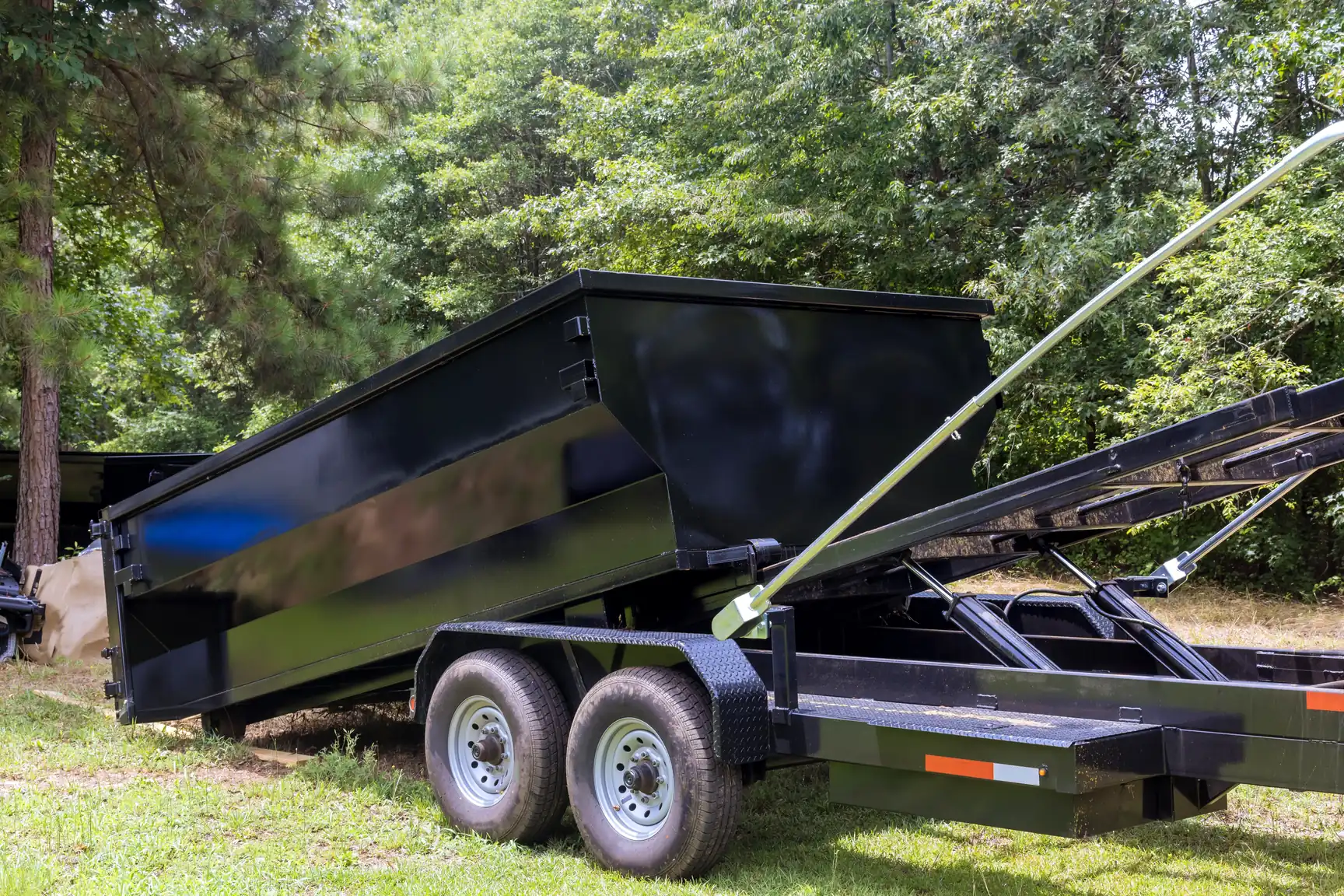
Short answer: most container operations here need a state-issued waste transporter registration and carry marking and recordkeeping duties with it, may or may not need intrastate operating authority depending on an exemption list nobody has settled for this trade, and meet a separate municipal regime the moment the work is in New York City.
The joint between your auto policy and your liability policy
Two policies sit on either side of the instant a container touches the ground, and the losses that go uninsured in this trade sit in the joint between them. Loading or unloading means what the general liability form says it means: it is that form’s own defined term. The form generally excludes injury and damage arising out of the use of an auto, and then says that use covers loading or unloading. Look for those words in the standard auto form and they are not there at all. It comes at the same instant from another direction, and the direction that decides it for a roll-off truck turns on whether the device moving the property is attached to the vehicle. Both forms were drafted to meet. Where they meet is seldom where an operator expects.
The other half of the seam is damage to the customer’s own property — a driveway split, a curb scored, a parking surface gouged, and in this state the city sidewalk and the protected street surface, because New York City writes rules about exactly that. Two liability exclusions bear on a loss like that: property in the insured’s care, custody or control, and that particular part of real property being worked on. Which side of them a placement loss falls on is answered by the exact wording and the exact facts, and not by us on a web page. We show a New York operator where the seam runs, so it gets asked about while the quote is being built rather than after a stoop has cracked. Your own policy wording is what controls, and forms differ between carriers.
New York registers waste transporters directly
The Part 364 registration, issued by the state
The credential is issued by the state — by the environmental agency’s waste management division, under Part 364. Two paragraphs of the registration subpart describe this trade. The first is the C&D trigger:
“A transporter of C&D debris in quantities greater than 10 cubic yards in a single shipment, except that Fill Type 1, Fill Type 2 and Fill Type 3 only require transport by a transporter registered under this Part if they are transported in the New York City Metropolitan Area Waste Impact Zone.”
The second catches the rest of a commercial route:
“A transporter of commercial waste, other than C&D debris, in quantities greater than 2,000 pounds in a single shipment.”
And a third provision turns those descriptions into an obligation: unless Part 364 or Part 360 exempts them, a person identified in section 364-3.1 may not move waste at all without holding a registration issued under the Part (6 NYCRR 364-3.2(b)).
Registration, not permit. The Part contains both instruments, and the permit subpart reaches transporters other than those exempt or subject to the registration provisions — so being inside the registration section is what keeps this operator out of it.
Why the waste is regulated at all comes down to two definitions. One covers waste from commercial operations such as stores, offices, restaurants, etc. The other is the one to read twice:
“construction and demolition (C&D) debris generated or transported by an industrial or commercial business, including excavated material”
Generated or transported. A commercial hauler moving the debris is enough to bring it inside the definition, whoever created it. An operator who assumes the customer’s status controls has read the wrong half of the sentence.
There are real exemptions, and two of them carry qualifiers that decide everything. Concrete, asphalt, brick and rock are exempt under 364-2.1(b)(13) — except when the material moves inside the downstate waste impact zone, where the Part applies again. And 364-2.1(b)(7) exempts C&D debris on its way out of a C&D handling and recovery facility: leaving a facility, not leaving a job site. Residential and institutional waste is separately exempt subject to named carve-outs and provided no other regulated waste is intermixed, as is waste moved wholly on-site or across private parcels without touching a public way.
Two things this page will not tell you, because the record does not support telling you. What the quantity exemption at 364-2.1(b)(6)(i) means is one: read as exceptions to an exemption it points the opposite way from the registration trigger. We use 364-3.1(d), which is unambiguous and which the agency’s own registration application follows. The household case is the other — a container dropped at a home for a renovation produces C&D debris transported by a commercial business out of a residence, and which description controls was not resolved by anything we read.
What does come with the registration is concrete. Carry it in the vehicle and produce it on request to agency representatives or any law enforcement officer. Mark the trucks: each transport vehicle must display the registered transporter’s name on both sides, and the transporter’s registration number on both sides and on the rear, with the lettering standing at least three inches high in a color that contrasts against the vehicle’s background (6 NYCRR 364-3.3(b)). Contain the waste so nothing discharges, deliver only to authorized receiving facilities, keep records of every regulated shipment for not less than three years, and file an annual report covering the previous calendar year by March 1st (6 NYCRR 364-5.2(c)(1)).
The registration is valid for one year from its effective date, is not transferable, and a change of ownership invalidates it — which makes it a due-diligence item in any sale of a container business.
One duty is narrower than the agency’s summary pages suggest. The waste tracking document reaches a transporter only where the C&D debris was itself generated inside the zone the rules call the New York City Metropolitan Area Waste Impact Zone (6 NYCRR 364-5.1(a)(2)), and that zone is defined:
“New York City Metropolitan Area Waste Impact Zone means the area encompassing the City of New York and the counties of Nassau, Suffolk, Putnam and Westchester.”
It is not a statewide construction and demolition duty. An operator working out of Buffalo is reading a different rule than one working out of Queens.
Intrastate operating authority, and the exemption list that decides it
New York runs an intrastate operating-authority regime for property carriage through the state transportation department, and the striking thing is what the statute does not contain. Nobody may engage in intrastate transportation of property by motor vehicle on any highway in the state as a common carrier — nor hold themselves out to provide it, by advertising or by any other means — unless a certificate issued by the commissioner is in force; and the same is written again for a contract carrier, with a permit in place of the certificate (New York Transportation Law § 172(1)–(2)).
No gross vehicle weight rating, no gross combination weight rating, no tonnage. What decides the question in New York is not how heavy the truck is but what is carried, how it is unloaded and how far it goes — and all of that lives in the exemption list at § 171, which removes thirteen classes of transportation from the article entirely. Three of them stand between a roll-off operator and the certificate requirement. The first is the one that looks decisive:
“The transportation of sand, gravel, dirt, debris, road materials, ready-mixed concrete and similar commodities when transported in dump trucks and when unloaded by being dumped.”
The word debris is squarely this operator’s cargo. But the exemption is doubly conditioned — on the equipment, in dump trucks, and on the method, unloaded by being dumped. A roll-off container is set down on the customer’s ground and winched back on. Whether that is a dump truck unloading by being dumped is not answered by anything we retrieved, and it decides whether the article applies at all. The second exemption is geographic: transportation of property wholly within a municipality, between contiguous municipalities, or within a commercial zone the commissioner defines, is removed from the article — except where the movement forms part of a continuous carriage or shipment, under common control, management or arrangement, running to or from a point beyond that municipality, those municipalities or that commercial zone (New York Transportation Law § 171(3)).
A container business that drops and pulls inside one town, or between two touching towns, is outside the article on the face of the statute. The third removes private carriage incidental to a primary business other than transportation, which is not a for-hire hauler and is noted here only so it is not misread as one. The article separately carves household goods common carriers into a different article; a roll-off operator is not a household goods carrier.
We are not going to tell you that you need intrastate property authority, and we are not going to tell you that you do not.
The safety and identification layer is a separate question with an actual number. The state’s safety part defines a commercial motor vehicle as one that
“has a gross vehicle weight rating or gross combination weight rating, or gross vehicle weight or gross combination weight of 4,537 kg (10,001 lbs.) or more, whichever is greater”
That figure is federal in origin — the part adopts the federal motor carrier regulations by reference and then defines the commerce they reach as commerce within New York State — and it is in force here for intrastate operation. It is not an independently set New York number and it has nothing to do with the operating-authority question, which has no number at all. The department states the practical consequence plainly: the regulations require a USDOT number to be displayed whether the carrier operates wholly within New York or across state lines (NYSDOT, Registration & Licensing, motor carrier).
For a carrier inside the article, the department states the rest of the package: liability insurance evidence filed by the insurer, proof of New York workers compensation and disability benefits insurance before authority issues, a federal carrier number for every applicant, and an annually renewed intrastate vehicle identification receipt carried in each vehicle. It also notes, without elaborating, that a vehicle working in New York City picks up further marking requirements.
The city layer, and why New York City is not New York
New York sets no statewide roll-off placement permit and no statewide right-of-way permit. Placement on a street or a sidewalk, and the licensing of the waste business itself at the local level, are municipal and they differ. The state says so itself: the environmental agency’s own transporter page tells a hauler working in the New York City area to contact the city’s trade waste regulator because it may have additional requirements to operate in New York City, and a hauler working in Westchester County to contact the county commission because it has additional requirements to operate in Westchester County. We did not retrieve the Westchester regime and will not describe what it requires.
The city, then, as one example and never as a picture of the state. New York City licenses the business: it is unlawful to operate, engage in, conduct or cause the operation of a business that collects trade waste at a commercial establishment which section 16-116 of the code requires to provide for the removal of that waste, or that removes or disposes of trade waste from those premises, without having first obtained a license from the commission under that chapter (New York City Administrative Code § 16-505(a)).
There is a construction and demolition carve-out, and this is the part that catches people: it is not self-executing.
“Notwithstanding the provisions of this subdivision, a business solely engaged in the removal of waste materials resulting from building demolition, construction, alteration or excavation shall be exempt from the licensing provisions of this subdivision where... no principal of such applicant is a principal of a business or a former business required to be licensed pursuant to this chapter...”
The same subdivision then says the exemption is granted by the commission on its review of an exemption application, in the prescribed form, accompanied by a statement describing the business and listing all of its principals. So it is something you apply for and are granted, it turns on the word solely, and it turns on who your principals are. The sentence a great many operators have been told — that construction and demolition haulers are simply exempt in New York City — is false. The code separately makes it unlawful to remove your own business’s trade waste, or to act as a trade waste broker, without registering with the commission.
The street layer is a different rulebook again. The city’s construction rules require a permit for placing construction material on the street during working hours and for storing it on the street outside them, and while a debris container is not named in that list the rules regulate containers on the street in terms: the street has to be protected with proper covering — planking, skids, plating, pneumatic tires — to prevent damage before construction material or equipment, containers included, is placed on it, and that protection goes directly under each steel wheel or roller of the container so the weight is adequately distributed (34 RCNY § 2-05(d)(2)).
Sidewalks have to stay clear for pedestrians and the curbline clear for drainage, permits have to be on the job site for inspection, and material and equipment may not sit within fifteen feet of hydrants or water sampling stations, within the corner quadrant the rule defines, or in any no-standing zone. Read that street-protection requirement as an insurance fact as much as a compliance one: it describes exactly the loss your general liability policy will be asked about when a sidewalk vault fails under a loaded box.
All of the above is one city. It establishes that the local layer exists and can be heavy. It establishes nothing about Buffalo, Rochester, Syracuse, Albany, Yonkers or any town in the state, and it should never be read as in New York you need.
Securing workers compensation, and where it shows up in New York
New York is a competitive state that also runs a state fund, and the statute frames the duty as one of securing rather than buying. An employer secures compensation to its employees in one or more of three ways: by insuring and keeping insured the payment of that compensation in the state fund; by insuring and keeping insured that payment with any stock corporation, mutual corporation or reciprocal carrier the state has cleared to write workers compensation business here, through a policy issued under the law of the state; or by furnishing the chair satisfactory proof of financial ability to pay the compensation itself (New York Workers’ Compensation Law § 50).
Three routes, two of them market routes, and the private route is open to any authorized insurer. All three secure the obligation; none releases anybody from it. The honest limit on that statement: the retrieval behind this page covered the securing section and no coverage-scope or exemptions section, so this page affirms that no exemption reaching a roll-off operator was found, not that the law contains none.
What makes this axis unusually live in New York is where the coverage question shows up. It is wired into the waste authorization itself — the state environmental agency states on its own transporter page that every new and renewed waste transporter permit has to be accompanied by proof of workers compensation insurance (NYSDEC, Waste Transporters), and the transportation department requires proof of New York workers compensation and disability benefits insurance before intrastate operating authority issues. Elsewhere a lapse in this line is a workers compensation problem. Here it is potentially an authorization problem too, which moves the renewal date to the dispatcher’s calendar.
A panel for New York in rows. Each row sets one thing the state requires beside the exposure that requirement leaves open and the coverage line that answers it. Hauler registration: A hauler credential, issued by the state. It leaves open a container placed on a customer’s property, and the driveway or curb it damages, which General Liability and Dumpster and Equipment Coverage answer. Intrastate motor-carrier authority: Not verified at the state level. No connector is drawn for this row. Roll-off placement permits: Municipal — varies by city and town. It leaves open placement on the public right-of-way, and a struck pedestrian or vehicle, which General Liability answers. Workers compensation: Compulsory; private insurers, or a competing state fund. It leaves open a driver or yard hand hurt on the job, which Workers Compensation answers. Notes: A registration, permit or bond is a condition of operating, not insurance: it answers none of the exposures on the right, so no line is drawn from it. Intrastate motor-carrier authority is not verified at the state level for this operator, so no line is drawn from it. The conclusion reads: The registration is not the coverage — the program is. No figures are shown.
Six coverages against a New York container operation
Six lines carry this trade. Here is the New York-shaped reason each exists.
For the whole program, start at the Dumpster Rental Insurance page.
How these accounts actually get hurt
Patterns rather than numbers. We have no sourced New York loss data and will not invent any.
The surface under the container. A driveway that splits, a sidewalk flag that cracks, a stoop or a vault that fails under a loaded box. The city writes a rule about protecting the street before the container goes down.
The box off the hoist. A container swings or drops onto a parked car, a railing, a utility box. Whether that is an auto loss or a liability loss is a wording question, and the answers are not uniform.
Paperwork that is really an operating license. A registration that lapses, a marking that does not match the registered name, an annual report missed. Those are authorization events here, not clerical ones.
The load that is not what the ticket says. Paint, solvent, a sealed drum, a tire. Part 364 puts the delivery duty on the transporter, so it surfaces at the receiving facility with the material still yours.
The routine crew injury. The tarp, the walk-around, the lift. In New York this is the claim whose coverage proof your transporter renewal depends on.
New York markets — boroughs in the city, counties everywhere else
We write dumpster rental and roll-off operations across New York. A reader in the city locates by borough and a reader upstate locates by county, so the list names both rather than forcing one label onto a state that does not use one.
No population, permit-volume or market-size figure appears above, and none is recorded for these markets. Where a county is named as sitting inside the waste impact zone, that is a cross-reference to the registration rules and nothing else.
Nearby states we also write
New York borders five states and all of them are inside our license. If a route crosses a line, read that state’s own page. Nothing established above about Part 364 carries across a state boundary.
What New York operators ask — FAQ
Do I need a New York state credential to haul roll-off containers?
Very likely yes, and the correct instrument is a registration rather than a permit. State law requires it and it is issued by the state, through the environmental agency’s waste management division. Two triggers reach this trade: a construction and demolition debris load above 10 cubic yards moved in one shipment, and a load of commercial waste that is not C&D debris weighing over 2,000 pounds in one shipment. The rule then makes it a prohibition — a person inside that section must not transport waste without a registration issued under the Part.
Why does everyone call it a permit?
Because Part 364 contains both, and the wrong half is the famous one. The Part splits into registrations and permits, and the permit subpart reaches transporters who are not otherwise exempt or subject to the registration provisions. Being inside the registration section is exactly what keeps an ordinary roll-off operator out of the permit subpart. Calling it a permit on a certificate or in an application is a real-world source of delay.
My customer generated the debris, not me. Does that get me out of it?
No. The definition of regulated waste catches construction and demolition debris generated or transported by an industrial or commercial business. The words generated or transported are doing the work: you being a commercial business is enough to bring the debris inside the definition, whoever generated it.
What about a small clean-out at a house?
That is genuinely unsettled and we are not going to pretend otherwise. Residential and institutional waste is exempt under its own paragraph, while C&D debris transported by a commercial business is regulated under another. A roll-off dropped at a home for a renovation sits in both descriptions at once, and nothing we retrieved resolves which controls. Ask the agency about your own pattern of work rather than taking an answer from a web page — this one included.
What comes with the registration once I have it?
Carry it in the vehicle and produce it on request to agency representatives or any law enforcement officer, or produce a justification that none is needed. Mark every transport vehicle with your registered name on both sides and your registration number on both sides and the rear, in letters and numbers of a set minimum height and a contrasting color. Contain the waste so nothing discharges. Deliver only to authorized receiving facilities. Keep records of every regulated shipment for at least three years, and file an annual report with the agency by the deadline the rule sets. The registration runs a year from its effective date, is not transferable, and a change of ownership invalidates it.
Do I have to use a waste tracking document?
Narrower than the agency’s summary pages suggest. The tracking-document rule reaches C&D debris only where the material was generated inside the New York City Metropolitan Area Waste Impact Zone, which the regulations define as New York City plus Nassau, Suffolk, Putnam and Westchester counties. It is not a statewide C&D duty, and an operator working out of Buffalo or Syracuse is reading a different rule than an operator working out of Queens.
Do I need intrastate operating authority from the transportation department?
We will not answer that for you, and any page that does should be treated with suspicion. New York has such a regime, its certificate requirement carries no weight threshold at all, and its exemption list is where the question is actually decided. Three exemptions stand in the way: one for dump trucks unloading by being dumped, whose application to a container set down and winched back on is not settled; one for transportation wholly within a municipality or between contiguous municipalities; and one for private carriage, which is not you. Which side of those a given operation falls on is a question for the department.
Does a New York City address change what I need?
It adds a layer rather than replacing one. The city licenses trade waste collection, and the carve-out for construction and demolition work is not self-executing — it turns on the word solely, it turns on who your principals are, and it is a thing you apply for and are granted on review of an exemption application. Separately, the city’s street rules govern what happens when a container is placed on the street, including the requirement to protect the street surface under the container before it is set down. Nothing in that describes Buffalo, Rochester, Syracuse or Albany.
This page reports New York law as our own state research file records it. It is general information rather than legal advice, and it is not an opinion on what any policy covers — the wording you hold controls that, and carriers do not all write it the same way.
Open a New York file
Send the truck list, the container count, the counties and boroughs you work, your Part 364 registration status and your current declarations. We will read the seam between your auto and liability forms first, and we will line your workers compensation renewal up against your transporter renewal so the two do not collide.
Related coverage for dumpster rental operators
- General Liabilitygeneral liability
- Commercial Autocommercial auto
- Dumpster and Equipment Coverageinland marine
- Commercial Propertycommercial property
- Workers Compensationworkers compensation
- Pollution Liabilityenvironmental / pollution liability
What it costs in New York · States we serve · Dumpster Rental Insurance · Get a quote · Contact us
Primary sources
- NYSDEC — Waste Transporters — the state agency’s own waste transporter page, including the statement that proof of workers compensation insurance is submitted with new and renewed transporter authorizations
- New York Transportation Law § 172 — intrastate property authority — the certificate and permit requirements, neither of which carries a weight threshold
- New York Transportation Law § 171 — exemptions from Article 8 — the thirteen classes removed from the article, including the dump-truck and single-municipality exemptions
- New York Workers’ Compensation Law § 50 — the three ways an employer may secure compensation, including the state fund
- New York State Department of Financial Services — the state insurance regulator