
Dumpster Rental Insurance by State
Dumpster Rental Insurance in Connecticut
Connecticut is not a check-your-town state and it is not a one-rule state. It is both at once: a compulsory registration in every town you haul from, and whatever that town then asks on top.
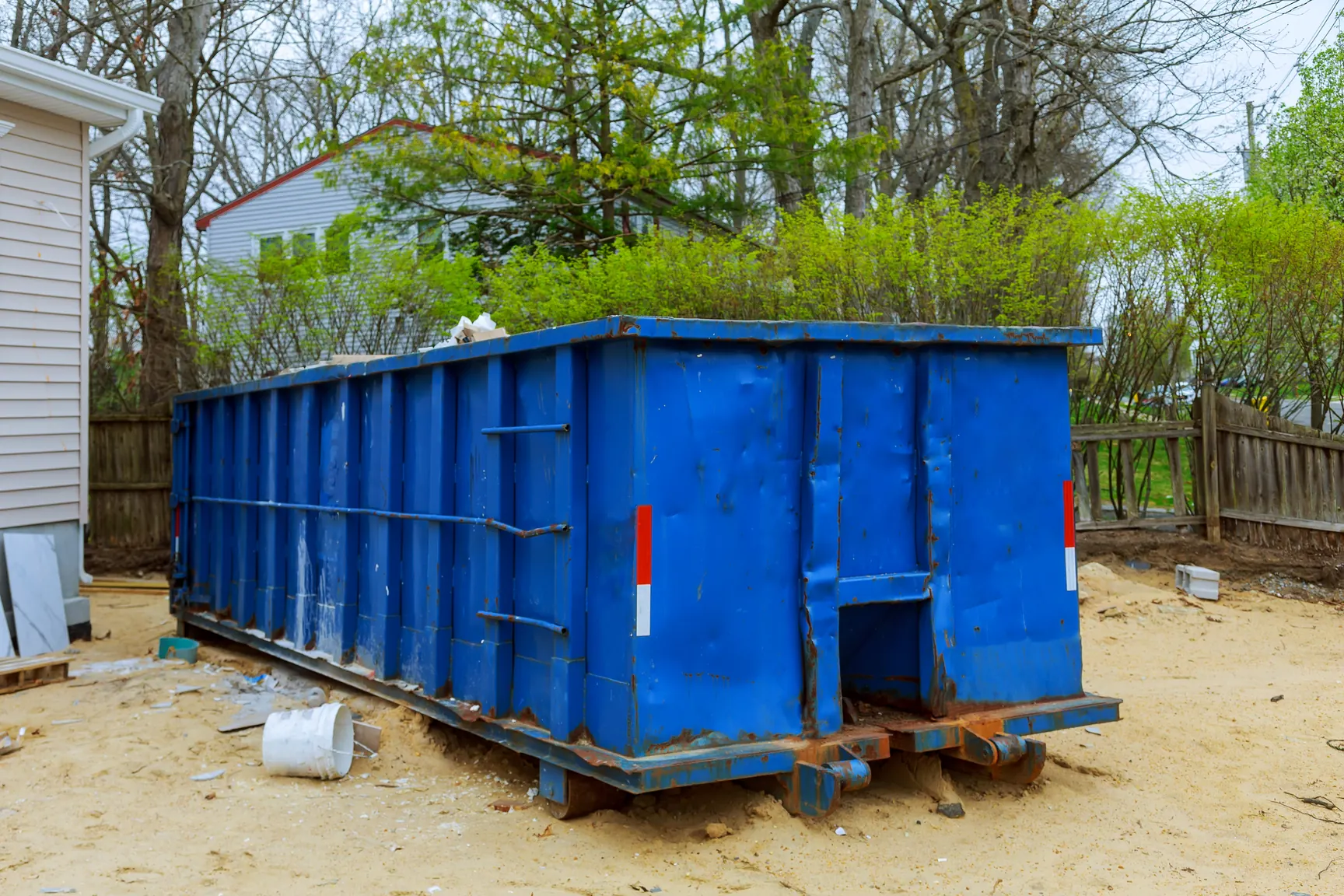
The Connecticut seam: loading, unloading and the customer driveway
A Connecticut route is short and dense. A collector can set a box in one town before eight, pull one in the next town by ten, and be back at the transfer station before noon. That density is the business case.
The everyday version of the split is straightforward. The auto policy answers for the truck: the drive, the hoist, and property moving on or off the bed. The liability policy answers for the container after the cable goes slack, for the ground beneath it, and for whatever happens around it while it stands. What neither description covers cleanly is the interval in which the box is half on the truck and half on the customer’s surface.
That interval is where the two wordings were drafted to meet. The liability form treats loading and unloading as an identified activity, steps back from injury and damage arising out of the use of an auto, and then folds loading and unloading into what using an auto means. The auto form does not use those two words at all; it arrives at the same instant by a different route. The question that matters here is whether the machine doing the moving was attached to the truck. A hoist and cable are. A telehandler the site crew brought over is not.
The second half of the seam is about the surface rather than about a person. New England drives take a frost cycle every winter, and a lot of the older stock in the Naugatuck Valley and around the city centers is asphalt over a base that has already moved once. A loaded container puts its whole mass on four small pads. Cracked apron, a settled corner, a broken drain cover, turf pressed into ruts by the tires. Liability wordings normally exclude two things that matter right here: property in the insured’s care, custody or control, and the particular part of real property under work. A placement loss can land either side of those exclusions. Which side depends on the wording you hold and on the facts of that one drop.
We are not going to settle that for you in a paragraph, and anyone who offers to should be treated with suspicion. What we can do is name the seam while the program is still being designed, so the question is put to an underwriter rather than to an adjuster. In Connecticut the same habit pays off on the regulatory side, because the state and the town are asking for two different things and the difference is easy to miss.
Connecticut regulations and licensing, town by town
Connecticut sits in an unusual position among the states we write. There is a genuine statewide mandate, so an operator cannot treat registration as optional anywhere. But the thing the mandate creates is filed with a municipality: Connecticut law makes a solid waste collector register, and the filing goes to each city or town where the waste was generated rather than to any state agency at all. Each of those towns is then free to build a scheme of its own on top.
Registering as a solid waste collector in Connecticut
The operative subsection is cast in the mandatory, and it names what you have to tell the town when you file.
“Any collector hauling solid waste generated by residential, business, commercial or other establishments, including, but not limited to, recyclables generated within the borders of a municipality, shall register annually in such municipality and disclose:”
The six disclosures that follow are ordinary business facts, and worth having ready before you start: who the collector and the owning company are and where they are; every other municipality you haul in; whether the work is residential, commercial or something else; which types of waste you carry; where recyclable material is expected to end up; and anything further the town asks for to protect the health and safety of its residents.
Three links have to hold before that duty reaches a roll-off business, and all three do. The load is solid waste: CGS § 22a-207(3) puts demolition debris on the face of the definition, alongside unwanted or discarded material generally. The operator is a collector:
“‘collector’ means any person who holds himself out for hire regularly to collect solid waste from residential, business, commercial or other establishments.”
And the filing goes where the waste came from — which is why a five-town service map is a five-registration obligation. The two carve-outs in that same subsection prove the point by describing somebody else: (g)(1) reaches a person whose own unrelated trade generated the material, hauling it themselves to an authorized or permitted facility, and every condition in it fails for a company whose trade is collection; (g)(2) reaches a person taking used household goods to a charity or a reuse retailer.
One reading trap is worth naming because it inverts the answer. CGS § 22a-220a opens, at subsection (a), with a permissive sentence about a municipality designating where waste may be disposed. An operator who stops there will conclude that the whole section is optional and that Connecticut leaves hauler registration to local choice. It does not. Subsection (d)(1) is mandatory and is not conditioned on the town having designated anything, adopted an ordinance, or acted at all. The permissive verb and the mandatory verb sit four subsections apart in one section.
Two more duties attach with no credential of their own. One is on the truck itself.
“The door of any private vehicle used to haul solid waste shall be clearly marked with the business name and address of the hauler”
The other is paperwork: CGS § 22a-220a(d)(2) requires an annual report to the municipality, due on or before July thirty-first, using whatever form the Commissioner of Energy and Environmental Protection has prescribed, and covering what you collected, where it first went in the prior state fiscal year, and what left the state or reached an in-state end user or manufacturer. Where a collector both picks up from a non-permitted in-state source and delivers to a non-permitted destination, CGS § 22a-220a(j) sends a report straight to the commissioner. And CGS § 22a-208c binds the hauler to lawful destinations without issuing anything at all.
Connecticut’s environmental agency does issue state transporter permits, and they are a different universe. Under CGS § 22a-454(a) they reach hazardous waste and the state’s own regulated waste class, with subsection (c) adding a permit for transferring hazardous waste between vehicles or modes; biomedical waste transporters and spill cleanup contractors have their own permitted lists. None of them reaches nonhazardous construction debris or ordinary household and commercial refuse.
Connecticut motor-carrier filings and the state’s own intrastate weight line
The transport side of Connecticut is a safety-and-security overlay on ordinary commercial registration rather than a separate permission to operate. The reach of the delegation is set by weight, and the intrastate figure is Connecticut’s own.
“is in intrastate commerce and has a gross vehicle weight rating or gross combination weight rating or gross vehicle weight or gross combination weight of eighteen thousand one or more pounds”
The ten thousand one figure in the next subdivision is the federal interstate line appearing in Connecticut law because the section incorporates federal parts by reference, and it is a federal number rather than a state one. Read the section carefully: it says the commissioner may adopt regulations and that they may be made applicable to the listed vehicles. The weights mark the outer edge of the delegated reach, not a command to a carrier. What commands a carrier is the regulation adopted under it, and CGS § 14-163d.
That section is where the annual work sits. CGS § 14-163d(a) requires each owner of a vehicle described at CGS § 14-163c(a) to file evidence of the security the law requires, in the form and on the schedule the Commissioner of Motor Vehicles prescribes. Subsection (b) allows electronic verification with a licensed insurer or a federal data source instead of a filing; subsection (c) measures that evidence against federal amounts; subsection (e) applies the requirement to for-hire and private property carriers by name and lets the commissioner attach it to an initial registration. The consequence of missing it is blunt.
“shall suspend the registration of each motor vehicle registered in the name of any owner who fails to file a motor carrier identification report or to provide satisfactory evidence of the security requirements imposed by law.”
Enforcement under CGS § 14-163c(d) lets a state or municipal police officer or a motor vehicle inspector examine the vehicle and the driver, enter premises to inspect and copy records, run a safety rating or compliance review under federal rules, order a carrier with an unsatisfactory rating to stop, place a vehicle or a driver out of service, or issue an infractions complaint. The federal carrier identification number is federal — the state motor vehicle agency publishes a route to that registration and administers the multistate registration program, but it does not issue the number.
What a Connecticut town adds on top
Placement standards, obstruction rules and set-out timing are purely municipal here. Connecticut sets none of them statewide. One city is offered below as an illustration of what a town can build on the statutory floor, cited to that city and generalized to no other Connecticut town, city or borough.
Hartford’s code is the clearest published example we found, partly because it names this operator’s equipment in terms — Hartford Municipal Code § 15-24(b) sets a fee discount for a vehicle or roll-off container garaged in the city. Under § 15-23(b) a solid waste collector applies annually, on or before the first of July, for a permit from the director of public works to engage in the business of refuse collection there. Section 15-23(d) then requires a separate permit for each vehicle used to move refuse in the city and for every permanent container above ten cubic yards, and forbids transferring a permit from one vehicle or container to another. Section 15-26 prohibits anybody unregistered, suspended or revoked from collecting, hauling, transporting or disposing of waste generated in the city. Section 15-23(g)(4) requires the cubic-yard capacity to be displayed on each body and an identifying number on each removable body, and repeats the state door-marking duty word for word; § 15-23(g)(6) wants the permit registration shown on the left windshield and on each container. Section 15-13(c) closes the set-out window: nothing to the curb before four in the afternoon on the day before collection.
The line that matters most to an insurance conversation is the condition of issue.
“No such permit shall be issued until the solid waste collector files with the city a certificate of liability insurance demonstrating coverage in the amount of one million dollars ($1,000,000.00) for property damage, one hundred thousand dollars ($100,000.00) per person and three hundred thousand dollars ($300,000.00) per occurrence for liability claims, together with such workers’ compensation insurance as provided by state law.”
Those three figures belong to that one city’s ordinance. They are not Connecticut limits, they are not a market standard, they are not our recommendation, and they are not a benchmark for any other town on this page or anywhere else in the state. We reproduce them because the figures only make sense attached to the city that wrote them. Note also what that drafting does — it states a property-damage amount above the per-person and per-occurrence liability amounts, which is an unusual ordering, and we offer no interpretation of it.
One unresolved point in that same code deserves flagging rather than smoothing over. Section 15-28(c) requires registered collection vehicles to be automatic unloading vehicles of watertight construction and completely enclosed, allowing an open top only below ten cubic yards and only if covered in motion — while § 15-23(d) charges for permanent containers above ten cubic yards and § 15-24(b) discounts roll-off containers garaged in the city. Our research does not resolve that tension and neither does this page: we do not tell you open-top boxes are prohibited there, and we do not tell you they are permitted. What we can say is that this city permits vehicles and containers separately and sets construction and covering rules on both, and that the enclosure question belongs to the city. Hartford Municipal Code § 15-30 confirms the general shape — that article runs in addition to the General Statutes rather than in place of them, so a collector owes the state registration and the local scheme together. Check the rules in every town you work.
Connecticut workers compensation and the routes an employer may take
Connecticut is a competitive workers compensation state, and CGS § 31-284(b) puts the duty on each employer while offering routes rather than releases. An employer that does not satisfy the chairperson of the Workers’ Compensation Commission as to its solvency and its financial ability to pay benefits directly has to insure its full liability one of three ways: by filing security with the Insurance Commissioner in a form acceptable to that officer, by buying from a stock or mutual company or association authorized to take such risks here, or by a combination of the two subject to the commissioner’s approval.
That is a competitive market described by its own structure. The default is a policy from an authorized private insurer, with self-insurance available on proof of solvency and a security-filing alternative running through the Insurance Commissioner. Self-insurance is a way of securing the obligation, never a release from it. The sanction is the loss of the protection an employer values most: where an employer has not complied, CGS § 31-284(b) allows an injured employee to sue for damages for a personal injury arising out of and in the course of employment, which is the exclusive-remedy shield in subsection (a) falling away. CGS § 31-286 lets an employer file a certificate of the Insurance Commissioner with the administrative law judge who has jurisdiction, and an employer that has insured its full liability files a certificate as CGS § 31-348 prescribes.
On exemptions our record is deliberately silent in both directions. Our research read the core sections and swept the chapter for any state fund and for a monopolistic arrangement, finding neither, against a large control count on self-insurance. It did not retrieve a Connecticut coverage-scope or exemptions section. So this page affirms that no exemption reaching a roll-off operator was found, and it does not affirm that the chapter contains none. Those are different statements and we will not collapse them.
A panel for Connecticut in rows. Each row sets one thing the state requires beside the exposure that requirement leaves open and the coverage line that answers it. Hauler registration: A hauler credential, issued by your city or town. It leaves open a container placed on a customer’s property, and the driveway or curb it damages, which General Liability and Dumpster and Equipment Coverage answer. Intrastate motor-carrier authority: State motor-carrier rules attach at a vehicle threshold. It leaves open the roll-off truck at fault, and the container in transit, which Commercial Auto and Pollution Liability answer. Roll-off placement permits: A statewide floor, then municipal rules that vary. It leaves open placement on the public right-of-way, and a struck pedestrian or vehicle, which General Liability answers. Workers compensation: Compulsory; bought from private insurers. It leaves open a driver or yard hand hurt on the job, which Workers Compensation answers. Notes: A registration, permit or bond is a condition of operating, not insurance: it answers none of the exposures on the right, so no line is drawn from it. The conclusion reads: The registration is not the coverage — the program is. No figures are shown.
The coverage stack for a Connecticut collector
Six lines, each with a Connecticut-specific reason to be there.
Common Connecticut roll-off claims by pattern
We publish no frequencies or severities for this state, because we have not measured them and a number invented to fill a page is worse than an honest gap. The shapes, though, are consistent.
First is surface damage at placement. The customer points at the driveway because the driveway is where a container fits, and the driveway is the least robust structure on a New England residential lot. Since the damage lands on exactly the surface the box was set on, it brings in the care, custody or control question and the part-being-worked-on question, and the outcome follows the wording rather than the blame.
Next comes damage during the movement: a cable that lets go, a box that walks on a sloped drive, a swing that catches a gatepost, a porch column or a parked car while the driver works a narrow street with cars on both sides. Everything in that group lands on the line between the two forms, and an adjuster starts from a narrow factual question: did the machinery that moved the container belong to the vehicle?
Third is third-party injury around a container in place — someone climbing in, someone pitching material over the rail, a child on a residential set, a lid or door moving in wind. Fourth is the contents problem: prohibited material found at the destination, or a demolition stream that turns out to hold something the facility will not take, which in this state also touches the question of whether the load has crossed into a class needing a state transporter permit. Fifth is driver and helper injury, which in this trade clusters around the tarp, the walk-around and the lift rather than around the drive itself.
Connecticut roll-off markets
Our Connecticut license reaches every town in the state. The five markets below are where our submissions concentrate, each one shown against its county purely as a map reference. No measure of size is attached to any of them: none was sourced, so none is published.
- Bridgeport — Fairfield County
- New Haven — New Haven County
- Stamford — Fairfield County
- Hartford — Hartford County
- Waterbury — New Haven County
Those county names are map labels and nothing more. Connecticut removed the government from its counties in 1960, and the towns, cities and boroughs are what govern. That is why nothing on this page sends you to a county office: your registration is filed with the municipality, and the permit scheme that may sit above it is the municipality’s too. One of the markets listed is also the city whose ordinance is quoted above, and those are two separate uses — being a market we write does not make that city’s figures anybody else’s figures.
Nearby states we also write
Connecticut has exactly three neighbors and all three are inside our license. All three have pages you can read today. Take nothing from this page across those lines: the neighboring shapes differ from Connecticut’s in the issuing body, the instrument and the statute, and each state’s own research governs its own facts.
Connecticut dumpster rental insurance FAQs
Does Connecticut make me register to haul roll-off containers?
Yes, and the duty is statewide. CGS § 22a-220a(d)(1) tells any collector who hauls solid waste from residential, business, commercial or other premises to register each year in that municipality and to disclose a defined list of facts about the business. The registration is filed with the town, not with a state agency, and the duty does not depend on the town having adopted anything of its own.
Am I a “collector” under Connecticut law if I only drop and pull boxes?
Almost certainly. CGS § 22a-220a(g) defines a collector by conduct — a person who regularly holds himself out for hire to collect waste of that kind from business, residential, commercial and other premises. A company advertising containers and pulling them on call is doing exactly that. The two carve-outs in that subsection describe your customer rather than you: one covers somebody hauling waste their own unrelated trade generated, and the other covers a person taking used household items to a charity or reuse retailer.
I work five Connecticut towns. How many registrations is that?
Five. The statute ties registration to the municipality where the waste is generated, and CGS § 22a-220a(d)(1)(B) assumes multi-town work by asking you to disclose the other municipalities you haul in. Plan the paperwork around your service map rather than around your yard.
Does the Connecticut environmental agency license waste transporters?
It does, but not for this waste stream. The state transporter permits under CGS § 22a-454 reach hazardous waste and Connecticut-Regulated waste, with separate permitted lists for biomedical waste transporters and spill cleanup contractors, and a further permit under subsection (c) for transferring hazardous waste between vehicles or modes. Ordinary construction debris and household or commercial refuse sit outside all of them. The state instruments that do touch solid waste, at CGS § 22a-208a and CGS § 22a-207b, permit facilities rather than haulers.
Is there a Connecticut weight threshold for motor-carrier rules?
Connecticut sets its own intrastate figure at CGS § 14-163c(a)(1), stated in the statute as eighteen thousand one or more pounds by weight rating or actual weight. The ten thousand one figure in the next subdivision is the federal interstate line restated in Connecticut law and should never be described as the state’s own. Note also that CGS § 14-163c is a delegation — it says the commissioner may adopt regulations and that they may be made applicable to those vehicles — so the duty a carrier actually feels comes from the regulations adopted under it and from CGS § 14-163d.
What does the Connecticut DMV actually require of me every year?
Evidence of security. CGS § 14-163d(a) requires each owner of a vehicle described in CGS § 14-163c(a) to file evidence of the security requirements imposed by law, at least once a year and in the form the Commissioner of Motor Vehicles prescribes. Subsection (b) lets the commissioner verify electronically with an insurer licensed here or through a federal data source and accept that instead of a filing, and subsection (c) reads that evidence against the federal amounts. Subsection (e) applies the filing to for-hire and private property carriers specifically.
What happens in Connecticut if I do not file?
The sanction lands on the registration itself rather than on an operating credential, because in this chapter Connecticut issues no separate state permission to a property carrier. After notice and hearing, CGS § 14-163d(d) directs the commissioner to suspend the registration of every vehicle registered in the name of an owner who has not filed a carrier identification report or satisfactory evidence of security. A first violation of the safety rules is an infraction under CGS § 14-163c(e)(1), with a civil penalty available for a repeat intrastate violation under (e)(2).
Can a Connecticut town require more than the state does?
Yes, and Hartford is the clearest published example: an annual permit from the director of public works, separate permits for each vehicle and for permanent containers above ten cubic yards, marking and display rules, a set-out window, and a certificate of liability insurance as a condition of issue. Those are that city’s rules and nobody else’s. Hartford Municipal Code § 15-30 says plainly that its article sits in addition to the General Statutes rather than in place of them, so a collector owes the state registration and the local scheme both.
This page reports Connecticut law as our own state research file records it. It is general information rather than legal advice, and it is not an opinion on what any policy covers — the wording you hold controls that, and carriers do not all write it the same way.
Quote a Connecticut collector operation
Tell us which towns you register in, how many containers you have out on an average week, what your boxes weigh loaded and where the material goes. If a municipal permit conditions issue on a certificate, tell us that too — we would rather build the program around it than discover it at renewal.
Related coverage for dumpster rental operators
- General Liabilitygeneral liability
- Commercial Autocommercial auto
- Dumpster and Equipment Coverageinland marine
- Commercial Propertycommercial property
- Workers Compensationworkers compensation
- Pollution Liabilityenvironmental / pollution liability
What it costs in Connecticut · States we serve · Dumpster Rental Insurance · Get a quote · Contact us
Primary sources
- Connecticut Insurance Department — the state insurance regulator