
Dumpster Rental Insurance by State
Dumpster Rental Insurance in Massachusetts
A permit your city or town issues, a carrier chapter that lets nonhazardous waste out and a safety rule that does not, and the hoist moment your policies argue about.
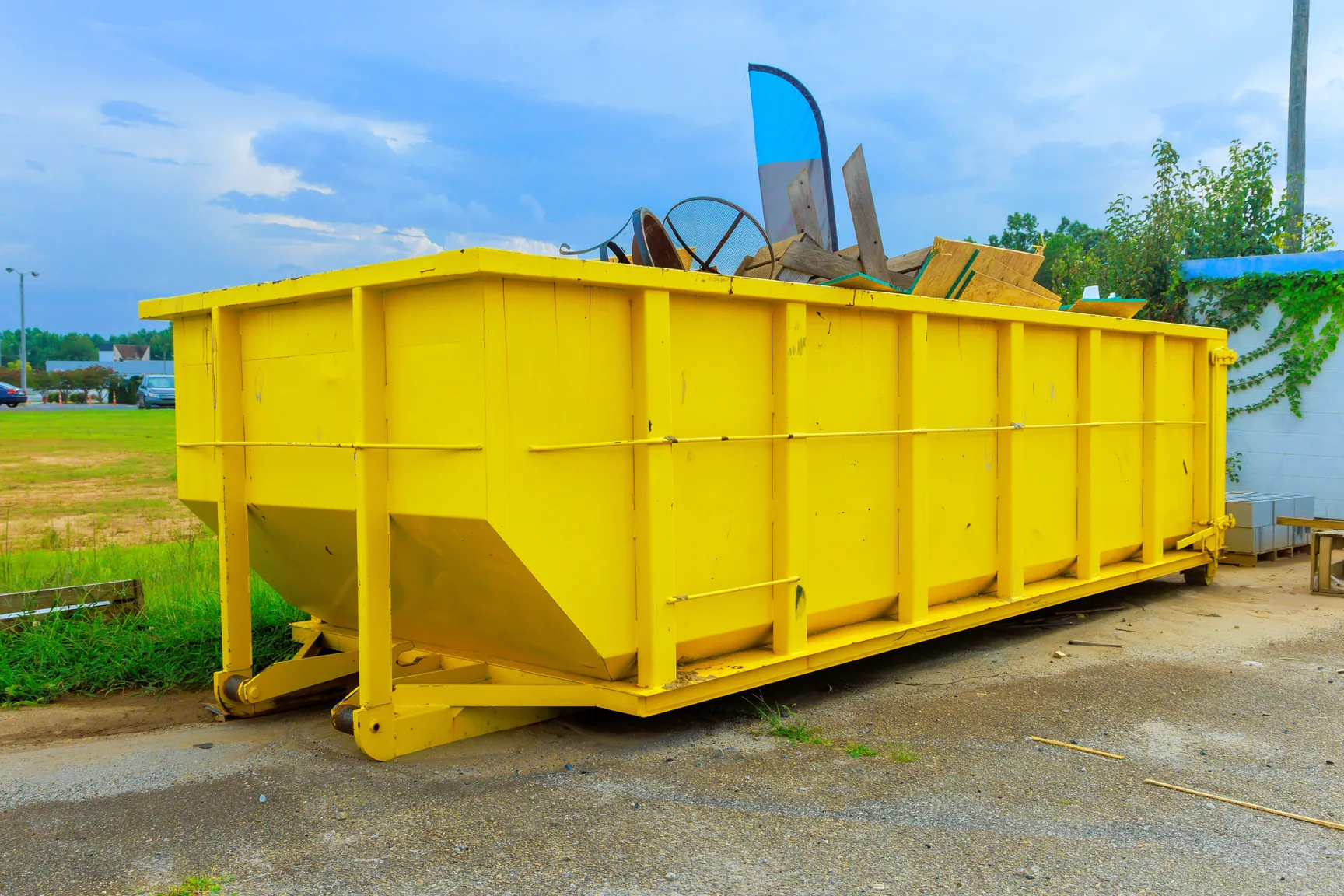
The hoist second, and which of your two policies was written for it
A Massachusetts container business runs on two liability contracts that both have something to say about a box coming off a truck. Between them is a seam, and the losses in this trade that end up uninsured are almost all sitting in it. That is not a warning about buying too little. It is a warning about buying two policies that each assume the other one answers.
Take the liability side first. Loading or unloading is a term the standard general liability form defines for itself. The same form generally declines injury and damage arising out of the use of an auto, and then tells you that the word use takes in loading or unloading. The standard auto form does not use those words at all. It gets to the same second by another route, and the part of the route that matters is whether the machinery moving the property was attached to the truck. A hook-lift is. A borrowed forklift is not. The two forms are drafted to meet, and the meeting point is not always where an operator expects it.
Then there is the other half, which is the surface the box sat on. In this state that is a brick sidewalk, a granite curb, a resident driveway on a street that was laid before anyone imagined a roll-off truck, or a finished lot a general contractor has already paid for twice. When it fails, the claim is yours. One exclusion covers property the insured holds in care, custody or control; a separate one covers the particular part of real property under work. Which of the two a placement loss falls inside, if either, is a question of the exact language and the exact facts, and it is not a thing a web page can resolve for your file.
What we can do is mark where the seam runs, so the question is asked while the policy is being placed rather than after a customer has sent photographs of a split apron. Your own wording controls the outcome, and no two carriers write it identically.
Massachusetts regulations and licensing for container haulers
Three layers reach this trade in Massachusetts and each is held somewhere different: a municipal permit with a statewide command behind it, a carrier chapter that lets you out and a safety regulation that does not, and a container layer that is municipal all the way down.
The board of health permit, and the phrase that sets its reach
There is a statewide requirement here and it is not administered by a state agency. State law requires the permit; it is issued by your local board of health, city by city and town by town.
“No person shall remove or transport garbage, offal or other offensive substances through the streets of any city or town without first obtaining a permit from the board of health of such city or town”
The rest of the section fills in the shape. A permit runs to the end of the calendar year it issues in and renews annually on application; it cannot be handed on without the board approving it; vehicles owned by the Commonwealth or its political subdivisions, and vehicles under contract with the Commonwealth for this work, sit outside the section entirely. The second paragraph is lighter and it matters to anyone running a route: a hauler moving covered substances through a city or town where the load was not collected may do so without a permit, provided it registers with that board of health and observes the rules that board has made. And MGL c. 111, § 31B obliges every board of health to make rules for the control of this removal and transportation, which is why the answers differ across a metropolitan area.
Now the part this page refuses to overstate. The section reaches “garbage, offal or other offensive substances”, and neither § 31A nor § 31B defines a single one of those three words. Nothing retrieved in our research settles whether a board of health reads them as reaching a box of clean concrete, brick and dimensional lumber. A mixed cleanout is plainly inside the words. A tidy demolition load is not obviously inside them. So: the permit exists, its reach turns on that phrase, and the board that covers your job is the body that answers it.
Two other things get mistaken for this credential and neither is one. The state environmental agency licenses hazardous waste transporters under MGL c. 21C, § 7 and publishes a separate licensed list for Class B precious metals transporters; neither class reaches a hauler of nonhazardous construction debris or municipal solid waste, and the rest of that agency’s solid waste instruments are facility-oriented — siting, construction, operation, modification and closure. Separately, the agency’s waste bans at 310 CMR 19.017 stop named materials from being disposed of or transferred for disposal in the Commonwealth, asphalt pavement, brick and concrete and clean gypsum wallboard among them, with treated and untreated wood banned from landfills only. The agency states that the duty to comply runs to organizations that transport waste to disposal facilities as well as to those that generate it. That is a real obligation on a hauler. It is not a license, it is not applied for, and it must never be described as one.
A carrier chapter that lets nonhazardous waste out, and a safety rule that does not
Read MGL c. 159B, § 3 on its own and a roll-off operator is heading for a public convenience and necessity hearing: nobody may carry on the trade of a common carrier, by motor vehicle, over a public way, unless a certificate from the department is in force for that carrier. MGL c. 159B, § 4 runs the parallel prohibition for a contract carrier permit. One section later, the whole thing falls away.
“Motor vehicles owned by the commonwealth or any of its political subdivisions and motor vehicles engaged in the transportation of non-hazardous waste materials shall be subject to section eighteen, but shall be exempt from all other provisions of this chapter.”
Note what that does and does not do. A hauler of nonhazardous construction debris or municipal solid waste is outside the certificate and outside the permit, at any weight and any volume. It is not outside section eighteen, the drivers hours rule, which limits continuous duty and aggregate duty in a twenty-four hour period, requires stated off-duty periods, and says that a break of less than three consecutive hours at a place where there is an opportunity to rest does not break continuity. An emergency proviso for flood, storm or other unforeseen emergency sits at the end of it.
The safety layer is separate and it does reach you. The Registrar of Motor Vehicles adopts 540 CMR 14.00 under MGL c. 90, §§ 19L and 31 — § 19L(a) is the command that the Registrar make regulations ensuring compliance by interstate and intrastate motor carriers alike. 540 CMR 14.03 incorporates a named list of federal parts, including the drug and alcohol testing part, driver licensing, financial responsibility, the general safety regulations, driver qualification, driving, parts and accessories, hours of service, inspection and repair, and hazardous materials — and it does so expressly for intrastate as well as interstate commerce. 540 CMR 14.02(1) names private carriers of property by motor vehicle among those reached, so the carrier chapter exemption does not cross the line into this regulation. 540 CMR 14.04(1) then requires compliance from every motor carrier in intrastate or interstate commerce, and 540 CMR 14.04(3) lists the records to be kept in the regular course of business.
The weight figure worth knowing is the Commonwealth’s own, not a bare federal borrowing.
“a motor vehicle with a gross vehicle weight rating or gross combination weight rating of 10,001 pounds or more used for the transportation of property”
It has to be quoted with the clause that follows it, because the Commonwealth hands the tie-break back to the federal definition.
“It is the intent that the term ‘commercial motor vehicle’ as used in 540 CMR 14.00 shall have the same meaning as in Part 390.5 of Title 49 Code of Federal Regulations and, to the extent there is a conflict between the two at any time, the definition in 49 CFR Part 390.5 shall control.”
One more tie-break sits above all of it at 540 CMR 14.07: where that regulation conflicts with another law or regulation of the Commonwealth, the stricter and more stringent standard applies. Enforcement of 540 CMR 14.00 is reserved to certified police officers.
Placement in Massachusetts, and why the Cambridge license is not yours
There is no statewide roll-off placement or right-of-way permit in Massachusetts and no statewide standard for where a container may sit. What the Commonwealth does instead is unusual and it is the thing that shapes a route here: it mandates by statute that a credential be obtained municipally, and then leaves each board of health to make its own rules. Placement standards, container licensing and street obstruction permits then sit on top of that, municipality by municipality.
Cambridge is offered as one municipality’s own code and nothing more. It is used here because it carries an entire chapter on dumpster licenses whose definition names a roll-off in terms. It sweeps in a receptacle of any kind — a box, a compactor unit, a trailer, a roll-off or something similar, wheeled or not — kept to hold, contain or move refuse, debris, trash and comparable discarded material. And the license it creates is the reverse of what an operator expects.
“no person, business, or any other entity shall operate, keep, store, or maintain a dumpster or temporary dumpster (defined below) without first obtaining the dumpster license required by this chapter”
It issues from the Commissioner of Inspectional Services, and the parties who must apply and sign are the ones with a stake in the ground: whoever owns the lot, whoever is putting the box to use there, a tenant on it, the manager of the property, or anybody else using the container. A hauling company is not among them. Where the hauler appears is inside the customer’s paperwork: the dumpster plan must carry the name, address, contact name and telephone number of the company servicing the dumpster, the date, time and frequency of service, and a copy of the service contract. So your customer holds the license, and your details sit inside their application.
The same chapter sets standards an operator has to be able to satisfy on arrival: a distance from the lot line approved by Inspectional Services, placement that keeps runoff out of catch basins and storm drains, placement that does not interfere with the curb, sidewalk and public parking, fire department approval of the location, and a separate city traffic, parking and transportation permit for any dumpster placed on a public way. Containers must be sound and covered when not being filled or emptied, with a temporary dumpster tarped overnight. Screening applies at sites other than construction sites unless waived. A visible decal or stencil must show the name and telephone numbers of the company servicing the box, and the plan and license get posted on the lot. A temporary license runs thirty days, renewable in thirty-day periods up to a total of twelve months.
None of that is Massachusetts law. It is one city’s ordinance, and the next city over will have written its own. Ask where the job is. And do not confuse any of it with MGL c. 111, § 150A, which is about assigning sites for waste facilities after a public hearing — a different statute, a different object and a different decision from where a container may stand.
Placing Massachusetts workers compensation
Massachusetts is a competitive state with no state carrier in the path, and the line is compulsory. The Department of Industrial Accidents holds it, and the statute defines both the department and the commissioner who heads it. The mandate reads as a duty with two manners of discharge rather than as a choice about whether to carry it.
“every employer shall provide for the payment to his employees of the compensation provided for by this chapter in the following manner: (1) By insurance with an insurer or by membership in a workers’ compensation self-insurance group, established pursuant to the provisions of sections twenty-five E to twenty-five U, inclusive, or (2) Subject to the rules of the department, by obtaining from the department annually a license as a self-insurer”
Both routes are private-market ones. The self-insurance route is conditioned on a deposit held by the state treasurer in trust for employees and on the department periodically determining the self-insurer’s liabilities, which is the regulatory shape of a competitive market rather than a monopolistic one: no state seller to buy from, and no statute voiding private contracts.
On exemptions, this page states the limit of what we checked. Our research file retrieved the securing section and the definitions, and no Massachusetts exemptions or coverage-scope section was retrieved. So we record that no exempt class and no employee-count floor reaching a container business was found — not that the chapter contains none. For a crewed operation the practical answer is the same either way: assume the duty applies and let us confirm the placement before a helper starts.
A panel for Massachusetts in rows. Each row sets one thing the state requires beside the exposure that requirement leaves open and the coverage line that answers it. Hauler registration: A hauler credential, issued by your local board of health. It leaves open a container placed on a customer’s property, and the driveway or curb it damages, which General Liability and Dumpster and Equipment Coverage answer. Intrastate motor-carrier authority: State motor-carrier rules attach at a vehicle threshold. It leaves open the roll-off truck at fault, and the container in transit, which Commercial Auto and Pollution Liability answer. Roll-off placement permits: Municipal — varies by city and town. It leaves open placement on the public right-of-way, and a struck pedestrian or vehicle, which General Liability answers. Workers compensation: Compulsory; bought from private insurers. It leaves open a driver or yard hand hurt on the job, which Workers Compensation answers. Notes: A registration, permit or bond is a condition of operating, not insurance: it answers none of the exposures on the right, so no line is drawn from it. The conclusion reads: The registration is not the coverage — the program is. No figures are shown.
Six coverage lines a Massachusetts container business buys
Six lines, each written for this trade, and each meeting Massachusetts at a different point.
What Massachusetts roll-off claims tend to look like
These are patterns rather than predictions. Nothing here says how any particular file will come out, and no figure is attached to any of it.
The surface claim comes first, as it does everywhere, but it arrives here with an older streetscape attached. A box goes onto a resident apron or a brick walk, something under it gives, and two questions open at once: was the truck in use in the sense the liability form intends, and was the broken apron a piece of work in progress or a piece of property you had charge of. Those live in different provisions of different policies, and the file can stall while two carriers read each other.
Second is the swing. A container under power catches a cornice, a street tree, a utility drop or a parked car in the seconds it is neither on the truck nor on the ground. That is the definitional moment the top of this page is about, and in a tight city street it happens at lower speeds and closer quarters than an operator expects.
Third is the undisclosed load. Something goes in that the customer never mentioned and it surfaces at the transfer station rather than at the job. In this state the waste bans sharpen it, because the duty to comply reaches the transporter and not only the generator.
Fourth is the driver injury that never involved driving — a tarp, a pin, a door, a walk-around on a February morning. That is a workers compensation file and the securing duty above is what stands behind it.
Fifth is the municipal one, and it is particular to how this state is organized. A job stops because the permit for that city or town is not in hand, or because the container standing in the street needed a separate traffic and parking permission. It is a compliance problem first and a contractual one second, and it reaches the insurance file as soon as somebody claims a loss from the delay.
Massachusetts cities where this work clusters
We write Massachusetts as one licensed state rather than as a set of territories. The cities below are simply where container work concentrates, each named with the county it sits inside — although in this state the county is a map unit and not the body that issues anything, which is exactly why the permit question has to be asked at the city or town.
- Boston — Suffolk County
- Worcester — Worcester County
- Springfield — Hampden County
- Cambridge — Middlesex County
- Lowell — Middlesex County
A route running from Boston out through Cambridge and Lowell crosses several boards of health in an afternoon, and each of them has its own rules to make under MGL c. 111, § 31B. That is the practical reason this state rewards asking early and writing the answers down. Being licensed across the Commonwealth is what lets one account follow the work without the coverage changing shape from one municipality to the next.
Nearby states we also write
Adjacency is geography, not law. Nothing verified about Massachusetts carries across a state line, and every page linked below is written from that state’s own research file and nothing else.
Questions we get from Massachusetts operators
Do I need a permit from every Massachusetts city and town I haul through?
That is the shape of it. MGL c. 111, § 31A puts the permit at the board of health of the city or town, not at the Commonwealth, so the question is asked once per municipality and nobody standardizes the answers. The section also carries a lighter duty for pass-through traffic: a hauler moving covered substances through a city or town where the load was not collected may do it without a permit, provided it registers with that board of health and follows its reasonable rules. The permit itself expires at the end of the calendar year it issues in, renews annually on application, and is not transferable without the board approving the transfer.
Does that permit really reach a clean load of brick and lumber?
We do not know, and we are not going to pretend otherwise. The statute reaches garbage, offal or other offensive substances, and neither MGL c. 111, § 31A nor MGL c. 111, § 31B defines any of those three words. A mixed household cleanout is plainly inside them. A clean construction load is not obviously inside them, and nothing in our research file settles how a given board of health reads it. Ask the board that covers the job, and price the answer into the work rather than assuming either way.
Do I need a common carrier certificate from the Massachusetts utility regulator?
Not for nonhazardous waste. MGL c. 159B, § 3 reads as though you would — no person may run as a common carrier by motor vehicle without a certificate from the department — and MGL c. 159B, § 4 says the same thing for a contract carrier permit. MGL c. 159B, § 13 then takes a hauler of nonhazardous waste materials straight back out of the chapter, at any weight and any volume, subject only to the drivers hours section. Quote § 3 without § 13 and you publish a certificate requirement that does not exist for this trade.
If I am exempt from that chapter, am I exempt from the safety rules too?
No, and the two questions have nothing to do with each other. The Registrar adopts 540 CMR 14.00 under MGL c. 90, §§ 19L and 31, and 540 CMR 14.02(1) names who is reached: motor carriers operating commercial motor vehicles on the ways of the Commonwealth, and private carriers of property by motor vehicle expressly among them. The exemption in the carrier chapter does not cross over. 540 CMR 14.07 then sets the tie-break — where that regulation and another Massachusetts law or regulation conflict, the stricter standard governs.
Are the federal hours of service rules Massachusetts rules?
They are federal rules that Massachusetts has adopted. Parts 382 through 397 of Title 49 of the Code of Federal Regulations belong to the federal government; they reach a wholly intrastate Massachusetts operation because 540 CMR 14.03 incorporates them as regulations of the Registry of Motor Vehicles. Separately, the one surviving piece of the carrier chapter is its drivers hours section, which sets its own limits on continuous duty and off-duty time and says a break shorter than three consecutive hours at a place with an opportunity to rest does not interrupt continuity. Where the two differ, the stricter standard applies.
My customer in Cambridge says I need the dumpster license. Is that mine to get?
It is not, and this catches operators who have worked in other states. The Cambridge license is a license to keep a dumpster and it runs against the property side: the responsible party is the owner or other person using it with an interest in the lot, a tenant, the property manager or another user, and a hauling company is not in that list. Where you do appear is in the paperwork. The dumpster plan has to give the name, address, contact and telephone number of the company servicing it, the date, time and frequency of service, and a copy of the service contract. So your customer holds the license, and your details and your contract go into the customer application.
Do I need workers compensation in Massachusetts for one part-time helper?
Massachusetts workers compensation is compulsory and our research file records no exempt class and no employee-count floor reaching this trade — with the limit of that statement stated plainly: no coverage-scope or exemptions section was retrieved, so we affirm that we found none rather than that none exists. MGL c. 152, § 25A directs every employer to provide for payment of compensation, and the two manners it gives are routes for doing it, not releases from it. Treat a helper as triggering the duty and have us confirm the placement.
What should I send you before I bid Massachusetts work?
Both liability declarations pages with their endorsement schedules, your rental agreement, and the list of cities and towns you actually run in. That last one is not padding: the permit layer here is municipal by statute, and a route that crosses six boards of health is a different compliance picture from a route that stays in one. A licensed agent reads the policies together, tells you which one answers at the hoist, and comes back with what the markets will do.
This page reports Massachusetts law as our own state research file records it. It is general information rather than legal advice, and it is not an opinion on what any policy covers — the wording you hold controls that, and carriers do not all write it the same way.
Have a licensed agent read your Massachusetts submission
Send both liability declarations pages and the list of cities and towns you run in. We will read the seam, say plainly which contract is answering when the box is under power, and come back with where the markets land.
Related coverage for dumpster rental operators
- General Liabilitygeneral liability
- Commercial Autocommercial auto
- Dumpster and Equipment Coverageinland marine
- Commercial Propertycommercial property
- Workers Compensationworkers compensation
- Pollution Liabilityenvironmental / pollution liability
What it costs in Massachusetts · States we serve · Dumpster Rental Insurance · Get a quote · Contact us
Primary sources
- Massachusetts General Laws — c. 111, § 31A — the statewide permit duty, and the phrase that sets how far it reaches
- Massachusetts General Laws — c. 159B, § 13 — the exemption that takes a nonhazardous waste hauler out of the carrier chapter
- Massachusetts Division of Insurance — the Commonwealth’s insurance regulator, named as a Division rather than a Department