
Dumpster Rental Insurance by State
Dumpster Rental Insurance in New Jersey
Of the states in this build, New Jersey asks the most of a roll-off operator before the first box goes out. Here is the chain, in order, and what it means for your policies.
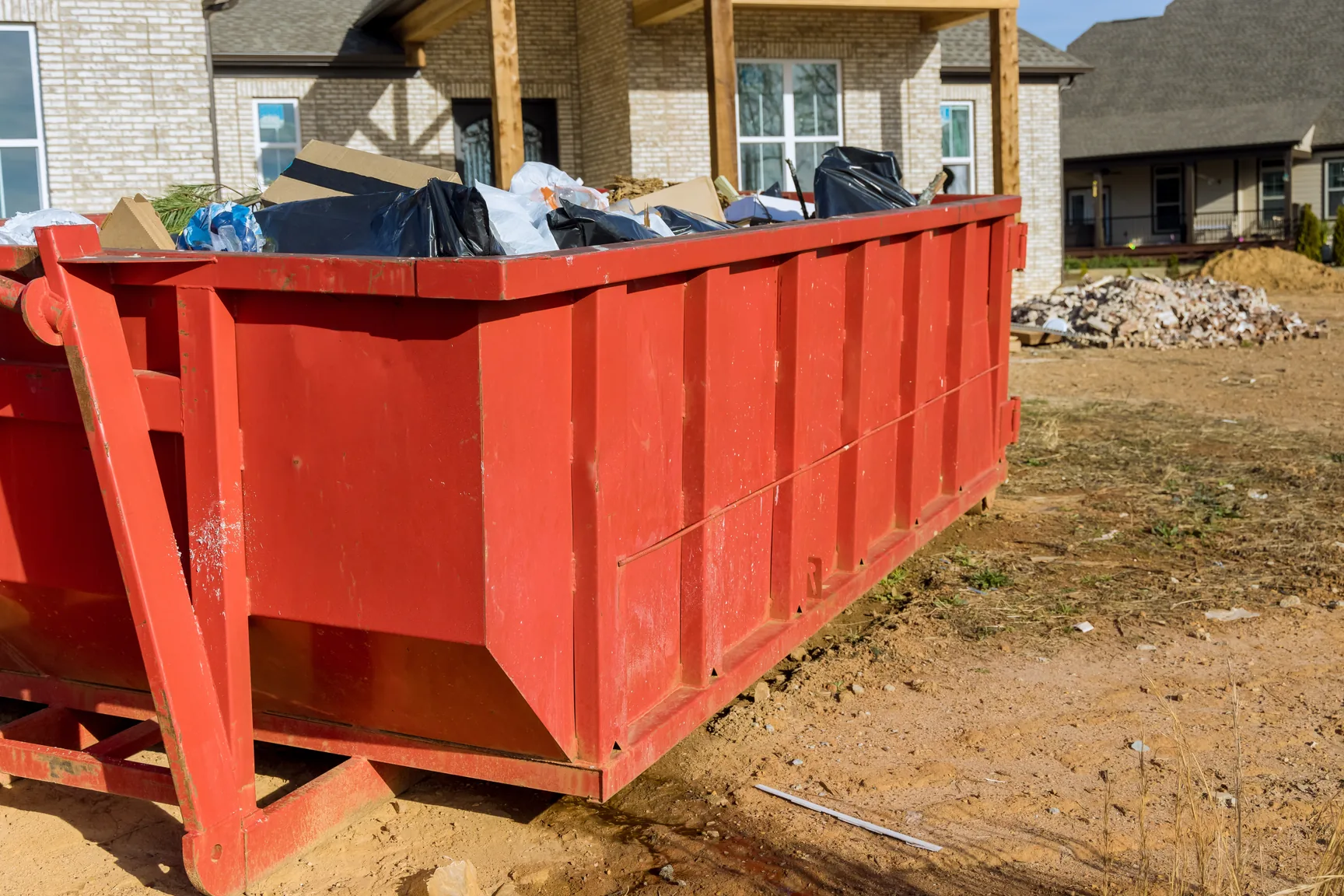
Placement damage and the New Jersey liability seam
New Jersey is a state of tight streets, short setbacks and paved everything. That geography pushes an unusual share of this industry’s losses into one category — damage to the surface the container was standing on, or to the surface it crossed to get there — which is exactly the category two different policies each claim a piece of.
Start with the words. The general liability form carries loading and unloading as a defined term of its own, and it generally steps away from injury and damage arising out of the use of an auto, having first told you that such use takes in loading and unloading. The auto form never uses that pair of words. It reaches the same instant by a different route, and the question that matters here is whether the equipment doing the lifting is attached to the truck. Both forms are drafted in the knowledge that the other exists. That does not guarantee they meet where you expected.
Now the surfaces. A brick apron in Paterson. A resurfaced driveway in an Essex County suburb where the homeowner watched the delivery. A loading curb in Camden with a utility box a meter from the wheel path. Liability wordings typically carry exclusions for property in the insured’s care, custody or control and for that particular part of real property being worked on, and whether a given placement loss lands inside or outside those exclusions is settled by the wording in force and by the facts on the day. It is not settled here, and an agent who tells you otherwise before reading your form is selling certainty rather than cover.
What this brand does is make sure somebody asks the question while the submission is open. The general liability and commercial auto pages take the seam apart properly. Your own policy wording controls, and the forms in use differ between carriers.
New Jersey licensing, from the registration statement to the decal
The New Jersey solid waste transporter registration
This is a state-issued credential, and it is required by state law. The prohibition is short:
“No person shall engage or continue to engage in the transportation of solid waste in this State without first obtaining an approved registration statement from the Department.”
Four links have to hold before that reaches a container rental business, and all four do. The activity: the same rule reaches a prime contractor, and a subcontractor working under one, engaged on solid waste transport. It then defines the prime contractor by the deal rather than by the truck — a generator agrees, orally or in writing, that this person will store, collect, process, transfer, treat or dispose of its waste, using, controlling or possessing a transport unit to do it. A contract to set a box down and take it away full is exactly that deal. The waste: the state’s definition of solid waste names processed or unprocessed mixed construction and demolition debris on its face, and the separate definition of construction and demolition waste reaches waste building material and rubble from work on houses, commercial buildings, pavements and other structures. The equipment, which is the link people miss:
“Any device used for transportation of solid waste shall be registered with the Department as either a solid waste cab, trailer, container, or single-unit vehicle.”
The box is a registered device. N.J.A.C. 7:26-3.4(h) then requires a registered vehicle to display, permanently and conspicuously, the current State solid waste decal, the department registration number and the registered company name, in letters and numbers at least three inches tall — and it excuses containers only from carrying the registration certificate in the cab, which a container obviously has not got. Read the exception properly: it confirms that containers are inside the marking duty.
And the license:
“‘License’ means the approval of any registration statement or engineering design pursuant to P.L.1970, c.39 (C.13:1E-1 et seq.) or P.L.1981, c.279 (C.13:1E-49 et seq.), for the collection, transportation, treatment, storage, processing, brokering, transfer or disposal of solid waste or hazardous waste in this State.”
The A-901 license is not a second document bolted on to the registration — it is the approval of the registration. Which is why the disclosure regime can be written at every applicant and permittee without naming transporters at all: N.J.S.A. 13:1E-128 requires a disclosure statement filed with the Attorney General, fingerprinting for identification and investigation of the people required to be listed in it, and an investigative report prepared by the Attorney General and sent to the Department. N.J.S.A. 13:1E-133 then withholds approval where the applicant has not shown sufficient integrity, reliability, expertise and competency, or has been barred elsewhere or convicted of listed offenses. Two agencies, two jobs, and the statute keeps them apart: the environmental department issues and approves; the Attorney General runs the integrity side.
One more instrument completes the chain. N.J.A.C. 7:26H-1.6 requires a person engaged in the business of solid waste collection or disposal to hold a certificate of public convenience and necessity from the Department, will not issue one until that person is registered and licensed, bars bidding for a collection contract without it, and makes the certificate immediately invalid if the license is denied, revoked or withdrawn. Whoever handles your filings should understand that these three are one dependency chain and not three separate renewals.
Finally, the citation everyone quotes for all of this is the wrong one. N.J.S.A. 13:1E-126 is a findings-and-declarations section — a policy recital explaining why the regime exists. It imposes nothing, and a filing that leans on it has cited a preamble.
New Jersey motor carrier safety rules
The safety layer belongs to the Superintendent of the State Police, who adopts the rules under N.J.S.A. 39:5B-32(a) and revises and readopts them in consultation with the Motor Vehicle Commission and the Department of Transportation. The rules live at N.J.A.C. 13:60 and adopt the federal motor carrier safety regulations by reference. Keep this apart from the waste chain above: the question of who may be in the hauling business at all is answered by the certificate, not here.
New Jersey states its weight figures as exceptions rather than as thresholds, and one of them is a trap:
“Include provisions with regard to motor carrier operators and vehicles engaged in intrastate commerce or used wholly within a municipality or a municipality’s commercial zone, except for farm vehicles weighing 26,000 pounds or less that are operated exclusively in intrastate commerce and are registered pursuant to R.S.39:3-24 and R.S.39:3-25, that are compatible with federal rules and regulations.”
Cover the word farm with your thumb and that sentence turns into a general exemption for smaller intrastate vehicles. It is not one. The exception is written for farm vehicles registered under the farm registration sections, and a roll-off truck is not among them.
There is a figure an operator will want here that this page does not give: the definition of a commercial motor vehicle for New Jersey intrastate operation. N.J.S.A. 39:5B-32(c) hands that definition to the rules adopted by the Superintendent, and the chapter carrying it is published through a host that serves an application rather than text — it could not be opened by direct request, by a browser session, or through two alternative publishers. Numbers for it circulate in secondary sources. We have not verified one, so we state the mechanic and print no figure. Separately, the state’s own transporter application requires vehicles to be registered as commercial with the motor vehicle agency, and returns applications where a passenger or passenger-commercial registration has been used — a registration-class condition that rides on the waste paperwork rather than on the safety rules.
Newark placement permits
Nothing in the state rules says where a container may be set down. The registration regime governs the business, the vehicle, the marking on the equipment and the people behind the company; placement is municipal and differs from one town to the next. New Jersey is nevertheless the state where the state itself marks the box, and that equipment duty must never be blended into a sentence about placement.
Our named example is the largest city, and one city’s code is never the state’s rule.
“No mechanical refuse container equipment may be placed on a street or public right-of-way without a permit. An application for a permit must be submitted to the Central Permit Office with the required fee. The applicant shall specify thereon the size and location of the equipment and the duration of time the equipment will be at the location. If such equipment is to occupy the street or public right of way for 24 hours or less, the applicant shall pay the required fee by mail or in person within 24 hours, exclusive of weekends and holidays, after placement of the equipment. If the equipment is to be used for more than 24 hours, the applicant must receive a permit prior to placement.”
The split at a day is the operative mechanic and it runs against intuition: the short placement can be paid for afterwards, while the longer one needs the permit in hand before the box touches the ground. Build that into dispatch, because the decision is made by whoever schedules the pull, not by whoever files the paperwork.
Two other Newark sections are worth knowing and both need care. Section 15:4-11 addresses a receptacle left standing in the roadway, at the curb or anywhere in the public right-of-way, and it opens with an exception pointing at another section of the chapter. We have not read the section it points at, so we will not describe that rule as a flat prohibition — the exception may be doing real work. And § 15:4-4 runs an annual private collector license through the City’s license unit, with the Director of Public Works satisfied as to the sufficiency and sanitation of vehicles and equipment before it is granted, and city-decaled vehicles limited to work inside the City. Its scope turns on collections made from the sidewalks of any street or public place. Whether a container set on a customer’s own lot and pulled from that lot falls inside that phrase is not resolved by anything we retrieved, and we are not going to guess on your behalf. The license exists; ask the City how it reads its own ordinance before you assume either way.
All of that is one municipality. It is not New Jersey’s rule and it does not describe Jersey City, Paterson, Trenton, Camden or any of the several hundred other towns in this state. Placement is decided where the box is going, so check that jurisdiction before the first drop into one of its streets, and keep the answer on file for the next job on the same block.
Securing workers compensation in New Jersey
This is a competitive state with no state fund in the picture. The compensation system is administered by the Division of Workers’ Compensation within the Department of Labor and Workforce Development, while the self-insurance route runs to the insurance regulator instead.
N.J.S.A. 34:15-71 puts the duty on every employer other than the State and its municipalities, counties and school districts, where that employer is subject to article 2 of the chapter: it must make sufficient provision for the full payment of anything it may come to owe an injured worker or that worker’s dependants, by one of the two methods the statute then names. The first, N.J.S.A. 34:15-77, is an application to the Commissioner of Insurance to carry your own liability on a showing of financial ability. The second, N.J.S.A. 34:15-78, is insurance with a stock company or mutual association authorized to write workers compensation or employers liability in this State. An open private market on the second route is precisely what makes the state competitive.
Two honest limits on what we have just said. The exception in the statute is an exception for public bodies as employers; it does nothing for a private roll-off business. And the duty attaches to an employer subject to article 2 — how an employer comes to be within article 2 is a question our research run did not open, so nothing here describes it and no employee-count floor is stated on this page. The workers compensation page covers how the line is rated for drivers and helpers.
A panel for New Jersey in rows. Each row sets one thing the state requires beside the exposure that requirement leaves open and the coverage line that answers it. Hauler registration: A hauler credential, issued by the state. It leaves open a container placed on a customer’s property, and the driveway or curb it damages, which General Liability and Dumpster and Equipment Coverage answer. Intrastate motor-carrier authority: A state operating credential reaches for-hire hauling. It leaves open the roll-off truck at fault, and the container in transit, which Commercial Auto and Pollution Liability answer. Roll-off placement permits: Municipal — varies by city and town. It leaves open placement on the public right-of-way, and a struck pedestrian or vehicle, which General Liability answers. Workers compensation: Compulsory; bought from private insurers. It leaves open a driver or yard hand hurt on the job, which Workers Compensation answers. Notes: A registration, permit or bond is a condition of operating, not insurance: it answers none of the exposures on the right, so no line is drawn from it. The conclusion reads: The registration is not the coverage — the program is. No figures are shown.
Coverage by coverage, in New Jersey terms
The dumpster rental insurance hub explains how the six are built into a single program.
The claim shapes that recur in New Jersey
We publish no claim counts and no severities, because we have none we could stand behind. Shapes, we can describe.
Surface and structure damage at placement dominates. Density is the reason: short driveways, curbed streets, shared alleys, utility covers where a wheel wants to sit. The operators who come out of these disputes intact are the ones whose drivers photograph the ground and the approach before the box comes off, every single time.
Second is the marking and paperwork failure, which is a New Jersey speciality because so much of the compliance is visible from the street. A decal that has weathered off a container, a registration number that no longer matches the company name, a unit put into service before its registration caught up — each is a roadside conversation and a bad look on a claim file.
Third is the permit gap on a street placement: a box that sat longer than the day it was paid for, or that went down before a longer-duration permit was issued. That is a municipal fine and, more awkwardly, evidence of an unpermitted occupancy if somebody was hurt around it.
Fourth is load contamination — the sealed tin at the bottom of a demolition load — which is the pollution conversation rather than the liability one.
Fifth is theft of and damage to containers standing on other people’s property, which is an inland marine question.
Sixth, and easiest to neglect: the driver file. Adopted federal safety rules mean qualification files, medical certificates, inspection records and hours discipline apply to a truck that may never leave one county. A thin file is not itself a claim, but it shapes every claim that follows it.
Where New Jersey demand concentrates
We are licensed across the state and we write all of it. These five are simply where the volume sits. Each is named with its county, and naming a place here is geography and nothing more — it is not a statement about where anything of ours is situated.
Nearby states we also write
- New York — which runs its own waste transporter permit regime — a different regime, not a version of this one.
- Pennsylvania — across the Delaware, read from Pennsylvania law alone.
- Delaware — the third neighbor, on its own record.
New Jersey has exactly three neighbors and we write all three. Nothing verified on this page transfers to any of them: the registration, the license and the certificate are this state’s own chain, and a neighbor’s permit regime is a different regime rather than a variant of this one.
Questions from New Jersey operators
Do I need a New Jersey license to haul construction debris?
Yes, and it is issued by the state. N.J.A.C. 7:26-3.2(a) bars anyone from transporting solid waste in New Jersey without an approved registration statement from the Department of Environmental Protection, and the same rule extends the bar to acting as a prime contractor or subcontractor for that transport. A prime contractor is defined around an agreement with a generator to handle waste through the use, control or possession of a solid waste transport unit — which is what a container rental agreement is. Construction and demolition debris is named on the face of the state’s definition of solid waste.
What is the A-901 license and is it separate from my registration?
It is not separate, and that single structural fact explains the whole regime. N.J.S.A. 13:1E-127(g) defines a license as the approval of a registration statement for collecting, transporting, treating, storing, processing, brokering, transferring or disposing of waste. So the license is the approval — one instrument, not two errands. What sits alongside it is an integrity review: N.J.S.A. 13:1E-128 requires a disclosure statement filed with the Attorney General, fingerprinting of the people named in it, and an investigative report sent by the Attorney General to the Department.
Does New Jersey register my containers as well as my trucks?
It does, and this is the state where the box itself carries state paper. N.J.A.C. 7:26-3.2(a)2 requires any device used for transporting solid waste to be registered as a solid waste cab, trailer, container or single-unit vehicle. N.J.A.C. 7:26-3.4(h) then requires each registered vehicle to display the state solid waste decal, the department registration number and the company name in letters and numbers of at least three inches, and carves containers out only of the duty to carry the registration certificate in the cab — which tells you containers are inside the display duty, not outside it.
What is the certificate of public convenience and necessity for?
It is the economic gate on the business, as distinct from the environmental registration on the activity. N.J.A.C. 7:26H-1.6 requires a person engaged in the business of solid waste collection or disposal to hold a certificate issued by the Department, makes the certificate dependent on already being registered and licensed, bars bidding for collection contracts without one, and provides that the certificate becomes invalid immediately if the license is denied, revoked or withdrawn. Three instruments, one chain: lose the first and the last falls with it.
Is there a weight below which New Jersey safety rules stop applying to me?
Not one this page can give you a number for, and the reason matters. N.J.S.A. 39:5B-32(b)(2) does contain a weight, but it is a farm vehicle exception — drop that one word and the sentence reads as a general intrastate exemption, which is false. The definition of a commercial motor vehicle for intrastate operation is left by N.J.S.A. 39:5B-32(c) to rules adopted by the Superintendent of State Police, and that chapter could not be opened by any instrument we use. Figures for it circulate in secondary sources. We do not publish an unverified one.
Who writes the motor carrier safety rules in New Jersey?
The Superintendent of the State Police, under N.J.S.A. 39:5B-32(a), with the revision and readoption of those rules done in consultation with the Motor Vehicle Commission and the Department of Transportation. The rules themselves sit at N.J.A.C. 13:60, which adopts and incorporates the Federal Motor Carrier Safety Regulations by reference. Do not merge that with your waste authorization: the economic gate on who may be in the hauling business is the certificate described above, and the safety layer is a separate matter.
Does Newark require a permit to put a container in the street?
Yes. Newark Code § 15:4-17(a) makes a permit the precondition for putting mechanical refuse container equipment down in a street or public right-of-way, and the mechanic is counter-intuitive: a placement of twenty-four hours or less may be paid for after the fact, within a day of the equipment going down, while anything longer needs the permit in hand before placement. The city also runs a private collector license under § 15:4-4, whose scope turns on collections made from the sidewalks of any street or public place — and nothing we retrieved settles how the City reads that phrase against a container pulled from a customer’s own lot.
How does a New Jersey employer secure workers compensation?
N.J.S.A. 34:15-71 requires an employer, other than the state and its municipalities, counties and school districts, to make sufficient provision for what it may owe an injured worker, by one of two methods the statute names. The first, at N.J.S.A. 34:15-77, is an application to the Commissioner of Insurance to carry your own liability on a showing of financial ability. The second, at N.J.S.A. 34:15-78, is insuring with a stock company or mutual association authorized to write the line in this State. That open market is why New Jersey is a competitive state and not a monopolistic one.
This page reports New Jersey law as our own state research file records it. It is general information rather than legal advice, and it is not an opinion on what any policy covers — the wording you hold controls that, and carriers do not all write it the same way.
Quote a New Jersey roll-off operation
Send the fleet list, the container count, the municipalities you place in, and where you are in the registration, license and certificate chain. We will come back with the cover, the gaps and the questions worth asking your current carrier.
Related coverage for dumpster rental operators
- General Liabilitygeneral liability
- Commercial Autocommercial auto
- Dumpster and Equipment Coverageinland marine
- Commercial Propertycommercial property
- Workers Compensationworkers compensation
- Pollution Liabilityenvironmental / pollution liability
What it costs in New Jersey · States we serve · Dumpster Rental Insurance · Get a quote · Contact us
Primary sources
- New Jersey Department of Banking and Insurance — the state regulator for every line of cover named on this page