
Dumpster Rental Insurance by State
Dumpster Rental Insurance in Nevada
Nevada permits places, and then lets a county decide whether a private hauler may collect at all. Here is what that changes about the cover you buy.
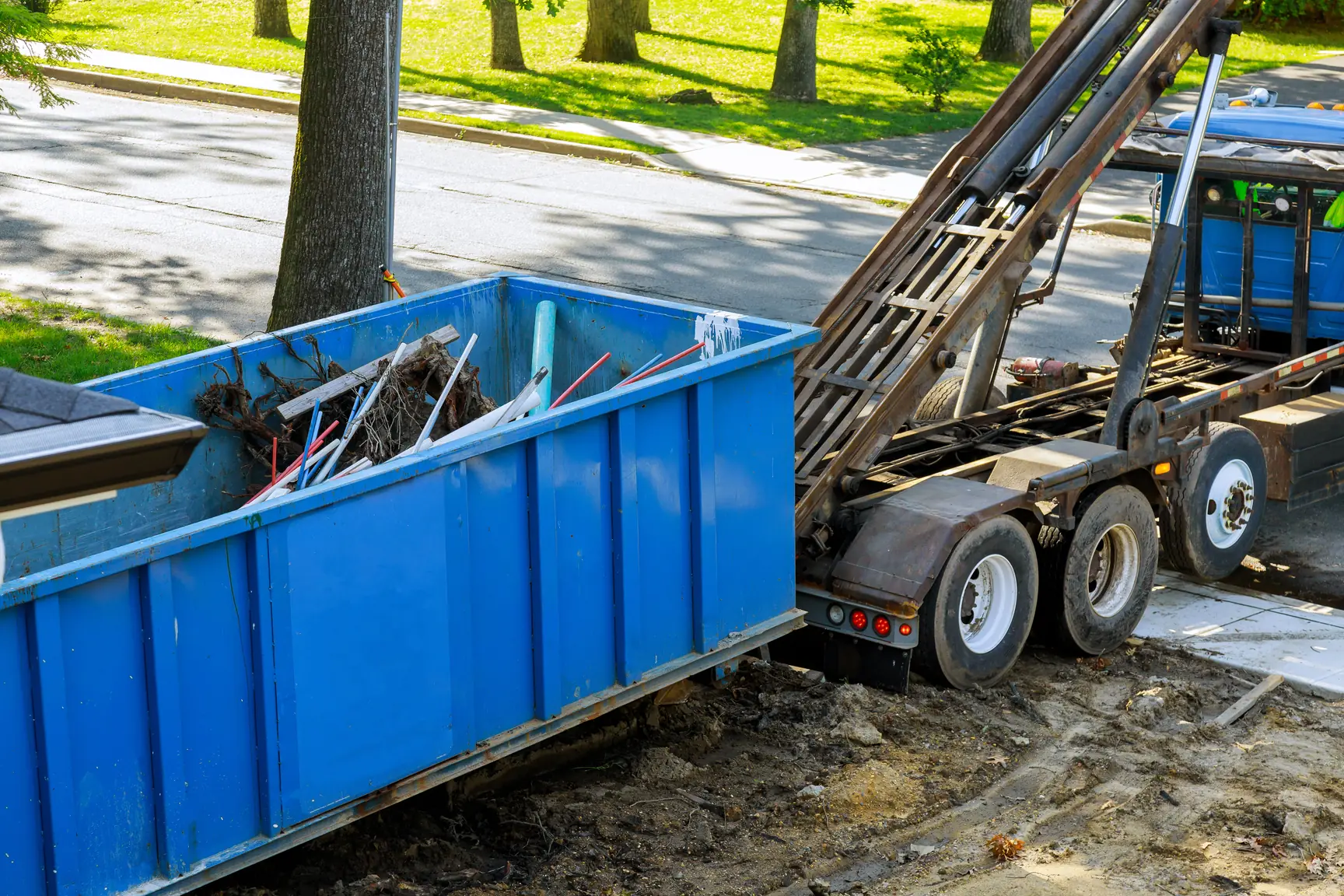
Where the auto form stops and the liability form starts in Nevada
A Nevada crew sets a box on a valley job at seven in the morning and pulls it on Thursday. Nothing about those two movements feels like an insurance question until something goes wrong during one of them, and then it becomes the only question that matters: which of your two liability policies is answering.
The rough division is easy to state. Commercial auto answers for the truck — driving it, hoisting with it, and the movement of property on and off it. General liability answers for the container once the cable is slack, for the ground it is resting on, and for whatever is happening around it while it sits. The trouble is the half-minute in between, when the box is on the cable and part of its weight is still on the frame.
That half-minute is where the two forms were drafted to meet. The general liability wording treats loading and unloading as a defined activity, and it generally steps back from injury and damage arising out of the use of an auto — then folds loading and unloading into what use means. The auto wording never uses that phrase at all. It arrives at the same instant by a different road, and the one that matters here turns on whether the device doing the moving is attached to the truck. A hoist and a cable are. A machine the customer walked over from the other side of the lot is not.
Then there is the second half of the seam, which has nothing to do with a person being hurt and everything to do with what you set the box down on. A loaded container is a concentrated point load on four small feet. Cracked slab, scored paver edge, a lawn pressed into ruts, a sunken spot where the tires stood while the box came off. General liability forms typically carry exclusions for property in the insured’s care, custody or control and for that particular part of real property being worked on, and whether a placement loss lands inside or outside those exclusions is decided by the wording you actually hold and by what actually happened at the drop.
We do not settle that question on a web page, and you should be suspicious of anyone who does. What we can do is show an operator where the seam runs in their own state so the question gets asked while the program is being built rather than after a driveway has already failed. In parts of Nevada, the first question is not what you are covered for — it is whether a private hauler may take the work at all.
Nevada regulations and licensing for roll-off haulers
Three separate layers reach a Nevada operator. The state does not credential the hauler. The state does credential the truck, through an entirely different agency. And the county or the city may decide who is allowed to collect within its boundaries at all.
Statewide hauler credentials in Nevada, and which waste they reach
Nevada runs transporter and facility credentials in the solid waste field. They reach asbestos transport, facilities that manage waste tires, and disposal sites. None of the three is a hauler license for the ordinary construction, demolition or municipal load that a roll-off business exists to move. The asbestos transport approval reads as follows.
“Before a transporter may transport asbestos, he or she must obtain the written approval of the solid waste management authority.”
The state permit provision is at NRS 444.553(2), and reading it carefully is the whole exercise. The prohibition there attaches to operating a solid waste management facility without a permit from the solid waste management authority. A facility is a place. Waste tire facilities carry their own version at NRS 444.507(1), and disposal sites carry theirs at NAC 444.6405(1). Every one of those duties lands on somebody who operates a site, not on somebody who drives a hook-lift between sites.
One caution belongs on this page because the record insists on it. A definition added to the statutes in 2025 is very wide indeed, and NRS 444.553(2) was amended in the same session to use it.
“any place that engages in any activity related to a solid waste management system”
The regulations that implement those statutes have not moved with them; NAC chapter 444 still frames its permit rule around a disposal site. Our research could not establish whether an operator’s own container yard falls inside the newer statutory definition, and we are not going to guess. This page states that Nevada asks for no state hauler license and that its state solid waste permits are permits for places. It does not tell you that a yard permit could never be required, and it does not read NRS 444.553(2) as reaching the act of hauling. Put the question to the solid waste management authority for your area.
Intrastate motor-carrier approval in Nevada, and the weight that triggers it
The motor-carrier credential sits with the Department of Motor Vehicles, not with an environmental agency. It is a written approval, and the statute states the duty plainly.
“A common carrier of property, other than a carrier of household goods or an operator of a tow car, shall not operate as a carrier in intrastate commerce without first obtaining written approval from the Department.”
A company that advertises containers and pulls them for whoever books one is a common motor carrier of property under NRS 706.036. The figure that decides whether the approval is in play is not in that statute at all — it sits in the regulation that interprets it, which is exactly where a researcher stops looking.
“the Director of the Department will interpret the term ‘common carrier of property’ to mean any person or operator, including a motor convoy carrier, who operates a motor vehicle or a combination of vehicles with a gross vehicle weight rating in excess of 26,000 pounds”
Getting the approval is a checklist rather than a hearing. Under NRS 706.438 the Department issues it on finding that the applicant meets the insurance requirements at NRS 706.291, names the terminal facilities supporting its intrastate work, acknowledges the safety rules that bite on its equipment and agrees to operate accordingly, and satisfies any further safety or financial-responsibility condition adopted by regulation. NRS 706.439(1) lets the Department hand the approval over when it registers the fleet, and NRS 706.4395 provides for cancellation. Liability minimums for a common or contract carrier of property that is not a fully regulated carrier are banded by weight rating at NAC 706.288, with hazardous commodities referred out to federal rules; we do not publish those figures, because a statutory floor printed on a marketing page reads as advice about how much cover to buy.
There is a second and separate Nevada weight line, and it belongs to safety rather than to authority. NAC 706.297(1)(e)(2) sets the intrastate commercial-motor-vehicle figure at 26,001 or more pounds for property other than household goods — and then, in the following paragraph, pulls a lighter vehicle back in on a reduced list of federal provisions purely because its carrier answers to the Department. An operator who concludes that a lighter truck is outside everything has made two mistakes in one sentence. The 10,001-pound number that turns up in general reading is the federal interstate line, reached in Nevada through NAC 706.297(1)(e)(1); the federal motor carrier agency owns it, and Nevada does not.
One thing a Nevada waste hauler does not hold is a certificate of public convenience and necessity. NRS 706.386 attaches that to a fully regulated common motor carrier, and NRS 706.072 confines that term to carriers of passengers or household goods whose rates, routes and services the Nevada Transportation Authority regulates. The contract-carrier permit at NRS 706.421 narrows the same way through NRS 706.051. If somebody tells you a Nevada roll-off operation needs a certificate, they are describing a different business.
Local placement, franchises and the Nevada county layer
Nevada writes no statewide placement, right-of-way or hauler-licensing rule for roll-off work. It hands the question down. Under NRS 244.187 a board of county commissioners may displace or limit competition in the collection and disposal of garbage and other waste, and NRS 244.188(1)(b) lets it grant an exclusive franchise; NRS 268.081 and NRS 268.083(2) give a city the same pair. So the local layer here is not a fee schedule and a setback. It can decide whether a market exists.
Read those statutes for what they are. Each says a governing body may act, not that it has. The one mandatory instruction in the group is NRS 444.530, and what it requires is an ordinance: a municipality with a solid waste management system inside its boundaries has to establish regulations for operating that system. Note also that the word municipality is wider here than in ordinary speech — NRS 444.470 defines it to take in counties, cities and towns whether incorporated or not, and Carson City by name.
A second local layer sits alongside the first. NRS 444.503(1) lets the Administrator of the Division of Environmental Protection designate a district board of health as the solid waste management authority, and NRS 444.495(1) then makes that board the authority in its area. In Nevada’s two largest population centers, the body that permits waste facilities is a local health district rather than the state division. That is a local arrangement and this page does not present it as a statewide rule.
What that adds up to is best shown by one county’s own code, offered as an illustration of how far a Nevada jurisdiction may go and as nothing else at all.
“it is unlawful for any person, other than the county, or a franchisee, or their duly appointed agents, to collect, haul, convey or transport any solid waste”
For general solid waste collection in unincorporated Clark County, that is a closed market rather than a license a newcomer can apply for. The sentence a roll-off operator’s whole position there turns on is the proviso at § 9.04.070(a), and it works by carving a stream out of the reservation rather than by opening the market. Waste arising directly from construction, remodeling, repair and demolition work, together with uncontaminated waste from land clearing, may be taken away — but the subsection puts that permission in the hands of a duly licensed construction, construction cleanup or demolition contractor, and it names the destinations the material may go to. It is a contractor-license permission wearing a waste-hauling shape. Subsection (b) applies the same reasoning to residue leaving an authorized construction or demolition materials recovery facility, and the remaining subsections reach self-haul, source-separated recyclables, licensed recyclers, septic and grease pumpers, yard and tree services, and a qualifying charity. None of those is a general roll-off permission and none of them should be read across.
This page reports what that ordinance says, cited to Clark County, as an example of the reach a Nevada county may have. It does not tell you whether any particular operator qualifies as a duly licensed construction, construction cleanup or demolition contractor — that turns on a contractor-licensing regime our research did not retrieve — and it does not extend the franchise or the proviso to any other Nevada jurisdiction. Placement and right-of-way rules in Nevada are municipal. Check yours where you work.
Securing Nevada workers compensation without a state fund
Nevada is a competitive workers compensation state, and the duty is compulsory for an employer inside the chapters. NRS 616B.612(1) tells every such employer to provide and secure compensation, on the terms those chapters set, for an employee whose accidental personal injury arises from the employment and happens in its course. The qualifying phrase in that subsection — employers within the provisions of the chapters — is doing work, and the sections that set that scope were not read in our research. So this page states the duty and states no exempt class, no headcount floor and no excluded employment in either direction. That is an honest gap, not a finding that Nevada has none.
How the cover is actually placed is settled by a definition rather than by a market description, and the definition is worth reading in full because of what is missing from it.
“‘Insurer’ includes: 1. A self-insured employer; 2. An association of self-insured public employers; 3. An association of self-insured private employers; and 4. A private carrier.”
Four routes, and no state fund among them. NRS 616A.290 describes a private carrier as an insurer authorized to write industrial insurance under those chapters, expressly leaving out self-insured employers and their associations. Self-insurance is a certification from the Commissioner of Insurance under NRS 616A.305, and a certified self-insured employer takes on the responsibility for compensation directly under NRS 616B.615(1). NRS 616B.612(2) treats a contractor or subcontractor as having secured compensation to the extent its people are covered by a consolidated insurance program.
One provision matters to any operator who bids municipal work. NRS 616B.627(1) requires a contractor to give the letting body a certificate from its insurer, certifying compliance, before starting work under a contract with the State, a political subdivision or a metropolitan police department. That is a paperwork step rather than a coverage question.
A panel for Nevada in rows. Each row sets one thing the state requires beside the exposure that requirement leaves open and the coverage line that answers it. Hauler registration: State transporter credentials exist, but none reaches roll-off hauling. It leaves open a container placed on a customer’s property, and the driveway or curb it damages, which General Liability and Dumpster and Equipment Coverage answer. Intrastate motor-carrier authority: State motor-carrier rules attach at a vehicle threshold. It leaves open the roll-off truck at fault, and the container in transit, which Commercial Auto and Pollution Liability answer. Roll-off placement permits: Municipal — varies by city and town. It leaves open placement on the public right-of-way, and a struck pedestrian or vehicle, which General Liability answers. Workers compensation: Compulsory; bought from private insurers. It leaves open a driver or yard hand hurt on the job, which Workers Compensation answers. Notes: A registration, permit or bond is a condition of operating, not insurance: it answers none of the exposures on the right, so no line is drawn from it. The conclusion reads: The registration is not the coverage — the program is. No figures are shown.
Six coverages, read against a Nevada operation
These are the six lines this brand writes, and each one earns its place for a different reason in a Nevada roll-off business.
Common Nevada roll-off claims, at the level of pattern
We do not publish claim counts or severities, because we have not measured them and a number invented for a web page is worse than no number. What we can describe is the shape of the losses that recur in this class, and how each one lands against the seam.
The box goes where the customer points, the customer points at the driveway, and the driveway is the thinnest structure on the property. Because the damage is to the very surface the container was set on, this loss raises a care, custody or control question or a real-property-being-worked-on question, and the outcome turns on wording and facts rather than on fault.
Then there is the loss during the movement itself: a cable that lets go, a box that walks on a slope, a swing that catches a gatepost or a parked vehicle while the truck is manoeuvring in a tight valley cul-de-sac. These are the ones that sit on the auto and liability boundary, and the practical test an adjuster reaches for is whether the equipment doing the moving was part of the truck.
Third-party injury around a set container is its own family — someone climbing in, someone loading over the rail, a child on a residential drop, wind moving a lid or a door. Fourth is the load contents problem: prohibited material discovered at the transfer station, or a demolition stream that turns out to include something the destination will not take. And fifth is the driver and helper injury pattern that workers compensation exists for, which in this trade clusters around the tarp, the walk-around and the lift rather than around the drive.
Nevada roll-off markets
Our license covers Nevada end to end, and we write the whole of it. The list below is simply where our submissions concentrate, each market set against the county containing it. Nothing about the size of any of these markets appears beside them, because our research sourced no such figure and we do not estimate one.
- Las Vegas — Clark County
- Henderson — Clark County
- North Las Vegas — Clark County
- Reno — Washoe County
- Sparks — Washoe County
- Carson City
Three of those markets are inside the county whose code is quoted above. Reno and Sparks sit in a different county with its own answer, and the answer has to be read there rather than carried north.
Carson City is listed with no county beside it, and that is correct rather than an omission. It is a consolidated municipality that sits inside none, and Nevada’s own drafting acknowledges it: the definition at NRS 444.470 lists counties, then cities and towns, and then names Carson City separately, because it is neither.
Nearby states we also write
Nevada touches five states and all five are inside our license. Two of them have a measured research record in this build, so these are the two we will point you at. The facts on those pages are theirs and not Nevada’s — a load that crosses a state line has left the intrastate regime at NRS 706.437(1) behind entirely, and nothing in our Nevada research speaks to what replaces it.
Nevada dumpster rental insurance FAQs
Does Nevada issue a state license to haul roll-off containers?
No. Nevada runs waste credentials for asbestos transport, for waste tire facilities and for disposal sites, and none of the three is a hauler license for construction debris or municipal solid waste. The state permits at NRS 444.553(2) attach to operating a facility — a place — rather than to running a truck. That is not the same statement as “nothing applies”: the rules that decide whether you can take a job in Nevada are county and city rules.
Can a Nevada county simply stop me collecting there?
It can limit or displace competition in garbage and waste collection, and it can grant an exclusive franchise, under NRS 244.187 and NRS 244.188(1)(b). A city has the parallel powers at NRS 268.081 and NRS 268.083(2). Those statutes are permissive — they say a governing body may do this, not that it has — so the answer is specific to the jurisdiction you want to work in, and it has to be read there.
What does Clark County Code § 9.04.070 mean for a construction and demolition load?
Clark County reserves general solid waste collection in the unincorporated county to itself and its franchisee, and then carries construction, demolition and land-clearing waste back out of that reservation — but only in the hands of a duly licensed construction, construction cleanup or demolition contractor, and only to the destinations the subsection lists. That is a contractor-license permission, not a waste-hauler permission. Whether a particular operator holds the contractor license it turns on is a question for Clark County and the contractor-licensing body, and this page does not answer it.
Do I need written approval from the Nevada DMV to run intrastate?
A common carrier of property operating in intrastate commerce needs it under NRS 706.437(1), and NAC 706.287 fixes that class by weight rating, above 26,000 pounds. A roll-off operator that holds itself out to whoever hires it is a common carrier of property under NRS 706.036. The Department will issue the approval once the applicant satisfies insurance, identifies its terminal facilities, acknowledges the safety requirements and meets anything else adopted by regulation — NRS 706.438.
Is a certificate of public convenience and necessity part of this?
Not for a waste hauler. A certificate under NRS 706.386 is for a fully regulated common motor carrier, and NRS 706.072 limits that term to carriers of passengers or household goods whose rates, routes and services the Nevada Transportation Authority regulates. The contract-carrier permit at NRS 706.421 has the same limitation through the definition at NRS 706.051. Neither instrument reaches a company hauling containers of debris.
Is workers compensation compulsory for a Nevada roll-off crew?
Yes, for an employer inside the chapters. NRS 616B.612(1) directs every such employer to provide and secure compensation. The scope is set by other sections this research did not read, so we state the duty and state no exemption in either direction. Coverage is placed through one of the four routes NRS 616A.270 recognizes, and none of them is a state fund.
Does a Nevada city or county permit affect my insurance?
It affects what an underwriter is looking at rather than what a policy says. A franchise question decides whether the revenue exists at all, and a contractor-license condition decides who may lawfully carry the load. Both belong in the submission, along with the container count, the destinations you use and whether any of your work is on a municipal contract — NRS 616B.627(1) puts a certificate obligation on a contractor before it starts work for the State or a political subdivision.
What does the 2025 change to the Nevada facility definition mean for my yard?
It is an open question and we are not going to close it for you. NRS 444.497 now defines a solid waste management facility very widely, and NRS 444.553(2) was amended to use that wider term, while the implementing regulations in NAC chapter 444 still speak in the older language of a disposal site. This research could not resolve whether a container yard falls inside the new definition. Ask the solid waste management authority for your area before you assume either answer.
This page reports Nevada law as our own state research file records it. It is general information rather than legal advice, and it is not an opinion on what any policy covers — the wording you hold controls that, and carriers do not all write it the same way.
Put a Nevada operation in front of an underwriter
Tell us the counties you pull in, what your boxes weigh loaded, where the material goes and whether any of your work is under a municipal contract. We will build the submission around the seam rather than around a template, and we will tell you plainly where your wording leaves the placement question open.
Related coverage for dumpster rental operators
- General Liabilitygeneral liability
- Commercial Autocommercial auto
- Dumpster and Equipment Coverageinland marine
- Commercial Propertycommercial property
- Workers Compensationworkers compensation
- Pollution Liabilityenvironmental / pollution liability
What it costs in Nevada · States we serve · Dumpster Rental Insurance · Get a quote · Contact us
Primary sources
- Nevada Division of Insurance — the state insurance regulator