
Dumpster Rental Insurance by State
Dumpster Rental Insurance in Louisiana
Louisiana is one of the states that does put a credential on the roll-off operator: a written notification to the environmental department and a transporter identification number. Then the state police rules reach the truck, and the parish reaches the curb.
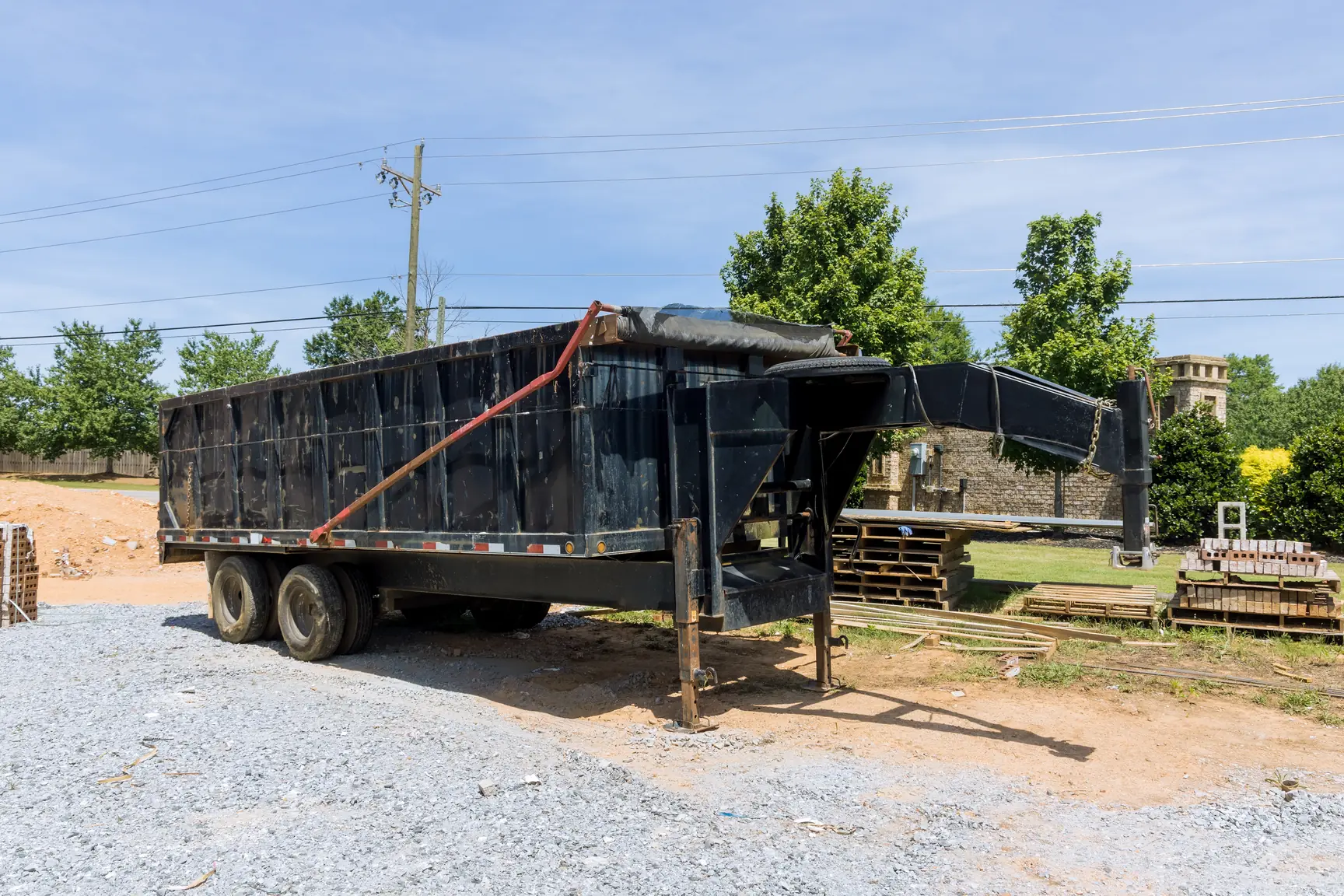
Louisiana asks things of a roll-off operator in three unrelated places. One is a filing with the environmental department. One is a weight line in a state police regulation. One is a parish or a city ordinance that decides whether a container may sit at a curb at all.
Each axis below carries its citation. Where the run behind our file stopped, or where a figure is held back under our own numerics rule, the page says so instead of rounding the edge off. The seam comes first, because it is the part no statute settles.
The Louisiana seam between a moving container and a resting one
Two liability forms both have an account of the instant a can comes off the rails on a Baton Rouge job, and the gap between those accounts is where this trade quietly loses money. The general liability form carries its own defined phrase about loading and unloading, and it will generally decline injury and damage arising out of the use of an auto — then tell you that use takes in loading and unloading. The commercial auto form never uses the phrase. It reaches the same instant by another route, and the route that decides arguments runs through whether the device moving the load is attached to the truck. The forms are drafted to meet each other, and the meeting point is rarely where an operator expects.
The second half is the ground. A container sits for a fortnight on a Lafayette drive, on a shell parking pad in Jefferson Parish, on grass behind a Shreveport rental — and when it goes, the surface goes with it. Whether a placement loss falls inside or outside a liability form’s exclusions for property in the care, custody or control of the insured, and for that particular part of real property being worked on, depends on exact language and exact facts. We are not going to resolve that here. What this page does is show where the seam runs so the question is raised at quoting time. The wording you hold governs the answer, and it is not written identically everywhere.
Louisiana adds a third thing to think about, and it is the load rather than the truck. Because the state credential attaches to a defined class of transporter, a change in what you haul can change which rules describe you. That is a conversation to have with an underwriter before it is one to have with an adjuster. What dumpster rental insurance covers starts the coverage question from the top.
Louisiana regulations and licensing for roll-off transporters
Three axes, in the order they arrive: the state credential, the rules on the truck, and the curb.
Axis 1 — the state transporter notification, and the number it produces
This is a state-issued credential. The environmental department receives the notification and assigns a Solid Waste Transporter identification number, through its Office of Environmental Services, and it publishes a public register of the holders. The class is set by a definition that describes a roll-off operator almost exactly:
“Transporter—any person who moves solid waste off-site to a non-processing transfer station or a collection, processing, or disposal facility, excluding individuals who transport their own residential waste to a collection facility, non-processing transfer station, or permitted processing facility and/or solid waste landfill.”
A can pulled off a job and run to a transfer station or a landfill is that, and the single carve-out covers an individual moving waste they generated themselves — which a hauler working for hire is not. The waste class holds too. The same section defines solid waste to include discarded material from industrial, commercial, mining and agricultural operations and from community activity, and names construction and demolition debris inside it; it then defines that debris as nonhazardous, generally non-water-soluble material produced when structures of any kind are built, remodeled, repaired, renovated or pulled down, while keeping regulated asbestos-containing material, white goods and creosote-treated lumber outside. The duty itself is a notification rather than an application:
“Persons who generate industrial solid waste and/or persons who transport, process, or dispose of solid waste shall, within 30 days after they become subject to these regulations, notify the Office of Environmental Services in writing of such activity.”
The same regulation obtains the form from the department or its website, and LAC 33:VII.401.B relieves anyone who has already notified from doing it again unless a change warrants it. A separate closure notification exists for an operator who stops. The department describes the filing as the way to request a transporter identification number for the first time or on a later occasion, and the statutory authority it recites is La. R.S. 30:2154.B(1)(a), under the Louisiana Environmental Quality Act.
Three near-misses sit close enough to be worth ruling out. The permit system in the same part of the code, running from § 509 onward, is a facility program covering permitted facility types, and a transporter is not a facility — the department keeps the two apart in its own site structure. Waste tires carry their own chapter with its own identically spelled defined term and its own application: the same word, a different class and a different waste stream, which is the sharpest naming trap in the Louisiana record. And the industrial solid waste generator identification number is a generator credential; hauling a customer’s waste does not make you an industrial generator.
Operating standards ride on the same class once you hold the number. LAC 33:VII.505 wants the bodies of vehicles carrying trees, limbs, construction materials or metals to hold the load without letting material fall or blow off, wants waste covered except while loading and unloading in a way that keeps rain out and vermin off and odors down, requires that waste go only to facilities permitted to receive it, and points vehicle types and sizes at the transportation department’s rules and at whatever local ordinance governs the streets a pickup has to travel.
Axis 2 — the state police rulebook, the 26,000-pound line, and the commission that is not yours
Enforcement here belongs to the Office of State Police, inside the Department of Public Safety and Corrections, through its Transportation Safety Services group and the Motor Carrier Safety Unit within its Commercial Vehicle Enforcement Division. LAC 33:V.10301.B states that only that office may enforce what the chapter adopts or enacts. The statutory policy sits at La. R.S. 32:1501(3), which asks that carrier transportation — including offering and accepting for transportation, loading, unloading and the carriage of hazardous materials, freight or passengers — meet minimum state standards of safe operation, manufacture and maintenance. Freight is defined at R.S. 32:1502(5) as anything loaded for transportation, so a container of rubble is freight and its hauler is a carrier under R.S. 32:1502(1).
Louisiana sets no weight figure in that statute. The number lives in the regulation, and our record says so rather than dressing it up as statutory.
“For the purpose of this Chapter, the federal motor carrier safety regulations, as adopted or amended herein, shall also govern all carriers, drivers, persons or vehicles not subject to the federal regulations, if the operated vehicle has a single or combined gross vehicle weight or gross vehicle weight rating, greater than 26,000 pounds and is used in commerce or industry.”
Greater than, not at or above — the comparator is strict. And LAC 33:V.10305.C.1 then substitutes that same figure for every ten-thousand-pound reference inside the federal parts the chapter brings in, which is why quoting a federal figure as a Louisiana requirement produces the wrong answer. Do not present the twenty-six thousand line as the only gate either: LAC 33:V.10305.A applies the adopted federal rules to anyone the federal regulations already reach, to in-state carriage of hazardous materials, and to vehicles built or used to carry sixteen or more people including the driver.
What attaches is compliance with an adopted federal code, enforced by the state. LAC 33:V.10303.A adopts a long list of federal parts as part of the chapter, and LAC 33:V.10305.C substitutes the Louisiana department and the state police wherever the federal text names the federal department, and substitutes compatible state forms where the federal text calls for federal ones. Name those parts as federal, because they are.
The trap in this axis is a single sentence in a different title, and it is the sharpest one in the Louisiana record:
“No motor carrier of waste shall operate without first having obtained from the commission a common carrier certificate or contract carrier permit”
Read alone, that puts every waste hauler in the state in front of the Public Service Commission. It does not. Subsection B ties the whole provision to waste as R.S. 45:162 defines it, and the definition is exhaustive:
“‘Waste’ means: (a) ‘Non-hazardous oilfield wastes’… (b) ‘Non-hazardous industrial solid waste’… (c) ‘Hazardous waste’…”
Municipal solid waste is not on that list of three. Construction and demolition debris is not on it either. The industrial limb reaches waste from a manufacturing, industrial or mining process, or material contaminated by it — not a house clear-out, not a roof tear-off, not a kitchen remodel. The same three-item limit runs through the commission’s own jurisdictional definitions of a common carrier by motor vehicle and of motor carriers, which reach household goods, passengers and that defined waste. A second, independent reason sits in the same chapter: a municipal-radius exclusion takes business conducted mainly inside one incorporated municipality, and within a short stated radius of it, out of the commission’s reach. So a Louisiana roll-off operator hauling construction debris or municipal solid waste falls outside the certificate and permit provision, while for those three defined classes the commission plainly does reach waste hauling. Add oilfield or industrial work and the answer changes. Commercial auto is where the vehicle side gets insured whichever answer applies.
Axis 3 — no statewide placement rule, and a New Orleans ordinance written for this exact trade
Louisiana sets no statewide roll-off placement permit and no statewide right-of-way permit. The state layer reaches the truck and the load and never the container’s resting place, and on the one point where it touches the question it points outward: the vehicle standards send types and sizes to whatever local ordinance governs the streets a pickup has to travel. Placement, street occupancy and local hauling permits are set municipality by municipality and parish by parish, and they differ.
New Orleans is the one municipality our file read in full, and it is offered as one city’s own code and never as Louisiana’s rule. It may not be generalized to Baton Rouge, Shreveport, Lafayette, Jefferson Parish, Caddo Parish or anywhere else. Its container provision is the most directly on-subject municipal text in this whole build — the section heading names dumpsters, the operative sentence names contractors and builders, and the trigger is curb space taken to serve a job beside it:
“The placement of trash containers, receptacles, other similar containers, and dumpsters… in the public right-of-way… shall be allowed only after the issuance of a permit by the department of public works.”
The same section fixes the term at no more than forty-five days, renewable for further forty-five-day periods where the applicant asks at least five working days before the current permit runs out, and lets the city attach conditions to any permit it issues. Section 146-585 then loads the container itself: the name, address and telephone number of the owner or of whoever assumes liability for it, permanently fixed on each side in contrasting, legible characters of a stated minimum height, the permit clearly displayed, and at least two reflective safety markers permanently fixed to each upper corner at each end, in a described yellow form. Note where that duty lands — on the party assuming liability for the container, which is the container company and not the customer. Section 146-586 lets the safety and permits director or the public works director have an unpermitted container removed and fine whoever placed it.
A separate instrument covers the truck, and operators miss it. Section 138-5(a) requires a permit from the sanitation director for vehicles that haul household garbage, trade or manufacturing refuse, garden trimmings, residential and business trash, contractors’ debris and similar waste products, with certification that disposal will happen where the director approves, and it exempts private passenger cars and station wagons. It is a per-vehicle permit rather than a company license. Its eligibility test is written in parish terms in the ordinance’s own words, reaching vehicles registered in the parish or carrying waste that came out of the parish, with service inside the city shown by existing contracts or a notarized statement. That is a Louisiana municipality reaching for the parish as its unit, in primary text rather than as a stylistic note. The customer side has its own rule as well: § 138-45(b) makes the owner of a small business or residential property under repair responsible for removing bulky waste and construction debris, and bars it from the curb and the neutral ground.
Figures withheld, and named rather than left silent. Section 146-584 sets money amounts for metered and unmetered curb space and an application fee; § 146-586 carries a monetary ceiling; and § 138-45(a) states volume bands that decide eligibility for city collection rather than anything about containers. Every one of those figures is quarantined under our numerics rule and none is reproduced on this page. Section 138-5(a) likewise requires a permit fee whose amount is not stated here. Read them in the city’s own code, or ask us and we will read them with you.
Whatever parish you work in, read its ordinance before the first drop. A New Orleans permit condition is a reminder that a municipality may want evidence of general liability cover before your container is allowed at the curb.
How Louisiana workers compensation gets secured
Louisiana runs a competitive market and compulsory cover. La. R.S. 23:1168.A opens by telling an employer to secure compensation to employees in one of the ways it then lists, and the four ways are ways of securing rather than an option to skip it: an authorized private insurer at A(1), a group self-insurance fund at A(2), an interlocal risk management agency at A(3), and individual self-insurance on proof of financial ability at A(4). The first of the four is the ordinary route, and A(1) describes it as keeping the payment of compensation insured with a stock corporation, a mutual association or another concern that is authorized to write the line in the state. The same paragraph then has the insurer send policy information to the national rating organization under its guidelines, with proof of coverage filed within thirty days of the effective date and naming every business entity in the state that the coverage reaches.
A(4) is not a fourth kind of insurance. It is a financial-ability route rather than a policy, and the assistant secretary may ask for a securities deposit or a surety bond and for proof of excess cover. A private market carrying the default route, with pooled and self-insured alternatives beside it and no state carrier in the section at all, is the shape of a competitive state.
Two limits, declared. A(5) was repealed in 2014, and that repeal removed a method of securing rather than a class of employer — do not read it as an exemption. And the sections defining which employers and which employees the act covers were not read in the run behind our Louisiana file, so no employee-count floor and no exempt class is written here, in either direction. Workers compensation covers class codes and payroll mechanics.
A panel for Louisiana in rows. Each row sets one thing the state requires beside the exposure that requirement leaves open and the coverage line that answers it. Hauler registration: A hauler credential, issued by the state. It leaves open a container placed on a customer’s property, and the driveway or curb it damages, which General Liability and Dumpster and Equipment Coverage answer. Intrastate motor-carrier authority: State motor-carrier rules attach at a vehicle threshold. It leaves open the roll-off truck at fault, and the container in transit, which Commercial Auto and Pollution Liability answer. Roll-off placement permits: Municipal — varies by city and town. It leaves open placement on the public right-of-way, and a struck pedestrian or vehicle, which General Liability answers. Workers compensation: Compulsory; bought from private insurers. It leaves open a driver or yard hand hurt on the job, which Workers Compensation answers. Notes: A registration, permit or bond is a condition of operating, not insurance: it answers none of the exposures on the right, so no line is drawn from it. The conclusion reads: The registration is not the coverage — the program is. No figures are shown.
How the six Louisiana coverages fit together
What each policy is doing on a Louisiana container account.
Common Louisiana roll-off claims, at pattern level
Patterns rather than figures — we publish no claim numbers, because our Louisiana file holds none and an invented one would be worse than silence.
The surface underneath. A can sits a fortnight on a drive or a shell pad, comes off loaded, and the surface is ruined. The customer says the driver chose the spot; the driver says the customer did. Whether that sits inside a care, custody and control exclusion turns on wording and facts, which is why the seam paragraph opens this page.
The curbside clip. A swap-out on a narrow New Orleans street catches a gallery post, a parked vehicle, a gate or a low line. Which form answers depends on where the loading and unloading language lands, and mid-claim is the worst time to find out.
The undeclared load. A renovation can arrives with solvent, fuel or treated timber beneath the drywall. Louisiana already keeps certain materials outside the debris definition, so what is in the container can change the rules you are under as well as the clean-up bill.
The crew injury. Tarping, cabling and cycling containers in summer heat is where crews get hurt, and the statute gives an employer four routes to secure that liability and no route around it.
Louisiana parishes behind these markets
Five Louisiana markets, each anchored on its parish. Louisiana has no counties, and in three of these the municipal and parish governments are one body — which matters when you are working out whose ordinance you are actually under.
New Orleans
Orleans Parish — city and parish are coextensive and governed as one — and this is the one municipality whose ordinances this page cites by name.
Baton Rouge
East Baton Rouge Parish — the capital, under a consolidated City-Parish government; a petrochemical and institutional construction market.
Shreveport
Caddo Parish — the northwest anchor, where the city and the parish publish separate codes and are separate governments.
Lafayette
Lafayette Parish — the Acadiana anchor, run by the Lafayette City-Parish Consolidated Government.
Metairie and Kenner
Jefferson Parish — the suburban market west of New Orleans — Metairie is unincorporated, so the parish is the only government there is.
Nearby states we also write
Louisiana borders exactly three states, so nothing is held in reserve here and nothing was chosen. Each page is written from that state’s own research file, and the Louisiana transporter notification above says nothing whatever about whether a neighbor requires anything similar.
- Texas dumpster rental insurance
- Arkansas dumpster rental insurance
- Mississippi dumpster rental insurance
Louisiana dumpster rental insurance FAQs
Does Louisiana actually issue a hauler credential, or is that another state?
It issues one. The environmental department takes a written notification from anyone who transports, processes or disposes of solid waste and assigns a Solid Waste Transporter identification number, then publishes a live public register of the holders. The duty sits at LAC 33:VII.401.A and the authority behind it at La. R.S. 30:2154.B(1)(a).
How soon after I start do I have to file that notification?
Within thirty days of becoming subject to the rules, in writing, on the form the Office of Environmental Services publishes. Under LAC 33:VII.401.B, someone who has already notified does not renotify unless something changes — so treat it as a one-time filing you keep current rather than an annual renewal.
I only haul construction and demolition debris. Am I still a transporter?
Yes. The regulation defines solid waste to take in discarded material from industrial, commercial, mining and agricultural operations and from community activity, and names construction and demolition debris expressly. It then defines that debris as nonhazardous, generally non-water-soluble material from construction, remodeling, repair, renovation or demolition of structures of every type, with asbestos-containing material, white goods and creosote-treated lumber kept outside the definition.
Do I need a Public Service Commission certificate to haul waste in Louisiana?
Not for municipal solid waste or construction and demolition debris. La. R.S. 45:164.A looks like it catches every waste hauler, but subsection B ties it to waste as R.S. 45:162 defines it, and that definition lists three classes only — non-hazardous oilfield waste, non-hazardous industrial solid waste, and hazardous waste. Add oilfield or industrial work to your book and you are on a different page of the statute, so ask before you do.
What is the Louisiana intrastate weight line for motor carrier safety rules?
Greater than 26,000 pounds, single or combined, for a vehicle used in commerce or industry that is not already caught by the federal regulations — LAC 33:V.10305.B. The comparator is strict rather than “or more”. A companion provision substitutes that same figure for every 10,000-pound reference inside the federal parts the state adopts.
Who enforces those rules on my trucks?
The Office of State Police, inside the Department of Public Safety and Corrections — its Transportation Safety Services group contains the Commercial Vehicle Enforcement Division and the Motor Carrier Safety Unit. LAC 33:V.10301.B says only that office may enforce what the chapter adopts, and LAC 33:V.10307 puts a civil penalty behind it after notice and a hearing.
What does New Orleans require before a container goes at the curb?
A public works permit for the placement itself under § 146-584, valid for no more than forty-five days and renewable in further forty-five-day blocks if you ask at least five working days out. Section 146-585 then wants the owner’s name, address and phone permanently on each side of the container in contrasting characters, the permit displayed, and two reflective safety markers on each upper corner at each end.
Is there a separate New Orleans permit for the truck itself?
There is, and it is missed constantly. Section 138-5(a) requires a permit from the sanitation director for every vehicle hauling commercial, contractors’ or residential refuse, construction debris and similar material — a per-vehicle permit, not a company license. Section 138-5(b) then writes the eligibility test in parish terms, reaching vehicles registered in the parish or carrying waste that came out of it.
This page reports Louisiana law as our own state research file records it. It is general information rather than legal advice, and it is not an opinion on what any policy covers — the wording you hold controls that, and carriers do not all write it the same way.
Start a Louisiana roll-off submission
Send us the trucks, the can count, the parishes you work and whether any of your loads are industrial or oilfield. That last answer changes more of this page than anything else on the list.
Related coverage for dumpster rental operators
- General Liabilitygeneral liability
- Commercial Autocommercial auto
- Dumpster and Equipment Coverageinland marine
- Commercial Propertycommercial property
- Workers Compensationworkers compensation
- Pollution Liabilityenvironmental / pollution liability
What it costs in Louisiana · States we serve · Dumpster Rental Insurance · Get a quote · Contact us
Primary sources
- LDEQ — solid waste transporter notification — the state department page behind the notification that produces a Solid Waste Transporter identification number
- LDEQ — current list of transporters of solid waste — the state’s own live public register of who holds a transporter identification number
- Louisiana State Police — Transportation Safety Services — the office that enforces the adopted motor carrier safety regulations on an intrastate truck
- Louisiana Department of Insurance — the state insurance regulator for policyholder questions and complaints