
Dumpster Rental Insurance by State
Dumpster Rental Insurance in Missouri
Missouri sends the hauling question down to its cities and counties, and its one statewide trucking credential switches off inside a geographic line most roll-off work never leaves.
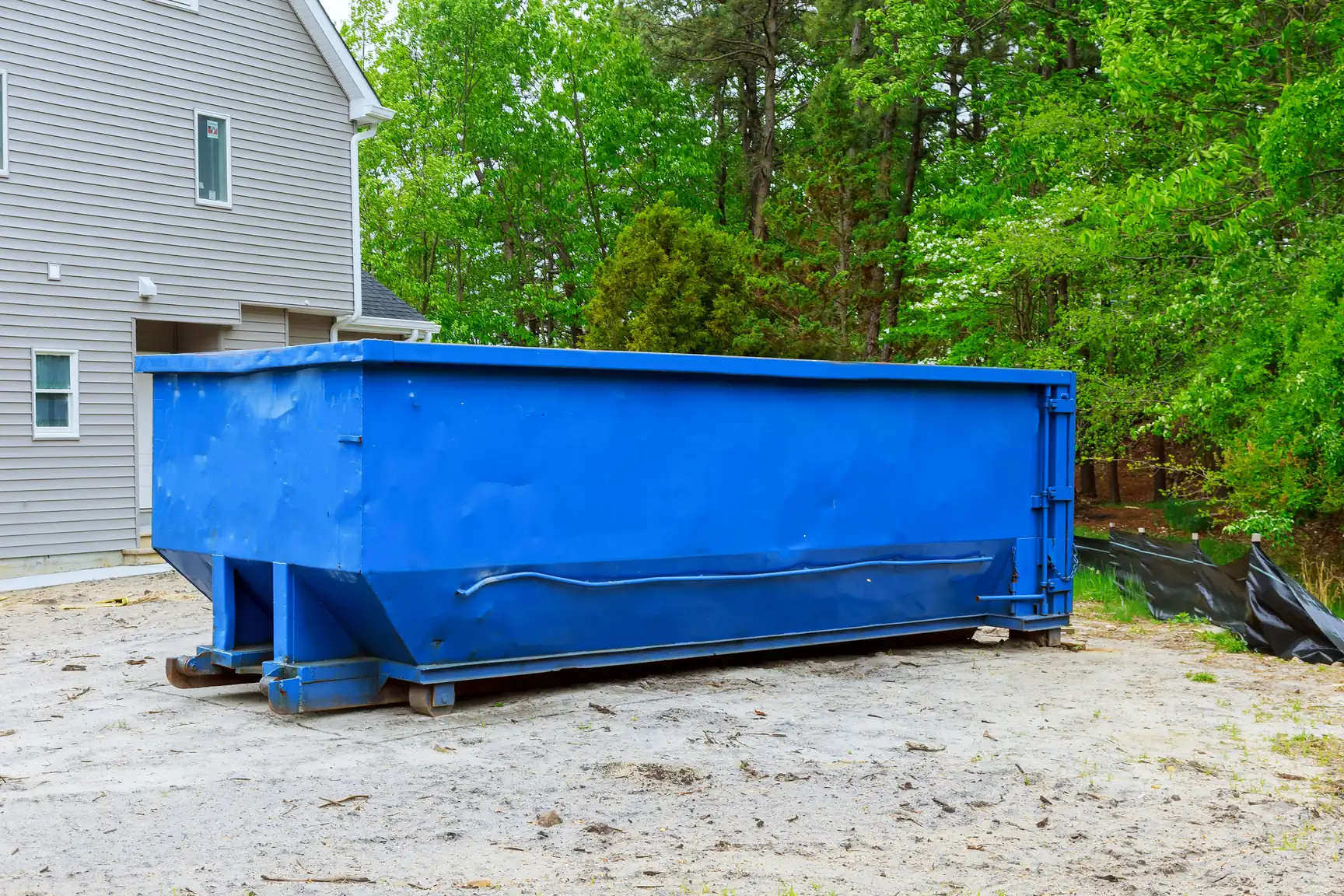
The coverage line a Missouri swap-out crosses
Before any statute enters the conversation, there is a drafting seam sitting under every roll-off business, and it decides more claims than any regulator does. Two liability policies both speak to the moment a container is coming off the rails or going back up, and the losses that go uninsured in this trade cluster in the gap between them.
On one side, the general liability form carries its own meaning for loading and unloading. It generally shuts out injury and damage arising from the use of an auto, and then treats loading and unloading as part of what using an auto is. On the other side, the standard auto form does not reach for that phrase at all. It gets to the same instant along a different path, and what it turns on is whether the thing that moved the property was attached to the truck. A cable winch or hook-lift arm on the chassis is attached. A skid steer the customer had running on the pad is not. The forms were built to meet each other, but the meeting point moves with the equipment and with the wording.
The other half of the seam is damage done to the surface the box was set on. In Missouri that is a driveway split on a Boone County remodel, a curb scraped on a narrow street in the city of St. Louis, an apron gouged behind a Springfield shop, a lawn cut into ruts after spring rain. Liability forms typically carry exclusions for property in the insured’s care, custody or control and for that particular part of real property being worked on. Whether a placement loss falls inside or outside either of those depends on the exact wording in force and on the exact facts, and it is not something a page like this resolves.
What this page is for is showing you where that seam runs across your own operation, so the question gets raised while an underwriter still has the file open rather than after a driveway is already broken. Your own policy language controls, and the forms in use are not identical from one carrier to another.
Missouri regulations and licensing
Missouri is an unusual entry. There is no statewide credential for a roll-off hauler, there is a statewide trucking registration that a great deal of roll-off work never triggers, and there is a municipal layer that the legislature deliberately put in charge. Reading those three in the wrong order produces the wrong answer.
Why no Missouri credential reaches the truck
Start with what Missouri does credential, because a flat statement that nothing is required would be false about this state. The environmental agency publishes its own enumeration of solid waste credentials, and it lists seven. Four are facility permits. One is a person-level technician certification. Exactly two reach a vehicle — a scrap tire hauler permit and an infectious and hazardous waste transporter license — and the environmental agency attributes both of those to the transportation department rather than to itself. The statute agrees: RSMo 226.008.1(2) gives the highways and transportation commission the job of licensing motor carriers hauling hazardous waste, used oil and infectious waste, and of permitting waste tire haulers. Four named streams. A roll-off box of nonhazardous construction debris or ordinary municipal waste is not one of them, so zero of the seven reaches this operator.
What the solid waste statute does instead is permit places rather than vehicles:
“It shall be unlawful for any person to operate a solid waste processing facility or solid waste disposal area of a solid waste management system without first obtaining an operating permit from the department.”
That is the permitting provision of Missouri’s solid waste law, and a sweep of the whole section for the word transport comes back empty. The section simply does not speak to moving waste. The corresponding definitions section carries no reference to a hauler at all, and where it mentions transportation it does so inside definitions that create no credential. Missouri’s waste districts are a real layer too, but they hold contractual and planning powers rather than licensing ones, and the council section that sets out those powers contains neither the word license nor the word permit.
So the honest sentence for Missouri is not that hauling is unregulated. It is that Missouri regulates it somewhere else — at the municipal layer, by statute, and on the highway side through a registration that has nothing to do with waste.
Missouri property carrier registration
The statewide credential that can reach a roll-off truck is a property carrier registration, administered by the Missouri Highways and Transportation Commission through the Department of Transportation. The requirement itself is one sentence:
“Except as otherwise provided in section 390.030, no person shall engage in the business of transporting property, except household goods, by motor vehicle for hire or compensation in intrastate commerce on any public highway in this state, unless there is in force with respect to that person a property carrier registration issued by the division pursuant to the provisions of sections 390.260 to 390.350, which authorizes such transportation.”
Read it for what is missing. There is no weight rating in that sentence, no combination weight, no tonnage. Missouri did not put a size line on the credential. The numbers all sit in the exemptions, and so does the exemption that matters most here.
One exemption does turn on weight: RSMo 390.030.1(7) lifts the duty from freight vehicles registered for a gross weight of six thousand pounds or less. The one that matters most here is geographic:
“The transportation of passengers or property wholly within a municipality, or between contiguous municipalities, or within a commercial zone as defined in section 390.020”
There is a proviso attached to that subdivision, but it withdraws the exemption from carriers of people in larger counties and from carriers hauling commodities in bulk in tank or hopper vehicles. A container of construction debris is neither. A separate provision pulled household goods carriers back out of this exemption some years ago, and it reaches household goods only, so a property carrier keeps the geography.
Everything then rides on how far the zone extends, and the statute draws it rather than naming it:
“any municipality within this state together with that territory either within or without the state of Missouri, extending one mile beyond the corporate limits of such municipality and one additional mile for each fifty thousand inhabitants or portion thereof; however, any commercial zone of a city not within a county shall extend eighteen miles beyond that city’s corporate limits and shall also extend throughout any first class charter county which adjoins that zone”
That is why the city of St. Louis matters on a Missouri page in a way it would not elsewhere: a city sitting inside no county draws a zone far wider than any other Missouri municipality gets. For an operator, the practical test is not the truck. It is the route. Work that stays inside one municipality, moves between touching municipalities, or stays inside the zone sits in the exemption; a haul that runs out of the zone to a distant landfill does not. That is a question to answer route by route and to keep a written note of, because it is also the question an underwriter will ask when the filing requirement comes up.
If the registration is required, the transportation department states the process on its own page: a USDOT number, an online application through its carrier portal, proof of insurance submitted by the insurance company rather than by the applicant, and an annual license fee per power unit for a carrier that is “not required to participate in the Unified Carrier Registration program”, and a yearly renewal license decal for all power units of a carrier that does not participate, charged per decal. Those two charges are a state license fee per truck. They are not a premium, not a rate, and not the cost of any insurance.
Two name collisions are worth closing. First, a certificate and a permit under this chapter reach household goods carriers and passenger carriers, and RSMo 390.260.3 removes those sections from property transportation outright. A roll-off operator holds neither. Second, the statute still says the registration is issued by the division, and that division does not exist: RSMo 226.008.5 abolished it and transferred its powers, and the revisor prints a cross-reference note recording the transfer beneath every affected section. Anybody quoting the registration sentence without that note will name a defunct agency.
The Missouri municipal layer
Missouri sets no statewide roll-off placement, street occupancy or right-of-way permit. Placement standards and hauler licensing are written by individual cities and counties and differ from one to the next — and Missouri is unusually direct about handing them the power. RSMo 260.215.2 gives a city or county express authority to adopt its own ordinances and standards for storage, collection, transportation, processing and disposal, so long as they conform to the department’s rules, and says the state sections do not take away a local government’s right to adopt and enforce rules at least as strict as the state’s. The municipal layer here is not a gap somebody forgot to fill. It is where the legislature put the question.
Kansas City is named below as one example, chosen because its code could be read in full with a dated edition banner. Nothing in it describes any other Missouri city.
“Required. No person shall engage in the business of collecting or processing refuse without first obtaining a permit therefore from the director; provided, however, that this subsection shall not be deemed to apply to employees of the holder of any such permit, or to prohibit any person from collection or processing his own refuse.”
The application provision shows how wide that permit is drawn: an applicant states which kind of permit is wanted — collecting, processing, transporting or some combination — what kind of refuse is involved, and whether the source is residential, commercial or both. So the city plainly contemplates a transport-only permit for a commercial source.
Here is the part this page will not overstate. The permit reaches the business of collecting or processing refuse, and the code defines refuse through garbage and rubbish, with rubbish defined as nonputrescible waste material, combustible or not. Construction and demolition debris fits those words on their face. But the chapter never says so, the retrieved text of it does not contain the term roll-off at all, and nothing establishes how the city reads its own ordinance against a construction box. So: the permit exists, it is a permit to collect, process or transport refuse, and its reach turns on that definition. Whether a roll-off operator needs one is a question for the director’s office, not for this page.
There is an insurance condition attached to that permit. The subsection requires an applicant to file and keep on file evidence of a satisfactory public liability policy covering all operations of the business and all vehicles used in it, sets minimum amounts for injury to one person, for injury or death of two or more people in a single accident, and for property damage, allows a small property damage deductible, and requires the insurer to give the director written notice before canceling, with that duty written into the policy itself. The dollar figures are one city’s ordinance minimums from a 2009 ordinance and are not written here: they are not a coverage recommendation, not a benchmark, not a statement that any amount is adequate, and not a description of any other Missouri city.
One more piece of Missouri law belongs in this section, because it runs the other way. RSMo 260.247 protects an incumbent private collector when a city annexes an area or moves collection service into one the private entity already serves: certified-mail notice is required, and the city may not start collecting there for at least two years unless it contracts with the incumbent. It reaches entities servicing fifty or more residential accounts or any commercial accounts, and it obliges the incumbent to produce information about its activity in the area on written request within thirty days. One statute grants power over you; the other protects you from the same government. Both are live, and neither is a placement permit.
Securing the Missouri workers compensation duty
Missouri is a competitive state. The duty is discharged in the private market or through qualified self-insurance, and there is no state fund in the operative text.
“Every employer subject to the provisions of this chapter shall, on either an individual or group basis, insure their entire liability under the workers’ compensation law; and may insure in whole or in part their employer liability, under a policy of insurance or a self-insurance plan, except as hereafter provided, with some insurance carrier authorized to insure such liability in this state, except that an employer or group of employers may themselves carry the whole or any part of the liability without insurance upon satisfying the division of their ability to do so.”
Two routes, both private: a policy with a company authorized to write the line here, or carrying the liability yourself after satisfying the division that you can. Either can be done individually or as a group. What this record does not carry is the threshold — who counts as an employer subject to the chapter is set somewhere this page did not read, so no employee count and no payroll figure appears here. An operator who has heard a number should check it with the division rather than assume it, and should not read the silence as permission.
The same subsection is unusually clear about the cost of doing neither. An injured employee, or the dependants of one who did not survive, may elect to sue the employer for damages instead — and in that suit the employer cannot defend by saying a fellow worker caused it, that the employee accepted the risk, or that the employee was to some degree careless. That is the whole bargain of the system removed at once, which is a far larger exposure than the premium it was meant to avoid.
A panel for Missouri in rows. Each row sets one thing the state requires beside the exposure that requirement leaves open and the coverage line that answers it. Hauler registration: State transporter credentials exist, but none reaches roll-off hauling. It leaves open a container placed on a customer’s property, and the driveway or curb it damages, which General Liability and Dumpster and Equipment Coverage answer. Intrastate motor-carrier authority: A state operating credential reaches for-hire hauling. It leaves open the roll-off truck at fault, and the container in transit, which Commercial Auto and Pollution Liability answer. Roll-off placement permits: Municipal — varies by city and town. It leaves open placement on the public right-of-way, and a struck pedestrian or vehicle, which General Liability answers. Workers compensation: Compulsory; bought from private insurers. It leaves open a driver or yard hand hurt on the job, which Workers Compensation answers. Notes: A registration, permit or bond is a condition of operating, not insurance: it answers none of the exposures on the right, so no line is drawn from it. The conclusion reads: The registration is not the coverage — the program is. No figures are shown.
Your six policies against Missouri work
Six lines sit under a Missouri roll-off operation, and each one bends slightly once the state’s particular shape is in the room.
The hub page at dumpster rental insurance reads the six as one program instead of six separate purchases.
The losses a Missouri operator reports
Patterns only. No frequency or severity figure appears on this page, because none was sourced for it.
The surface claim leads. A loaded box comes up onto the rails and the wheels track a line across a thin residential driveway, or the rails catch an apron on the way down. The driver and the homeowner are both unhurt and the estimate still arrives with a coverage argument attached, because the concrete under the box is exactly the property those two liability exclusions were drawn around.
Overhead strikes come next. A hoist lifts a box under a service drop on a narrow older street in the city of St. Louis or in an Independence subdivision, and the loss is somebody else’s equipment plus every hour the block spends dark.
Then the container that travels. A box set on a slope, on gravel, or on ground that softens after two days of Missouri rain moves in the night and finds a parked car or a fence line. The driver is gone, the customer says the placement was wrong, and the argument about care and control begins.
Then the undeclared load. A remodel box returns with paint, solvent or something from a regulated stream, and the scale house finds it. That is a pollution question and a contract question with the customer at the same time, and in Missouri there is no state hauler credential sitting underneath to define the operator’s duties for you.
And the injury on the ground. A helper pulling a tarp across a heaped load, a driver stepping off a wet chassis, a hand caught between a door and a frame. That is the workers compensation side, and it shapes an operator’s cost of risk for years longer than a single liability claim does.
Missouri roll-off markets
The unit these markets sit inside is the county, with one entry that sits inside none. No population, permit-volume or market-size figure appears here, because none is in the record. Geography is not an availability claim — Missouri is one of the 48 states this agency holds a license in, and that is what makes these markets writable.
Nearby states we also write
Missouri touches eight states, more than almost any entry in this build, and all eight are inside the licensed footprint. Three are linked here. Missouri’s conditional answer does not travel across a state line in either direction — each record governs its own state.
Missouri dumpster rental insurance FAQ
Does Missouri license me as a waste hauler before I can run roll-off boxes?
Not as a statewide credential for this work. Missouri does run transporter credentials — scrap tire haulers, and motor carriers moving hazardous waste, used oil and infectious waste — and the environmental agency attributes both of the vehicle-side ones to the transportation department. None of them reaches a nonhazardous construction or municipal load. What Missouri permits statewide is facilities. RSMo 260.205.1 and RSMo 226.008.1(2).
Missouri registers property carriers. Does my roll-off truck need that registration?
It depends on where the work is, not on what the truck weighs. RSMo 390.270 requires a property carrier registration for hauling property for hire on Missouri highways, and RSMo 390.030.1(8) lifts that duty for transportation performed wholly inside one municipality, between touching municipalities, or inside a commercial zone. An operator whose routes stay inside the zone sits in the exemption; one crossing out of it does not. Answer it route by route, in writing.
What is a Missouri commercial zone, and why does it decide the question?
RSMo 390.020(4) draws it geographically: a municipality plus a band of territory beyond its corporate limits, widening with the size of the municipality, and with a much wider band for a city that sits inside no county together with an adjoining first class charter county. It is the only thing standing between a Missouri roll-off operator and the registration, which makes it worth mapping against your actual drops.
The statute says a division issues the registration. Which Missouri agency issues it now?
The highways and transportation commission, working through the Department of Transportation. RSMo 226.008.5 abolished the old division outright and moved its powers, and the revisor prints a cross-reference note recording that transfer under every affected section. Quoting RSMo 390.270 without reading that note names an agency that no longer exists.
Does the Kansas City refuse permit apply to a construction roll-off container?
This page will not tell you it does, because the record does not establish it. Kansas City Code § 62-5(a) requires a permit to engage in the business of collecting or processing refuse, and the application contemplates transport-only permits and commercial sources. Whether the city reads its own refuse and rubbish definitions as reaching a construction and demolition box was not resolved, and nothing retrieved shows how the city applies it. Ask the director’s office directly.
How many employees before Missouri workers compensation becomes compulsory?
This page does not carry a number, and the reason matters. RSMo 287.280.1 puts the duty on every employer subject to the chapter; who is subject to it is set elsewhere and was not retrieved for this page, so writing a head count here would mean supplying a figure from outside the record. Treat the duty as live and confirm your own position with the division rather than with a web page.
A Missouri city is expanding collection into an area I already serve. Do I have any protection?
Yes, and it is unusual. RSMo 260.247 requires a city or political subdivision that annexes an area, or moves or expands collection service into one a private entity already serves, to give that entity notice by certified mail and to hold off collecting there for at least two years unless it contracts with the incumbent instead. The section reaches private entities servicing fifty or more residential accounts or any commercial accounts, and it obliges the incumbent to hand over information about its activity in the area on written request.
Is there a statewide Missouri permit for setting a container in a street?
No — and the absence is deliberate rather than accidental. RSMo 260.215.2 hands cities and counties express power to write their own rules for storage, collection, transportation, processing and disposal, and says the state sections do not displace local ordinances that are at least as strict. The municipal layer in Missouri is where the legislature put the question, so the answer changes town by town.
This page reports Missouri law as our own state research file records it. It is general information rather than legal advice, and it is not an opinion on what any policy covers — the wording you hold controls that, and carriers do not all write it the same way.
Build a Missouri submission worth quoting
Tell us your truck and container counts, the municipalities you actually drop in, whether any regular haul leaves the commercial zone, and which cities you hold permits with. Those answers move a Missouri quote further than anything else on an application form. Nothing here is legal advice or a statement of what any policy covers; the wording in force on your own policy controls.
Related coverage for dumpster rental operators
- General Liabilitygeneral liability
- Commercial Autocommercial auto
- Dumpster and Equipment Coverageinland marine
- Commercial Propertycommercial property
- Workers Compensationworkers compensation
- Pollution Liabilityenvironmental / pollution liability
What it costs in Missouri · States we serve · Dumpster Rental Insurance · Get a quote · Contact us
Primary sources
- RSMo 390.270 — property carrier registration required — the credential itself, one sentence long, with no weight in it
- RSMo 390.030 — exemptions, including the commercial zone — where the numbers and the geography actually live
- Missouri DNR — solid waste permits and licenses — the agency’s own enumeration of what it does and does not credential