
Dumpster Rental Insurance by State
Dumpster Rental Insurance in New Mexico
Two state credentials, from two agencies, and a municipal layer neither of them displaces.
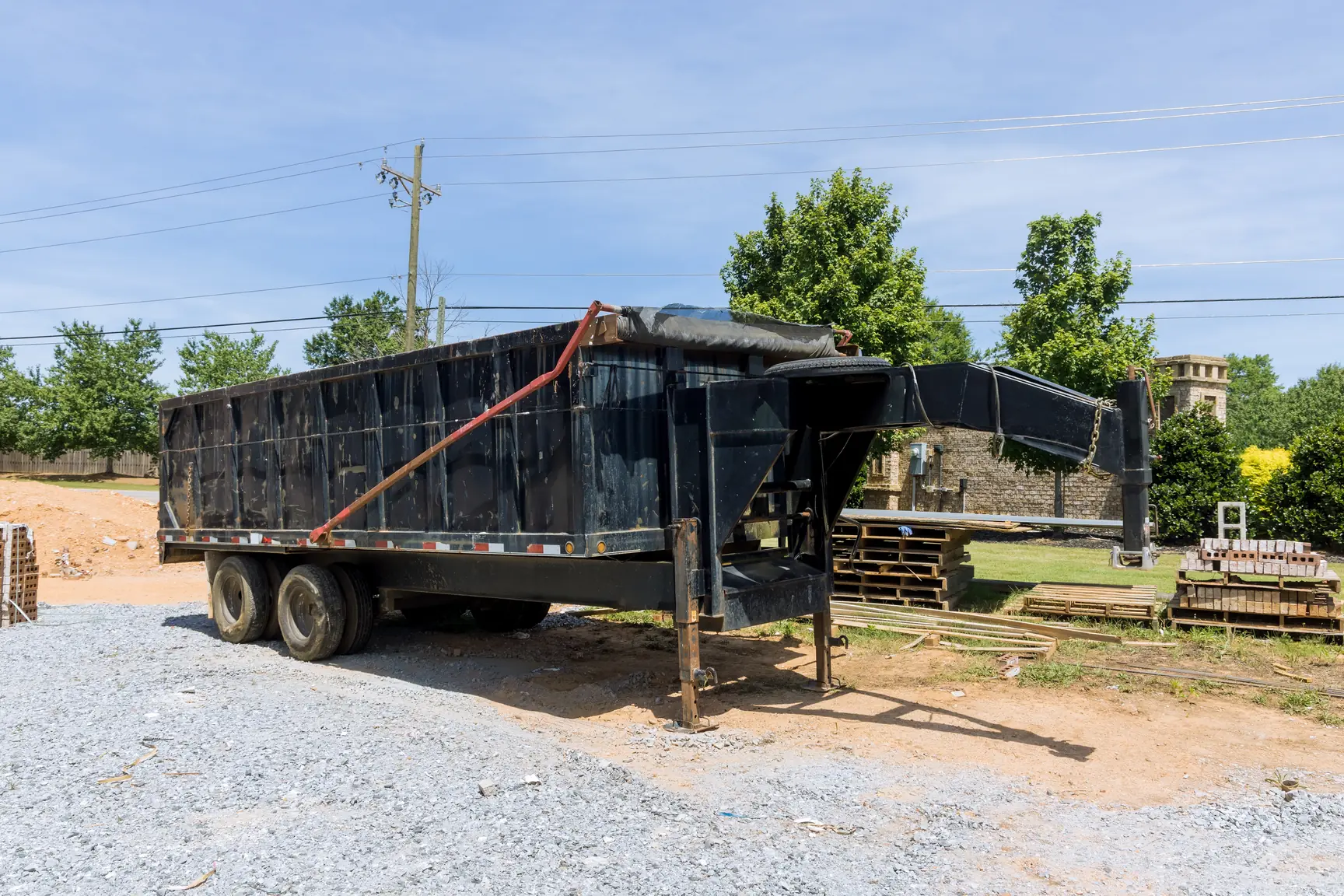
How a New Mexico placement loss falls between two forms
Picture a mid-morning drop on a remodel in the northeast heights. The driver backs down a stamped-concrete apron the homeowner had poured two summers ago, sets the box where the general contractor asked, and leaves. Nothing has gone wrong yet. But two of the policies you bought have already started disagreeing about who answers if it does.
The rough division is familiar enough. Commercial auto is the truck — driving it, working the hoist, and property moving on and off the bed. General liability is the container once it is down, the surface under it, and the activity around it for however many days it stands. The description that fails is the one for the moment in between, when the box is on the cable and its weight is transferring from steel to concrete.
That moment is the point where the two wordings were drafted to meet. The liability form names loading and unloading as an activity, steps back from injury and damage arising out of the use of an auto, then treats loading and unloading as part of what using an auto means. The auto form never uses that phrase. It reaches the same instant by other routes, and the one that matters here turns on whether the equipment doing the moving was attached to the truck. A hoist and cable are. A loader the site already had is not.
The other half of the seam has nothing to do with anyone being hurt. It is the apron. Spalled surface, a cracked control joint, a broken irrigation line, a section of xeriscape gravel pressed into the subgrade. General liability forms typically carry exclusions for property in the insured’s care, custody or control and for that particular part of real property being worked on. A placement loss can land either side of those exclusions, and which side it lands on is settled by the wording you hold and by the facts of that one drop.
We will not resolve that on a web page, and a broker who offers to has told you something about their reading rather than about your policy. What we do instead is put the seam in front of an operator while the program is being assembled. In New Mexico that is only half the preparation, because the state asks for two separate credentials before you move anything, and a city can still say no afterwards.
New Mexico regulations and licensing on three layers
New Mexico answers the credential question twice at state level — an environmental registration and a transport operating authority, from two different departments — and then hands a third answer to the municipality. An operator who has satisfied the state has not necessarily bought themselves a market.
The New Mexico commercial hauler registration
The duty is a rule-level duty and it is stated plainly in the rule.
“Commercial haulers of solid waste and any haulers that transport special waste shall register with the department 30 days prior to beginning operations and every five years thereafter, and shall submit the following information:”
Whether it reaches you is answered by a single definition, and a roll-off business sits inside it with room to spare.
“'Commercial hauler' means any person transporting solid waste for hire by whatever means for the purpose of transferring, processing, storing or disposing of the solid waste in a solid waste facility, except that the term does not include an individual transporting solid waste generated on his residential or business premises for the purpose of disposing of it in a solid waste facility.”
The carve-out at the end is for somebody moving waste their own premises produced. A company that hauls a customer’s waste for money is not that person. What the registration then asks for is a substantial picture of the business: who owns and operates it, the start-up date, hours and collection days, the container types needed for the premises served, where the maintenance yard is, a certification that drivers, trailers and vehicles are and will stay properly licensed or registered, how odors are controlled, the haul distance from the nearest and farthest collection points to the disposal site, which transfer stations and disposal facilities are used, an outline of crew training to tell hazardous, special and ordinary solid waste apart, and disclosures about past environmental fines and about any permit or registration revoked or suspended for cause.
Two structural points belong with it. The registration is not transferable: 20.9.3.37(B) NMAC ends it on any change of owner or operator, and the incoming party registers afresh before operating — which makes it a diligence item in any sale of a New Mexico roll-off business. And the agencies are not one agency. The registration goes to the New Mexico Environment Department, while the issuing-agency line of the rule itself names the New Mexico Environmental Improvement Board — the body that writes the rule rather than the one that takes the filing, and neither may be written as the other. The reviewing unit is published under two different bureau names on the same site in the same week, so we name neither as the only name.
Keep a fence around the statute. The prohibited acts in the Solid Waste Act are about disposing outside a permitted facility, disposing of the wrong waste type, building or operating or closing a facility without a permit, modifying one without permission, and disposing in a way that harms the environment. None of them prohibits hauling without a registration. The duty is real, and it lives in the rule, hooked to NMSA 1978, Section 74-9-8(H). A facility permit is a third thing again, and it runs on its own timetable — an author who says New Mexico solid waste permits last twenty years and says it about a hauler has merged two different instruments.
The New Mexico property warrant, and why the agency list misleads
The second state credential is a transport one, and its New Mexico name is a warrant. The prohibition it answers to is broad and has no weight limb at all.
“no person shall offer or provide a transportation service for hire within the state without first obtaining an appropriate operating authority from the department”
The rule the transportation bureau publishes says which services need a warrant, and the third of them is the one a roll-off operator is in.
“Warrants. A warrant is required for each of the following service types: (1) charter services; (2) towing services, including for repossessions; and (3) transportation of property, excluding household good services for which a certificate is required, and cadaver transports regulated under the Funeral Services Act, Chapter 61, Article 32 NMSA 1978.”
Two agencies describe the same operator holding the same credential, which is why this is a finding rather than an inference. The environmental rule asks a registering hauler for it in terms.
“if applicable, proof that a current valid warrant has been issued by the New Mexico public regulation commission, or in the case of a public entity hauling special waste, proof of financial responsibility.”
That rule names a body that no longer runs this program, and we quote it as served rather than tidying it. Motor carrier regulation moved to the state transportation department from the first of July 2024, and the commission’s own site now lists utilities, pipeline safety and consumer relations. Note also that New Mexico has a second department in the same chapter of its statutes: for the Motor Transportation Act, the unmodified word department means the department of public safety, which runs roadside and port-of-entry enforcement. Operating authority and roadside enforcement are two agencies, and writing one name for both gets one of them wrong.
The error to avoid on this axis is to read the bureau’s own summary as the rule. Its overview enumerates limousines, taxis, shuttles, tour and sightseeing operators, household goods movers, non-emergency medical transport, network companies and towing services — introduced by the word including, which makes it illustrative. Motor carriers of property are absent from that list and present in the rule the bureau itself publishes. An operator who trusts the enumeration will conclude New Mexico does not reach a waste hauler, and will be wrong.
Scope is set by the definition of property at NMSA 1978, Section 65-2A-3(RR), which is an open list of movable articles of value and excludes only household goods and a farmer’s own unprocessed produce. Two of the things it expressly includes — hazardous matter and manure — are themselves waste streams, which is the clearest internal signal that a load being waste does not put it outside the definition. The exemptions at NMSA 1978, Section 65-2A-38 are six and only six: school buses, United States mail carriers unless otherwise in the carrier business, hearses and funeral vehicles, a county or municipal public bus system, private carriers, and commuter services. There is no waste, garbage, refuse or rubbish exemption by name or by description. The one that could have reached this operator, private carriers, is undefined anywhere in that chapter — a hole we record as a hole — and on the ordinary meaning it describes a business hauling its own goods rather than hauling for pay.
Under 18.3.3.9(B) NMAC the operating authority faces immediate revocation if coverage is not on file with the department for four consecutive months, and the rule wants the policy written in the carrier’s exact legal and trading name and endorsed to run until canceled, with the insurer filing directly. The property-carrier minimums at 18.3.3.10(B) NMAC are a reference out to federal rules rather than a New Mexico figure, and one of the two federal citations in that subsection is malformed as served — we reproduce nothing from it. Safety rules at 18.3.4 NMAC adopt federal material and substitute intrastate commerce for the federal terms, with a provision that removes weight and seating limits for the purposes of that rule. NMSA 1978, Section 65-2A-7(C) wants a copy of the operating authority in every vehicle; Section 65-2A-12(C) forbids transferring or leasing it; Section 65-2A-12(D) lets the department cancel it where the holder does not operate for twelve consecutive months or lets proof of financial responsibility lapse for four.
Municipal reservation and permits in New Mexico
New Mexico writes no statewide roll-off placement or right-of-way permit. What it does instead is preserve the local layer twice over, from two different statutes: NMSA 1978, Section 74-9-42 says nothing in the Solid Waste Act limits a county or municipality from adopting stricter solid waste requirements or from exercising planning and zoning powers, and NMSA 1978, Section 65-2A-39 says nothing in the Motor Carrier Act restricts a municipality’s police power over its own streets and public places. So the third layer sits on top of both state credentials rather than beneath them.
One city is offered as an illustration, cited to that city and generalized to no other New Mexico municipality. Its ordinance starts from the opposite end to most.
“Except as otherwise provided herein, all refuse accumulated in the city shall be collected, conveyed, and disposed by the city. No person shall collect, convey over any of the streets or alleys of the city, or dispose of any refuse accumulated in the city except as herein provided.”
Refuse there is defined broadly enough to cover the ordinary load — putrescible and nonputrescible solid wastes, with hazardous and toxic wastes carved out — and commercial collection is simply everything that is not residential collection, so the chapter is not a household-only chapter. Against that reservation, § 9-10-1-5(C) authorizes the Mayor to issue permits, for a fee the Mayor or a designee sets, allowing people other than the producer or the premises owner to transport certain solid waste, and the first category named is construction or demolition site refuse. That is why this example reaches a roll-off operator instead of sitting beside one. Subsection (B) also lets the Mayor enjoin commercial collection, conveyance or disposal.
Three cautions on that example. The permit is drafted as an authorization to the Mayor rather than as a duty on the hauler, so the prohibition and the permit have to be read together or the sentence does not stand up. The word annual appears in the subsection heading and nowhere in the operative text, and a heading is not the law — we do not tell you the permit runs for a year. And our research located no separate roll-off placement or right-of-way obstruction permit in that code, so this page asserts none; what it did find alongside the transport permit were container-handling duties, including a duty to provide and maintain commercial containers in sanitary condition. The code host serves a current supplement, but the section itself was last amended more than a decade ago — a current supplement is not a recently amended section. Placement rules in New Mexico are municipal. Check the ones where you work.
Workers compensation and the three-worker line in New Mexico
New Mexico is a competitive workers compensation state with a private market and a solvency alternative. The scope question comes first, and the statute answers it with a headcount and an override: NMSA 1978, Section 52-1-6(A) applies the Act to employers of three or more workers, and applies it to every employer engaged in activities that must be licensed under the Construction Industries Licensing Act whatever the headcount, while putting employers of private domestic servants and of farm and ranch laborers outside it.
Two fences on that paragraph, both from our own record. The administering agency’s compliance page adds a category for any business registered as a limited liability company or incorporated, and that category has no counterpart in the statutory text our research read — so this page states the three-worker test and the construction override, and does not tell you that every New Mexico limited liability company needs cover. And whether a dumpster rental business is engaged in activities requiring a license under that construction statute was not determined in our research. We do not assert that it is, and we do not assert that it is not. Ask the agency, or ask us and we will ask on your behalf.
How the cover is placed is set by NMSA 1978, Section 52-1-4(A). An employer subject to the Act directs its insurance carrier to file evidence of coverage with the director, on a certificate carrying whatever the director’s regulation requires, and that certificate has to come from an insurer authorized under the state insurance code. Where an employer satisfies the director that it is financially solvent and that insurance is unnecessary, the director issues a certificate to that effect which is filed in place of the insurance certificate. Subsection (C) makes the insurer or the employer directly and primarily liable to the worker, and subsection (D) requires notice of cancellation to reach the director within ten days. That is an ordinary competitive structure: buy from an authorized insurer, or prove you do not need to.
A panel for New Mexico in rows. Each row sets one thing the state requires beside the exposure that requirement leaves open and the coverage line that answers it. Hauler registration: A hauler credential, issued by the state. It leaves open a container placed on a customer’s property, and the driveway or curb it damages, which General Liability and Dumpster and Equipment Coverage answer. Intrastate motor-carrier authority: A state operating credential reaches for-hire hauling. It leaves open the roll-off truck at fault, and the container in transit, which Commercial Auto and Pollution Liability answer. Roll-off placement permits: Municipal — varies by city and town. It leaves open placement on the public right-of-way, and a struck pedestrian or vehicle, which General Liability answers. Workers compensation: Compulsory; bought from private insurers. It leaves open a driver or yard hand hurt on the job, which Workers Compensation answers. Notes: A registration, permit or bond is a condition of operating, not insurance: it answers none of the exposures on the right, so no line is drawn from it. The conclusion reads: The registration is not the coverage — the program is. No figures are shown.
Matching coverage to a New Mexico hauling operation
Six lines, each with a New Mexico reason attached.
Common New Mexico roll-off claims and what they touch
We publish no claim counts or severities here. We have not measured them, and a figure invented to fill a section is worse than an acknowledged gap. These shapes are illustrative.
The first shape is surface damage at placement. The customer chooses the spot, and the spot is the drive or the apron. Because the loss lands on the exact surface the box was set on, it meets a care, custody or control question or a part-being-worked-on question, and those are decided on wording rather than on fault.
Second is damage during the movement: a cable failure, a box that slides on a sloped drive, a swing that catches a gate, a wall or a parked vehicle while the driver works a narrow lot. Those losses straddle the two forms, and a deciding fact is a mechanical one — was the gear that shifted the container part of the truck, or was it not?
Third is third-party injury around a set container — climbing in, throwing material over the rail, a child on a residential drop, a door or lid moving in wind. Fourth is the contents problem, which in New Mexico has a regulatory edge as well as a coverage edge: a load that turns out to hold special waste is inside a different limb of the registration rule, and a mixed load has already lost its construction-and-demolition classification. Fifth is driver and helper injury, clustering in this trade around the tarp, the walk-around and the lift rather than around the driving.
New Mexico roll-off markets
Our New Mexico license runs statewide. Below are the markets our submissions cluster around, each set against the county it sits in. No size figure is attached to any of them, because our research produced none and we do not invent numbers to fill a table.
- Albuquerque — Bernalillo County
- Las Cruces — Doña Ana County
- Rio Rancho — Sandoval County
- Santa Fe — Santa Fe County
- Farmington — San Juan County
- Roswell — Chaves County
Distance is the operational fact that shapes a submission here in a way it does not in a compact state. A single operator may hold a metro contract and still run a scheduled swap four hours away, which changes the fleet mix, the driver-hour picture and where your containers actually sit overnight. The first market on that list is also the city whose ordinance is quoted above; being a market we write and being an example we cite are two different acts, and nothing about that ordinance describes any other county on the list.
Nearby states we also write
New Mexico borders five states and touches Mexico to the south. Three neighbors with measured research records are linked below. Carry nothing across those lines in either direction: New Mexico is the one state in this build that answers both credential questions with a yes, and its term for a property operating authority means nothing at all under any neighbor’s law.
New Mexico dumpster rental insurance FAQs
Does New Mexico require a state registration to haul waste for hire?
Yes. Under 20.9.3.31(A) NMAC a commercial hauler of solid waste registers with the state environmental department thirty days before it starts operating and again every five years, submitting a long list of information about the operation. The registration is state-issued, not municipal, and the department publishes the same requirement in plain words on its own permitting page.
Is the New Mexico hauler registration in the Solid Waste Act itself?
No, and the distinction matters if you are reading the statute. The prohibited acts at NMSA 1978, Section 74-9-31 are about facilities and disposal, and none of them forbids hauling without a registration. The duty is created at rule level, and its statutory hook is NMSA 1978, Section 74-9-8(H), which directs the board to establish requirements and procedures for commercial haulers. So New Mexico does require the registration; the Solid Waste Act is not the instrument that requires it.
Does a customer load of construction debris count as solid waste here?
Yes. NMSA 1978, Section 74-9-3(D) treats construction and demolition debris as a defined class — steel, glass, brick, concrete, asphalt roofing, pipe, wallboard, lumber from building or taking down a structure, plus rocks, soil and vegetation from land clearing for a construction project. One clause has an operational bite for a roll-off: if that debris is mixed with other solid waste, whether or not it came from the same project, it stops being construction and demolition debris by the state’s own definition.
What is a New Mexico warrant, and do I need one?
A warrant is New Mexico’s term for the operating authority a motor carrier of property holds. NMSA 1978, Section 65-2A-7(A) bars offering a transportation service for hire in the state without an appropriate operating authority from the department, and 18.3.2.8(A) NMAC lists a property warrant as one of the three warranted service types. The state environmental rule confirms the same operator holds it: 20.9.3.31(A)(15) NMAC asks a registering commercial hauler for proof of a current valid warrant.
The transportation bureau list does not mention property carriers. Am I outside it?
No. The bureau’s overview enumerates limousines, taxis, shuttles, tour operators, household goods movers, medical transport, network companies and towing — an illustrative list introduced by the word including, not an exhaustive one. The rule the bureau itself publishes at 18.3.2.8(A) NMAC names transportation of property, and its own subscription form offers a warrant category that is not towing. Do not read the enumeration as the law.
Is there a weight at which the New Mexico warrant applies?
There is no weight limb on the warrant at all — the trigger is the activity of carrying property for hire. New Mexico law does carry weight figures, but they belong to safety and to a different act: NMSA 1978, Section 65-3-3(A)(1) applies the Motor Carrier Safety Act at twenty-six thousand one or more pounds intrastate, and the Motor Transportation Act uses twelve thousand pounds or more for its own definition. A truck below those figures still needs the warrant.
What keeps a New Mexico warrant alive once I have it?
Insurance on file, mainly. Under 18.3.3.9(B) NMAC a warrant is subject to immediate revocation if coverage is not on file with the department for four consecutive months, and the rule wants the policy in the carrier’s exact legal and trading name, endorsed to run until canceled, filed by the insurer directly. NMSA 1978, Section 65-2A-7(C) requires a copy of the operating authority to be carried in each vehicle, and Section 65-2A-12(C) forbids transferring or leasing a warrant to anybody else.
If I hold both state credentials, can an Albuquerque customer hire me?
Not automatically, and that is the point of the third layer. Albuquerque reserves refuse collection in the city to itself by default under its Code of Ordinances § 9-10-1-5(A), and then authorizes the Mayor to issue permits to transport certain solid waste out of that reservation — with construction or demolition site refuse the first named category. Neither state credential displaces that municipal layer, because NMSA 1978, Section 74-9-42 and Section 65-2A-39 both preserve local authority expressly.
This page reports New Mexico law as our own state research file records it. It is general information rather than legal advice, and it is not an opinion on what any policy covers — the wording you hold controls that, and carriers do not all write it the same way.
Ask us to price a New Mexico operation
Tell us whether your registration and your warrant are both current, which cities you take private accounts in, how far your longest scheduled run is, and what your boxes weigh loaded. Credential lapses and coverage lapses are the same event in this state, so we would rather see the filings than hear about them at renewal.
Related coverage for dumpster rental operators
- General Liabilitygeneral liability
- Commercial Autocommercial auto
- Dumpster and Equipment Coverageinland marine
- Commercial Propertycommercial property
- Workers Compensationworkers compensation
- Pollution Liabilityenvironmental / pollution liability
What it costs in New Mexico · States we serve · Dumpster Rental Insurance · Get a quote · Contact us
Primary sources
- New Mexico Office of Superintendent of Insurance — the state insurance regulator