
Dumpster Rental Insurance by State
Dumpster Rental Insurance in South Carolina
No statewide hauler permit, a motor carrier chapter that stopped reaching property in 2022, and placement rules written one city at a time — over a safety layer that still reaches every truck you own.
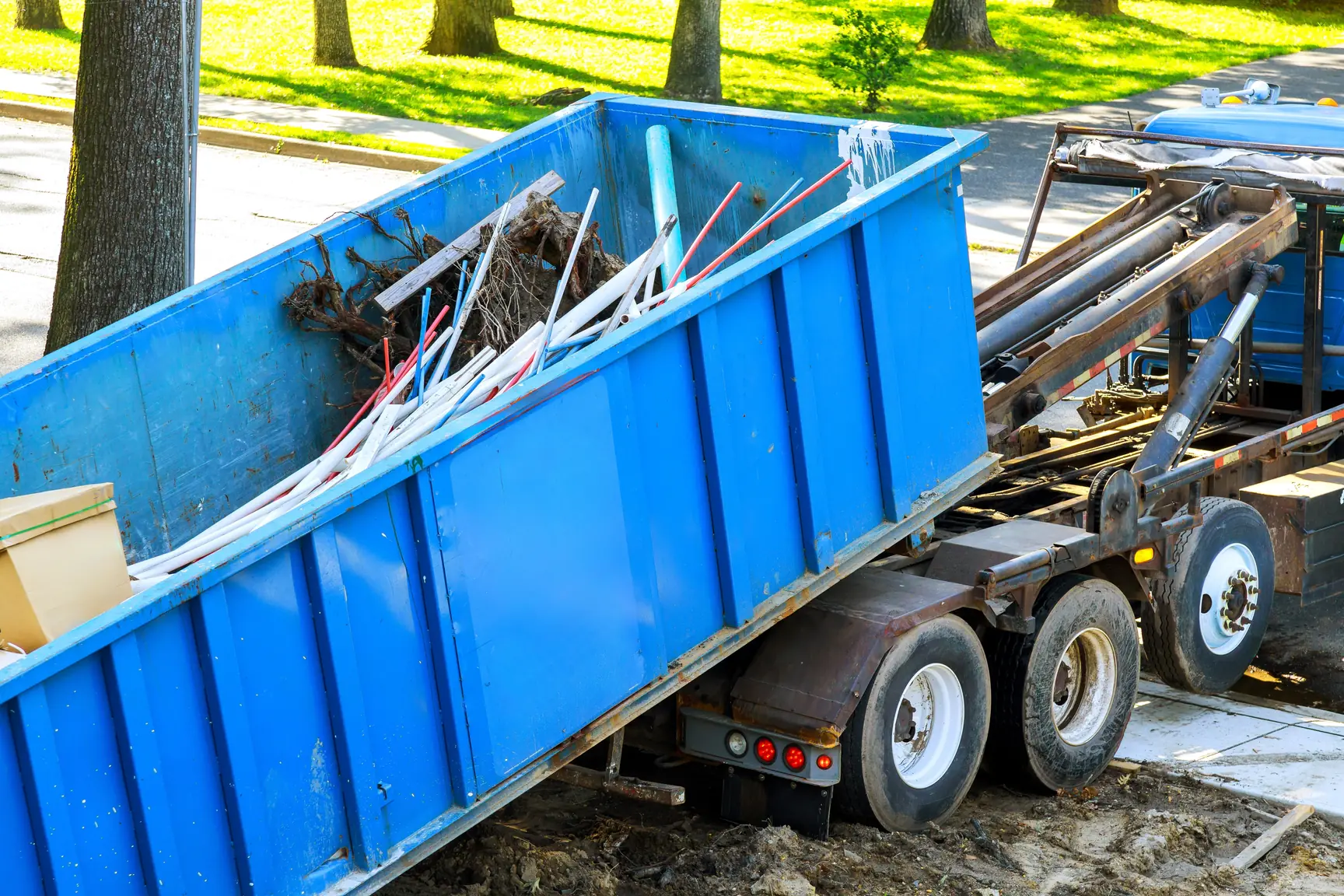
Where the truck stops answering and the box starts, on a South Carolina job
A dumpster rental operation carries two liability policies that both lay claim to the same twenty seconds. The hoist takes the weight, the box tilts back, the rails find the ground, the truck pulls forward and the cable goes slack. The answer to which policy responds for a loss inside those seconds is written across two forms.
Commercial auto answers for the truck, and it answers for more than driving. The form reaches the work of getting a load on and off the vehicle, which is deliberately broad language and is why a container that swings into a parked sedan while the hoist is under power reads as an auto loss rather than a premises one. That reach follows the chassis. It does not follow the box after the chassis has gone.
General liability picks up everything on the far side of that line. Once the empty is on the ground and the driver has pulled off the address, the container stops being part of a vehicle operation and becomes something quieter and riskier: your property, sitting on somebody else’s property, unattended, for four days or ten. It fills with material you did not choose. Children climb it. A neighbor trips on a rail at dusk. None of that is a driving exposure, and an operator who has only ever bought commercial auto has bought the smaller half of the job.
The seam shows up in placement damage, and South Carolina hands it a specific set of surfaces. A peninsula rehab in a historic Charleston block puts a loaded box on brick pavers and a drive cut for a carriage, not a hook-lift. Upstate subdivisions run on red clay that carries a box in February and rolls under it after three days of rain. Coastal lots hide septic lids and irrigation heads an inch below sod. The rails need do nothing dramatic; they need only be where a homeowner did not expect them, for long enough. Whether the bill lands on auto, on general liability or in the care and custody wording of neither turns on where the truck was in the cycle — a question worth settling with your agent while nothing is broken.
The South Carolina rules a roll-off operator actually meets
Three regulatory questions get asked about this trade, and in South Carolina they have three different answers with three different agencies behind them. Taking them in the wrong order is how operators end up chasing a certificate the General Assembly removed while missing the safety rules that reach every truck on the yard.
No statewide hauler credential, and the waste streams South Carolina does credential
South Carolina issues no permit, license or registration to the person who hauls ordinary construction and demolition debris or household rubbish from a customer’s address to a transfer station. That is a measured finding rather than an assumption, and the measurement is in what the solid waste act does instead: it permits the place, not the truck.
“No person shall operate a solid waste management facility without a permit from the department.”
The same section goes on to condition construction, expansion, modification and closure of a facility on the department’s requirements. Read the chapter looking for the hauler and you will not find one; read it looking for the landfill and it is all there. The waste stream itself is defined at § 44-96-40(6), where “Construction and demolition debris” is given a meaning covering the discards of building, repair, demolition, road work and land clearing — but a definition creates no duty on whoever moves the material.
It does not follow that South Carolina credentials no transporters. It credentials four, and every one belongs to a stream this operator is not in. The waste tire program names haulers expressly, beside collectors, processors, recyclers and disposers, and directs the department to require a permit or registration of them all (§ 44-96-170(J)(1)). Infectious waste carries its own registration for transporters alongside generators and facilities (§ 44-93-30). Hazardous waste is permitted at the level of the facility, site or activity before anyone may transport, store, treat or dispose of it (§ 44-56-60(a)(2)) — though that subsection carries a court validity annotation in the served text, so it is the weakest of the four and nothing here rests on it. Septic pumpers and haulers are licensed through the department’s onsite wastewater program, recorded from the agency’s own navigation and cited to no statute. Roll-off hauling of nonhazardous debris is not among the four. If you also pull tires or pump tanks, the credential you need is that stream’s, not a general hauler’s.
One wrinkle worth knowing before you ring anybody. The department that administers this chapter changed on July 1, 2024 under 2023 Act No. 60, and the code has not caught up with itself: the definitions section still points at the body that was wound up, while another section of the same chapter names the successor. The current administering body is the South Carolina Department of Environmental Services, through its Division of Land and Waste Management. An operator working from the definition alone will telephone an agency that no longer exists.
The 2022 amendment that took property out of South Carolina operating authority
South Carolina narrowed this regime in 2022. The prohibition that made a certificate compulsory now names a short list of cargo, and ordinary debris is not on it.
“No corporation or person, his lessees, trustees, or receivers may operate a motor vehicle for the transportation of persons, hazardous waste for disposal, or household goods for compensation on an improved public highway in this State except in accordance with the provisions of this chapter”
What that sentence used to say is the whole point, and the served Effect of Amendment note records the swap in the legislature’s own bookkeeping.
“2022 Act No. 214, SECTION 1, in the first sentence, substituted ‘, hazardous waste for disposal, or household goods’ for ‘or property’”
The same substitution was made at § 58-23-30 and § 58-23-40 by sections 3 and 4 of that act, all with the same May 2022 effective date. Nonhazardous solid waste carried for money is property; property came out. Section 58-23-25 shuts the door from the other side by denying the Public Service Commission authority over a property carrier, private carriers included, save for certificate carriers of household goods or hazardous wastes for disposal.
The trap is that the certificates survived the prohibition. Sections 58-23-250, -260 and -270 still authorize a certificate D for property vehicles on regular routes and schedules, a certificate E for property vehicles on no particular route or schedule, and a certificate F for contract hauling of freight or property. An operator who finds the class E description will recognize their own business in it perfectly — irregular routes, property, for hire — and may apply for a credential the General Assembly stopped requiring. The definition at § 58-23-10(4) compounds it: “motor vehicle carrier” was never conformed to the rewrite. The operative sections were amended; the definition was not, and the operative sections govern.
What does still reach your trucks is the safety layer, and it is a different agency, a different article and a regulation rather than a statute. There is no weight threshold to find here: a full-text sweep of the served chapter for the word “pounds” returns nothing at all. Scope is stated instead by who is covered.
“to all motor carrier vehicles engaged in interstate commerce and intrastate commerce over the highways within the State of South Carolina, whether common carriers, contract carriers, exempt carriers, or private carriers”
That regulation adopts the federal safety, equipment and hazardous materials rules — 49 CFR Parts 382, 383, 385, 387 and 390 through 399, and Parts 107 and 171 through 180 — and applies them to intrastate running as well as interstate. Those are federal rules. They reach a South Carolina intrastate roll-off truck only because this South Carolina regulation adopts them, and it takes future amendments with them, so the incorporated text moves while the incorporating text stands still. Any weight figure that bites your operation here arrives from inside those federal parts and should be named as federal, because the State did not set it. South Carolina sets one number of its own in that regulation and it is not a weight: the minimum driver age for intrastate carriers is lowered to eighteen. The article’s own definition at § 58-23-1110(5) expressly takes in private carriers and applies whether or not the hauling is for compensation, and enforcement is exclusive to the Transport Police Division of the Department of Public Safety under § 58-23-1120. So the honest summary is not that South Carolina deregulated your truck. It is that the economic credential stopped reaching you and the safety rules never did.
Placement is a city and county question in South Carolina
No South Carolina statute retrieved for this page creates a placement, container or right-of-way permit for a roll-off box. The solid waste act’s permitting section reaches facilities, and nothing else in the code steps in behind it. That is a narrow negative and it is worth stating precisely, because the useful version of it is the State does not set placement rules and the dangerous version is placement is unregulated here. The second is false. There are forty-six counties and a great many municipalities, nothing bars them from regulating waste collection, and this page swept none of them.
One worked example shows what a municipal layer looks like when you read it properly. In the City of Charleston, the code puts a container duty on construction, renovation and demolition sites — and puts it on the property side of the transaction rather than on the hauler. Under § 14-49 it is unlawful for the owner, agent or contractor in charge of such a site to allow debris to accumulate before, during or after the job, and the same section makes it their duty to keep adequate containers on site, arrange collection and disposal, and be able to show proof of where the material ended up. Subsection (b) of that section, as published, says containers must be kept “on the side” where it plainly means the site; we quote nothing from it rather than silently repair a municipal ordinance. The companion section makes the same point by withdrawal.
“The same shall be removed by the contractor or builder, or owner or resident of the premises having hired the contractor or builder, each being jointly and severally responsible for such removal.”
The City declines to collect builder and contractor refuse and hands responsibility jointly to the builder and the owner who hired them. That is a commercially useful fact, because it tells you who your counterparty is and who has an incentive to argue about a removal. It is not a municipal license for the hauler: nothing in the retrieved chapter licenses one, and we do not assert one. Charleston also publishes street-blocking and dumpster permitting outside that chapter, on pages this page did not read, so nothing is claimed here about a Charleston right-of-way permit either way. And this is one city’s ordinance, presented as an example and never as South Carolina’s rule — the answer in Rock Hill or Horry County is whatever those governments say it is, which is why the only reliable step is the telephone call before the truck rolls.
A small illustration of how fast a stale agency name travels: that Charleston chapter still refers to the state environmental body that ceased to exist in July 2024, in an ordinance last touched in 2017. A live municipal code can be current law and out of date at the same time.
Securing workers compensation as a South Carolina employer
South Carolina is a competitive state. Coverage is bought in the private market, the regulator is the South Carolina Workers’ Compensation Commission, and the securing statute offers an employer two routes rather than one.
“Every employer who accepts the provisions of this title relative to the payment of compensation shall insure and keep insured his liability thereunder in any authorized corporation, association, organization, or mutual insurance association formed by a group of employers so authorized or shall furnish to the commission satisfactory proof of his financial ability to pay directly the compensation in the amount and manner and when due as provided for in this title.”
Insure, or satisfy the commission that you can pay claims yourself. The same subsection lets the commission allow two or more employers in similar businesses to pool their liabilities and qualify as self-insurers, requires acceptable security from one, and keeps group self-insurers under the commission’s exclusive jurisdiction rather than the insurance department’s. Two private-market routes and a pooled variant of the second is the regulatory shape of a competitive state.
Is it compulsory? Yes, and the proof is in the penalty rather than the verb. Section 42-5-40 fines an employer for failing to secure compensation, and a statute that fines you for not securing is not inviting you to secure. We will not publish the fine figures on an insurance page, where a dollar amount reads as a price. There is a second thing we will not publish: our South Carolina record does not contain the section defining which employers are inside the title, and the phrase about accepting the provisions of the title is itself a pointer to a definition we did not read. No employee-count floor and no exempt class appears here, because supplying one from memory is exactly the failure §14 exists to prevent.
And the section head lies. Section 42-5-20 is headed as prohibiting a self-insurer, which reads as though South Carolina forbids self-insurance. The body does the opposite — subsection (A)(1) expressly permits proof of financial ability and direct payment. What is actually prohibited sits in (B) and is narrow: an association formed under § 42-5-50 is not treated as a licensed insurer and gets no protection from the state guaranty association. The heading compresses a guaranty-association exclusion into three misleading words, and an author working from headings publishes the reverse of the law.
One more precision, because it matters to where you shop. South Carolina does operate a state accident fund, and by its own published account it covers the State itself together with the local governmental entities inside it. A privately held roll-off operation is neither, so that fund is not a route open to you. The sentence South Carolina has a state workers compensation fund is true and, left unqualified on a page like this one, misleading.
A panel for South Carolina in rows. Each row sets one thing the state requires beside the exposure that requirement leaves open and the coverage line that answers it. Hauler registration: State transporter credentials exist, but none reaches roll-off hauling. It leaves open a container placed on a customer’s property, and the driveway or curb it damages, which General Liability and Dumpster and Equipment Coverage answer. Intrastate motor-carrier authority: State motor-carrier rules attach at a vehicle threshold. It leaves open the roll-off truck at fault, and the container in transit, which Commercial Auto and Pollution Liability answer. Roll-off placement permits: Municipal — varies by city and town. It leaves open placement on the public right-of-way, and a struck pedestrian or vehicle, which General Liability answers. Workers compensation: Compulsory; bought from private insurers. It leaves open a driver or yard hand hurt on the job, which Workers Compensation answers. Notes: A registration, permit or bond is a condition of operating, not insurance: it answers none of the exposures on the right, so no line is drawn from it. The conclusion reads: The registration is not the coverage — the program is. No figures are shown.
The six policies a South Carolina roll-off account is assembled from
Nothing above is a coverage decision on its own; it is the frame the decisions sit in. Six lines do the work for this trade, and each one meets South Carolina somewhere specific.
-
General liability, and the box at rest
The line that answers for the container once the truck has gone — the days it sits on a Charleston brick drive or a clay pad in the Upstate, and everything that happens around it. Read the general liability page.
-
Commercial auto, under a safety layer that never narrowed
The certificate stopped reaching property in 2022, and the federal safety rules still apply intrastate through Regs. 38-424, enforced by the Transport Police. Read the commercial auto page.
-
Dumpster and equipment coverage, for the fleet that lives elsewhere
Your boxes sit on other people’s land across five markets that do not touch each other, which is what takes them out of a property form and into inland marine. Read the container and equipment page.
-
Commercial property, for the yard
The yard, the office, the shop and whatever is stacked there overnight — and on the South Carolina coast, a wind and water conversation that starts earlier in the year than operators expect. Read the commercial property page.
-
Workers compensation, on two statutory routes
Insure or prove you can pay, under § 42-5-20(A)(1), with the state fund closed to you and the exception band deliberately unstated on this page. Read the workers compensation page.
-
Pollution liability, for what turns up in the load
South Carolina permits the facility you deliver to, which means the scale house is where a prohibited item becomes your problem — paint, tires. Read the pollution liability page.
What actually goes wrong on South Carolina roll-off routes
Claims in this trade are boring, repetitive and expensive, and they cluster in four places.
The surface under the box. Driveways, aprons, curbs, sidewalk panels, buried irrigation and septic lids.
The swing and the strike. Everything that happens while the hoist is under power: a rail into a garage door frame, a cable failure, a box that walks on a slope, a homeowner who steps in to help. These sit on the auto side of the seam described at the top of this page, and the disputes are about which side rather than whether.
Somebody else’s use of your container. An unattended box is an invitation. Neighbors fill it, a passer-by climbs it, a contractor on a different job tips in material you never agreed to take. Overweight loads and prohibited items both start here, and both follow you to the scale house.
The load itself. What is in the container is not fully known until it is tipped, and the consequences land downstream at a permitted facility rather than at the customer’s address. That is what the pollution line exists for.
South Carolina roll-off markets
We write dumpster rental risks across South Carolina. These five markets are listed with the county each sits in so you can place yourself beside them. No figures appear here, because none were sourced for this page.
- Charleston — Charleston County. Peninsula rehab work, tight historic-district access, and a harbor-side industrial belt.
- Columbia — Richland County. The capital, the seat of the agencies named on this page, and a steady institutional repair cycle.
- Greenville — Greenville County. The Upstate anchor, on the interstate corridor running toward the North Carolina line.
- Myrtle Beach — Horry County. A coastal resort market whose construction and property turnover run on a season.
- Rock Hill — York County. Northern South Carolina, close enough to the state line that crews routinely work both sides of it.
Naming a market is a statement about where we write business, not a statement about where anybody is situated.
Nearby states we also write
Both of South Carolina’s land neighbors are inside our licensed footprint, and each one answers the credential question from its own record. Nothing verified above travels across a state line.
- North Carolina — The other Carolina, and the one whose rules get written onto this state by mistake.
- Georgia — The south-western neighbor, with its own credential question answered from its own record.
South Carolina questions owners ask us
Do I need a South Carolina state license to haul roll-off containers?
Not as a hauler of ordinary construction debris or household rubbish. South Carolina permits solid waste FACILITIES rather than the trucks that feed them, and the transporter credentials it does issue belong to waste tires, infectious waste, hazardous waste and septage. If you also pull tires or pump septic tanks, that separate stream carries its own credential and this answer does not cover it.
Did South Carolina really stop requiring a certificate for hauling property?
For the operating-authority regime, yes. A 2022 act rewrote the prohibition in Chapter 23 of Title 58 so that it names people, hazardous waste for disposal, and household goods. Ordinary nonhazardous debris hauled for money is property, and property is no longer on that list. The Class D, E and F property certificates are still printed in the chapter, which is why stale advice keeps pointing operators at them.
So nothing at the state level touches my trucks?
The safety layer does, and it reaches further than the certificate ever did. S.C. Code Ann. Regs. 38-424 applies the federal motor carrier safety and hazardous materials rules to intrastate operation as well as interstate, and it names private carriers alongside common and contract carriers. Enforcement belongs to the Transport Police Division of the Department of Public Safety under § 58-23-1120.
Who decides where I can set a box down in South Carolina?
A city, a town or a county — never the State. Nothing retrieved in the South Carolina code creates a placement, container or right-of-way permit for a roll-off box. There are forty-six counties and hundreds of municipalities, and the rule genuinely differs between them, so the only reliable step is to ring the jurisdiction the box is going to before the truck rolls.
Is workers compensation optional for a small South Carolina crew?
Treat it as compulsory. S.C. Code Ann. § 42-5-20(A)(1) tells a covered employer to insure and keep insured, and § 42-5-40 fines an employer who fails to secure. Which employers sit inside the title turns on a definition our South Carolina record does not contain, so we will not publish an employee-count floor or an exempt class from memory.
South Carolina has a state accident fund. Can I buy from it?
No. That fund is a state agency, and by its own published account it covers the State itself together with local governmental entities inside the state. A privately held roll-off operation is neither, so the fund is not a route open to you. Your routes are the two in § 42-5-20(A)(1): an authorized insurer, or approved proof of financial ability to pay directly.
Does my general liability policy pay when a container cracks a driveway?
It depends where the truck was in the cycle, and that is the question worth settling before you need the answer. Damage caused while the hoist is under power reads as an auto loss; damage that shows up under a box that has been sitting for a week reads as a general liability loss. Some placement damage also falls outside both, into the care and custody wording, which is the gap worth naming in advance.
This page reports South Carolina law as our own state research file records it. It is general information rather than legal advice, and it is not an opinion on what any policy covers — the wording you hold controls that, and carriers do not all write it the same way.
Related coverage for dumpster rental operators
- General Liabilitygeneral liability
- Commercial Autocommercial auto
- Dumpster and Equipment Coverageinland marine
- Commercial Propertycommercial property
- Workers Compensationworkers compensation
- Pollution Liabilityenvironmental / pollution liability
What it costs in South Carolina · States we serve · Dumpster Rental Insurance · Get a quote · Contact us
Primary sources
- S.C. Code of Laws, Title 44 Chapter 96 (Solid Waste Policy and Management Act) — the facility permit, and the definition of construction and demolition debris
- S.C. Code of Laws, Title 58 Chapter 23 (motor vehicle carriers) — the 2022 amendment, and the safety article
- S.C. Code of Laws, Title 42 Chapter 5 (securing workers compensation) — the two routes an employer may take
Get a South Carolina dumpster rental quote
Tell us how many boxes you run, what you haul, where you tip and which markets you serve, and we will build the program around the seam rather than around a template. This page is general information about South Carolina law and insurance, not legal advice, and the rule that governs your placement is whichever city or county the box is going to.