
Dumpster Rental Insurance by State
Dumpster Rental Insurance in West Virginia
The one state in this book where the hauling credential, the safety rules and the rate regulation all sit with the same commission — and where your two liability policies still argue at the hoist.
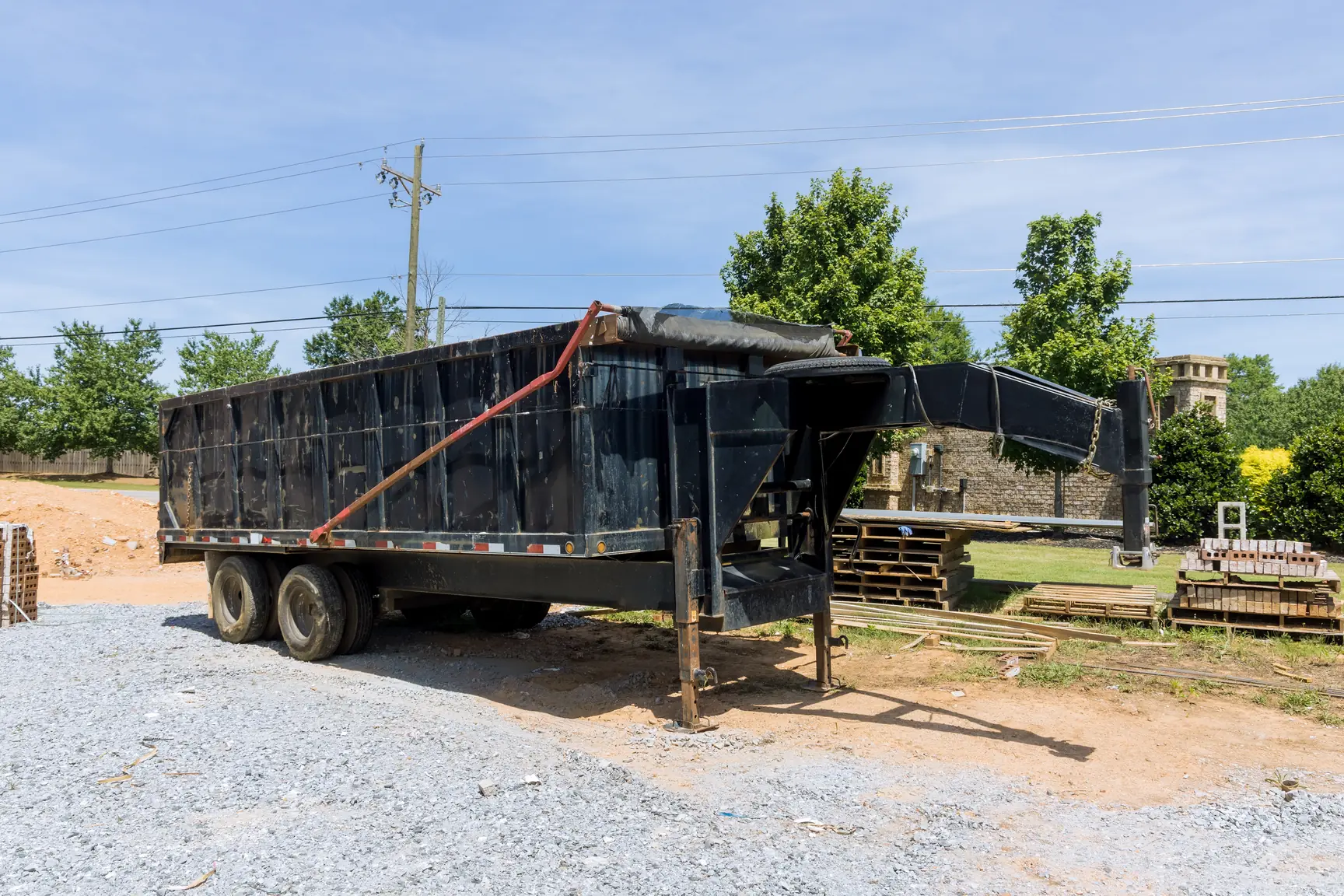
Two policies, one hoist, and the gap a West Virginia operator falls into
You buy two liability contracts to run containers, and each of them was drafted with something to say about the second a box comes off the rails. The uninsured losses in this trade gather in the gap between them. Nothing about that is a failure to buy enough cover; it is what happens when two documents each assume the other is answering.
On the liability side, loading or unloading is a term the standard general liability form defines for itself. That form generally declines injury and damage arising out of the use of an auto, and then tells you that use takes in loading or unloading. The standard auto form does not reach for that phrase at all. It arrives at the same second by a different road, and the stretch of road that matters is whether the equipment moving the property was attached to the truck when the loss occurred. A hoist is. A skid steer somebody hired for the day is not. Two forms built to meet.
The other half of the seam is what the box was standing on. In this state that is a hollow driveway cut into a slope, a narrow shoulder on a county road, a river-town street with no set-back to speak of, or a finished pad a general contractor is already paying for. When it fails, the claim is yours, and the language that decides it is found in exclusions for property in the care, custody or control of the insured, and for that particular part of real property being worked on. Whether a placement loss sits inside or outside them turns on exact words and exact facts, and it is not something to settle on a web page.
So this page marks where the seam runs in a West Virginia operation, with the aim that the question is asked while the policy is being placed rather than after a customer has photographed a broken apron. Your own wording decides the outcome, and no two carriers write it identically.
West Virginia regulations and licensing for solid waste carriers
This is the state in this book where the layers collapse into one institution. The credential, the safety rules and the rate regulation all sit with the same commission, and the environmental agency — which is where every instinct points — holds none of them.
The certificate of convenience and necessity, and who really issues it
State law requires the credential, and it is issued by the state: the Public Service Commission of West Virginia, through its Transportation Division and Motor Carrier Section. The statutory definition of a common carrier by motor vehicle — a person who undertakes, directly or under a lease or any other arrangement, to carry property for hire on this state’s public roads for whoever asks, on regular routes or irregular ones — is what puts a roll-off operator inside the chapter in the first place.
“It shall be unlawful for any common carrier by motor vehicle to operate within this state without first having obtained from the commission a certificate of convenience and necessity unless the common carrier is an emergency substitute carrier.”
The Commission’s own rule then narrows the duty in a way that lands squarely on this trade rather than lifting it off.
“No common carrier by motor vehicle, except an emergency substitute carrier, in the transportation of passengers or solid waste may operate on the public highways of West Virginia without first having obtained a certificate of convenience and necessity from the Commission.”
Read those two together and the position is clear. A general intrastate property carrier sits outside that rule; a solid waste carrier sits inside it. The legislature assumes the same thing in its own words at West Virginia Code § 24A-2-4a, which opens by describing a common carrier transporting solid waste under authority granted by the certificate section. And there is no third door: the Commission rule imposes the matching duty on a contract carrier of solid waste, who takes a permit instead of a certificate.
What the certificate carries is the part operators underestimate. The territory is drawn on the certificate and operating outside it is forbidden, with a companion rule requiring the description to be readable off the state highway agency’s county road maps and barring reference to unincorporated communities. West Virginia Code § 24A-5-2c requires every commercial customer agreement to be written and drafted under the Commission’s rules, permitting terms longer than a year, and the rules make it an annual exercise with each commercial customer while requiring the agreement to say the Commission may change those rates without the customer’s permission. A commercial customer reaches any commercial, industrial, governmental or institutional entity contracting for collection and transportation of solid waste for compensation, landlords contracting for their occupants included. Vehicles must show the authorized trade name and at least one certificate or permit number on each side, in letters of at least three inches. An annual customer count goes to each county or regional solid waste authority in the territory and to the state solid waste management board. And every motor carrier of solid waste must take part in a recycling program reaching at least thirty percent of its customers’ waste stream.
Two duties are worth setting out in the statute’s and the rule’s own words, because they show up on paper that a customer or an auditor reads. The first is a legend.
“The rates and practices of this motor carrier are regulated by the Public Service Commission of West Virginia.”
The second happens at the scale house, every load, in writing, under oath.
“The operator-driver of every solid waste motor carrier vehicle which arrives at a commercial solid waste facility … is required to declare, in writing and under oath, the name of the county and state of origin of the solid waste”
One more fence belongs here because it is the sentence this page will not write. The chapter exempts vehicles that federal law has preempted out of state economic regulation over intrastate motor carriage, and the federal section it points at was read in full. Its preservation clause names state safety authority, size and weight and hazard routing and minimum financial responsibility, the intrastate carriage of household goods, and non-consensual towing. There is no solid waste carve-out in the federal text, and our research run located no determination applying the exemption to a solid waste hauler. So this page states West Virginia law as West Virginia writes it and says nothing about federal preemption in either direction. Two neighboring exemptions in the same list are worth naming only to close them: source-separated recyclables moved free of charge or by a nonprofit cooperative, and carriers of scrap, waste or other used tires. Mixed construction and demolition debris hauled for a fee is neither.
West Virginia safety rules, insurance filings and the cargo carve-out
The same commission holds the safety function. Its Motor Carrier Section registers intrastate and interstate carriers and collects the registration, filing, insurance and hazardous materials charges, while its Safety Enforcement Section inspects vehicles and enforces the federal safety criteria the Commission has adopted. There is no separate motor carrier bureau inside a transport department to point at.
The weight figure in the chapter is real and it answers a different question from the one operators ask it.
“by motor vehicle with a gross vehicle weight rating of 10,001 pounds or more”
That phrase sits inside the definition of a private commercial carrier — a person moving property for itself, for a commercial purpose — and it marks where the Commission’s safety jurisdiction starts for that person. It is not the line at which a for-hire solid waste carrier needs authority, because the for-hire certificate duty has no weight floor at all. Move that figure onto the authority question and the sentence stops being true.
The safety adoption itself reaches a wholly intrastate operation. The statutory hook directs the Commission to make safety rules, driver qualification rules and maximum hours of service rules for carriers under the chapter, and the rule made under it requires every motor carrier under the Commission’s jurisdiction, and every private commercial carrier under its safety jurisdiction, to run vehicles, equipment and cargo in conformity with the federal safety regulations — without regard to whether the carrier is in intrastate or interstate commerce. The adoption is static rather than rolling: the federal parts are taken as they stood on the effective date of the rules, which is why a West Virginia compliance answer carries a date with it. Two smaller rules have teeth an operator will meet: the federal identification number must be displayed with the other required markings, and radar detectors may not even be possessed in a commercial vehicle on West Virginia highways, with seizure and destruction as the consequence.
Insurance is a condition of the credential rather than a separate subject. The Commission rule provides that no motor carrier may operate and no certificate or permit stays in force until the carrier has filed, and the Commission has approved, a surety bond, a policy or certificate of insurance, self-insurer qualifications, or other security. A further rule adds an annual insurance registration with a fee, and requires Commission approval before the carrier operates in that fiscal year. Filing is not the end of it; approval is.
One number is deliberately absent here. The statutory insurance proviso and the Commission’s own current rule table do not obviously agree, and our research run did not resolve the difference, so no single required liability limit is published here for West Virginia. Ask us and we will work from the filing your certificate actually needs rather than from a figure copied off a web page. What the rule does say plainly is the carve-out, and it is written for this exact commodity.
“The minimum amounts referred to in Rule 3.3 for cargo insurance do not apply to motor vehicles transporting raw coal or only solid waste or other discarded property that is being transported to a place of disposal.”
So a roll-off operator here sits inside the liability filing requirement and outside the cargo limit table. That is a useful thing to know before somebody sells you a cargo limit you were never required to buy.
Placement in West Virginia: a city permit that is not called one
West Virginia sets no statewide roll-off placement or right-of-way permit, and the statewide certificate does not displace the municipal layer. Charleston is offered as one municipality’s own code and nothing more, and it shows two instruments of different kinds sitting in the same city.
The first is a business credential. Charleston Code of Ordinances § 98-45 makes it unlawful for a commercial waste hauler to collect, remove, transport or dispose of refuse or recyclables inside the corporate limits unless the city has first granted it an annual permit as a private collector, transporter or disposer. It comes from the city manager, must be carried and shown on request to a police, health or other proper city officer, and may be revoked for failing to work within the rules the city manager sets. The definition that makes it reach a roll-off operator has no weight, volume or container qualifier in it at all: an entity whose business is to collect, carry or dispose of waste or recyclables inside the city. And the same chapter explains why the work exists, because the city’s own collection service stops short of material that comes off demolition, repair, alteration or building-erection work.
The second instrument is the one an author looking for the phrase dumpster permit will never find. Charleston Code of Ordinances § 102-4(a) requires a permit from the street commissioner before a person places or leaves any obstruction to travel in or upon a street, sidewalk, public grass strip or other public place. A container standing in a Charleston street is an obstruction to travel, so that is the permit, and it is not named for containers at all — the word dumpster appears nowhere in the retrieved article of that chapter. The same subsection requires a red light at night on an obstruction occupying a roadway or sidewalk, and where it runs twenty feet or more along the curb, a light at each end hung clear of the obstruction on the carriageway side. A companion section puts a duty on the customer side that shapes the demand: building contractors and excavators whose work leaves debris on a street or anywhere in the city must clear it within forty-eight hours of notice, or as the city manager directs, and again at the end of every project.
None of that is West Virginia law. It is one city, and the next one will have written its own. What the state layer does instead is create demand and create reporting. West Virginia Code § 22C-4-10(a) obliges every person occupying a residence or running a business establishment either to subscribe to a collection service and pay for it, or to prove lawful disposal at an approved facility at least once in every thirty-day period. And the origin declaration and the annual customer count both run to the county or regional solid waste authority, whose job under the rule includes enforcing that mandatory-disposal duty.
How West Virginia employers secure the workers compensation line
This is a competitive private market with a self-insurance alternative and no state fund in the path. The regulator is the West Virginia Offices of the Insurance Commissioner, with an Industrial Council doing the rulemaking and the Insurance Commissioner administering the residual public funds. The statute that describes the old arrangement is still printed in the code and says in its own text that it remains there for historical purposes.
The duty attaches broadly. West Virginia Code § 23-2-1(a) makes persons, firms, associations and corporations regularly employing another person to carry on any form of industry, service or business here into employers subject to the chapter. West Virginia Code § 23-2-1(b) then lists four classes that are not required to procure coverage but may elect it: employers of domestic service employees; employers of five or fewer full-time employees in agricultural service; employers of employees working outside the state except in temporary employment; and casual employers, meaning those with no more than three employees whose period of employment is temporary, intermittent and sporadic and does not exceed ten calendar days in a calendar quarter. A container business with a crew is in none of those four, and an elective class is not an elective regime — everyone outside those classes must secure coverage.
The routes are the ordinary competitive ones. West Virginia Code § 23-2C-15(a) lets an employer buy from a private carrier licensed and otherwise authorized to transact the line in this state, or self-insure if it satisfies the code requirements and is permitted to, and it records that private carriers sell through licensed agents in the state. The self-insurance test at West Virginia Code § 23-2-9(a)(1)(A) is a capability test: an employer of sufficient capability and financial responsibility to ensure payment of benefits at least equal in value to the compensation the chapter provides. A private carrier is defined by its authorization from the Insurance Commissioner and nothing else, an adverse risk assignment mechanism exists for risks the voluntary market will not take, and every employer must keep a notice posted identifying its workers compensation insurer with contact details for claim questions.
A panel for West Virginia in rows. Each row sets one thing the state requires beside the exposure that requirement leaves open and the coverage line that answers it. Hauler registration: A hauler credential, issued by the state. It leaves open a container placed on a customer’s property, and the driveway or curb it damages, which General Liability and Dumpster and Equipment Coverage answer. Intrastate motor-carrier authority: A state operating credential reaches for-hire hauling. It leaves open the roll-off truck at fault, and the container in transit, which Commercial Auto and Pollution Liability answer. Roll-off placement permits: Municipal — varies by city and town. It leaves open placement on the public right-of-way, and a struck pedestrian or vehicle, which General Liability answers. Workers compensation: Compulsory; bought from private insurers. It leaves open a driver or yard hand hurt on the job, which Workers Compensation answers. Notes: A registration, permit or bond is a condition of operating, not insurance: it answers none of the exposures on the right, so no line is drawn from it. The conclusion reads: The registration is not the coverage — the program is. No figures are shown.
Six coverages behind a West Virginia container fleet
Six lines, each written for this trade, each meeting West Virginia at a different point.
Loss patterns on West Virginia roll-off accounts
Patterns, not predictions. Nothing here forecasts any particular file and no figure is attached to any of it.
The surface claim leads. A box goes down on a customer approach, the approach lets go under a corner, and two questions open together: did this arise out of operating the truck, and was the failed surface something under your charge or something your job had opened up. Different provisions, different policies, and a file that can sit still while two carriers read each other’s wording.
Second is the swing, and terrain sharpens it here. A container under power on a graded or side-sloping set catches a bank, a porch post, a low line or a parked vehicle in the seconds it is neither on the truck nor on the ground. That is the definitional moment the top of this page is about.
Third is the load that was not what the customer said. It surfaces at the transfer station or the landfill, and in this state it surfaces against a written declaration your driver signed under oath, which changes the character of the conversation that follows.
Fourth is the driver injury that never involved driving — a tarp, a pin, a door, a walk-around on a wet grade. That is a workers compensation file, and the securing duty above is what stands behind it.
Fifth is regulatory rather than physical, and it is particular to this state. A job sits outside the territory the certificate describes, or a commercial account has no written agreement for the year, or invoices went out without the required legend. None of those is an insurance loss on its own. Each of them reaches the insurance file quickly once work stops or a customer complains.
The West Virginia cities this work follows
We write West Virginia as one licensed state rather than as a set of territories, and the cities below are where container work concentrates. Each is named with the county it sits inside, which is also the unit the annual customer count and the origin declaration run to.
- Charleston — Kanawha County
- Huntington — Cabell County
- Morgantown — Monongalia County
- Parkersburg — Wood County
- Martinsburg — Berkeley County
- Wheeling — Ohio County
There is a specific reason to look at that list as a certificate question rather than a marketing one. Your operating territory is described on paper and enforced as described, so the distance between the Kanawha valley, the northern panhandle and the eastern end of the state is a regulatory distance as well as a driving one. Being licensed across the state is what lets one account follow the work as that territory grows, without the coverage changing shape underneath it.
Nearby states we also write
A shared border is a fact about maps. Every neighbor with a credential on this axis reaches it through a different institution, and none of them rate-regulates hauling the way this state does. Each of the pages linked here was built from its own state’s file.
What West Virginia operators want to know
Which West Virginia agency actually issues my hauling credential?
The Public Service Commission of West Virginia, through its Transportation Division and Motor Carrier Section — the utility regulator, not the environmental agency. The environmental agency permits solid waste facilities under West Virginia Code § 22-15-10(b); the whole of that article was read and it licenses no hauler at all. The Commission publishes its own application instructions for solid waste carriers and routes them to the Motor Carrier Section.
Is there a weight below which I would not need authority in West Virginia?
No, and the figure people quote is from a different question. The only weight in that chapter defines a private commercial carrier — someone hauling their own property for their own commercial purpose — where the gross vehicle weight rating reaches 10,001 pounds, and it marks where the Commission’s safety jurisdiction begins. The for-hire certificate duty has no weight floor at all: West Virginia Code § 24A-2-5(a) and the Commission rule turn on being a common carrier of solid waste for hire, not on what the truck is rated at.
Can I work anywhere in West Virginia once I hold the certificate?
Only inside the territory the certificate describes. The Commission rule forbids operating outside it, and a companion rule requires every component of the territory description to be ascertainable from the state highway agency’s county road maps, expressly barring reference to unincorporated communities. So the geography is drawn on paper and enforced as drawn. If your work is moving into a new part of the state, the territory description is the thing to look at before the truck goes.
Do I need a written contract with every commercial customer?
Yes, annually, and this is unusual enough to catch operators moving in from other states. West Virginia Code § 24A-5-2c requires a solid waste carrier and its commercial customer to put the agreement in writing, drafted to the Commission’s rules and general orders, and it expressly allows a term longer than a single year. The Commission rule makes the exercise annual with each commercial customer, and requires every agreement to state that the Commission may raise, lower or modify the rates in it without the customer agreeing. A commercial customer here includes a landlord contracting for its occupants’ waste.
What is that legend my invoices are supposed to carry?
A rate-regulation notice. The Commission rule requires every bill or invoice issued by or for a motor carrier of solid waste to carry, in bold capital letters, a sentence stating that the carrier’s rates and practices are regulated by the Public Service Commission of West Virginia, together with the complaint line. It is a small thing that gets missed when an operator prints invoices from generic software, and it is exactly the kind of item that surfaces in an audit rather than at the counter.
What has to happen at the landfill gate in West Virginia?
A sworn declaration, per load, from the driver. West Virginia Code § 24A-2-4b(a) requires the operator-driver of every solid waste motor carrier vehicle arriving at a commercial solid waste facility — landfills and transfer stations among them — to declare in writing and under oath the county and state the waste came from. Copies go to the facility operator, to the Commission and to the county solid waste authority. Build it into the run rather than treating it as paperwork to be caught up on later.
Do the household curbside rules in the Commission rules apply to my roll-offs?
The rule says its solid waste section applies to all motor carriers of solid waste, but most of the subsection is written against a subscribing residential customer at a curb: a container weight limit a carrier may refuse, curbside placement conditions, a monthly bulky goods service for households. The bulky goods definition expressly excludes construction and demolition debris generally, and a separate provision says a carrier need not take construction and demolition debris from a household that did not generate it on its own property. The one provision that touches this commodity is a pricing rule: compensation for collecting construction and demolition materials from residents is negotiated between the resident and the carrier.
Does West Virginia workers compensation still run through a state fund?
It does not. The market opened to private competition and the statute that describes the transition says in terms that it remains in the code for historical purposes. Today an employer either buys from a private carrier licensed and otherwise authorized to transact the line in this state, or self-insures if it meets the code requirements and is permitted to. West Virginia Code § 23-2-1(a) makes employers regularly employing another person subject to the chapter, and the four classes that may elect in rather than being required to procure coverage are domestic service, small agricultural service, out-of-state employment and casual employment. A roll-off operator with employees is in none of them.
This page reports West Virginia law as our own state research file records it. It is general information rather than legal advice, and it is not an opinion on what any policy covers — the wording you hold controls that, and carriers do not all write it the same way.
Send a West Virginia roll-off submission to a licensed agent
Send both liability declarations pages, your certificate and its territory description, and we will mark the seam, show which contract is on the hook while the container is off the ground, and report what the markets say.
Related coverage for dumpster rental operators
- General Liabilitygeneral liability
- Commercial Autocommercial auto
- Dumpster and Equipment Coverageinland marine
- Commercial Propertycommercial property
- Workers Compensationworkers compensation
- Pollution Liabilityenvironmental / pollution liability
What it costs in West Virginia · States we serve · Dumpster Rental Insurance · Get a quote · Contact us
Primary sources
- West Virginia Code — § 24A-2-5 (certificate of convenience and necessity) — the operative prohibition, and the instrument a solid waste carrier actually holds
- West Virginia Secretary of State — Title 150, Series 9 (motor carrier rules) — the Commission’s own rules on carriers, insurance filings and solid waste duties
- West Virginia Offices of the Insurance Commissioner — the regulator of the workers compensation market and the carriers writing it