
Dumpster Rental Insurance by State
Dumpster Rental Insurance in Wisconsin
Wisconsin licenses the service that moves the waste, not only the place it ends up — and its motor carrier chapter reaches a for-hire truck at any weight.
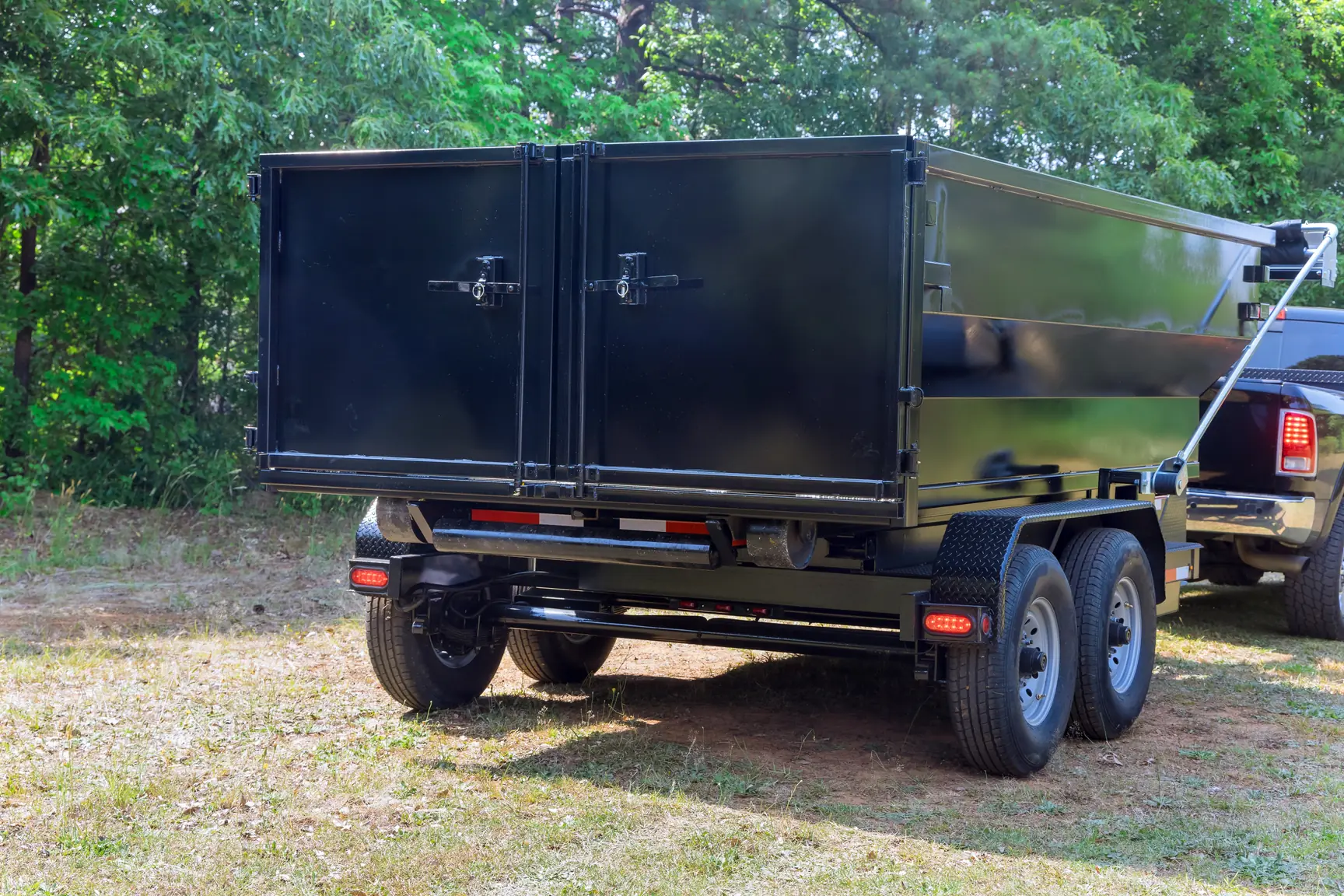
Which policy answers when a Wisconsin container comes off the rails
Every roll-off business carries two liability policies that both have something to say about the same few seconds, and the losses that end up uninsured in this trade gather in the space between them. It is worth settling that before any Wisconsin agency joins the discussion.
The general liability form supplies its own meaning for loading and unloading. It then generally excludes injury and damage arising out of the use of an auto, and treats loading and unloading as part of what use means. The standard auto form never uses that pair of words. It reaches the same instant by another path, and the question that matters here is whether the machinery that moved the property was attached to the truck. A cable hoist or hook-lift arm on the chassis is attached. A telehandler a customer had working on the pad is not. The two forms were drafted to meet, and the meeting point shifts with the equipment and with the wording actually in force.
The second half of the seam is what the container did to the ground it sat on. In Wisconsin that is a driveway cracked on a Dane County remodel, a curb caught on a tight Milwaukee alley approach, an apron gouged behind a Brown County shop, a lawn cut into ruts by a spring thaw that softened everything for a week. General liability forms typically carry exclusions for property in the insured’s care, custody or control and for that particular part of real property being worked on. Whether a placement loss falls inside or outside those exclusions depends on the exact wording and the exact facts, and a web page does not settle it.
What this page can do is show an operator where that seam crosses its own work, so the question is asked while a submission is being built rather than after a claim is opened. Your own policy wording controls, and the forms carriers use are not identical.
Wisconsin regulations and licensing
Wisconsin reaches a roll-off operation from two directions at once, and then leaves the third question to its cities, villages and towns. One agency licenses the hauling service. Another regulates the truck as a for-hire carrier with no weight floor underneath it. The municipality decides what the container may do once it is on a public street.
The Wisconsin hauler license and the definition it hides in
The credential here is issued by the state, by the Department of Natural Resources, and the operative sentence in the rule is short.
“Unless exempt under sub. (2), no person may operate or maintain a collection or transportation service unless the person has obtained an operating license from the department.”
The statutory hook behind it takes two moves, and reading only the first one makes the rule look like it is about sites. Wis. Stat. § 289.31(1) says nobody may operate a solid waste facility without an operating license from the department — and a reader stops there, because the section head says operating license and the subsection says facility. The reach is set somewhere else entirely, in a definition:
“‘Solid waste facility’ means a facility for solid waste treatment, solid waste storage, or solid waste disposal, and includes commercial, industrial, municipal, state, and federal establishments or operations such as, without limitation because of enumeration, sanitary landfills, dumps, land disposal sites, incinerators, transfer stations, storage facilities, collection and transportation services, and processing, treatment, and recovery facilities.”
Collection and transportation services are named in that list, sitting between storage facilities and processing plants. A service that moves waste is therefore a licensed thing in this state by statute rather than merely by rule, and the word facility in the section above it does not narrow that. As for the load: the statutory definition of solid waste reaches garbage, refuse, treatment sludges and other discarded or salvageable material coming out of industrial, commercial, mining and agricultural operations and out of community activity. Construction and demolition debris and ordinary municipal waste both sit inside it.
There is one boundary a small operator might hope to stand on, and it is narrow:
“Services for the collection and transportation of only ordinary solid waste from a single household or solid waste amounting to less than 20 tons per year.”
A commercial operation running trucks and containers passes that figure early in the year, so the exemption is not available to it. Thirteen further exemption classes sit alongside it, covering quarry spoils, electronics, recyclable feedstocks, treatment sludges, roadside litter crews, dredge material, private in-house hauling, food processing wastes, infectious waste, contaminated soil, industrial byproducts and parcel carriage. None of them describes hauling a customer’s debris to a transfer station.
What the license then carries is a short list of operating duties, and every one of them is also a loss driver an underwriter will recognize. Each vehicle displays WDNR followed by the license number on the driver’s door, lettered at least two inches high with a half-inch brush stroke against a contrasting background. Waste goes only to facilities the department has licensed or approved, or that are exempt from its regulation. Vehicles and containers have to be durable, cleanable and leak-proof to the degree the waste demands, and kept in repair. Loads are handled so contents do not fall, spill or leak, covers are provided, and a spill is returned to the vehicle and the ground cleaned. A service carrying municipal solid waste has to tell its clients about state and local recycling obligations — in writing for non-household clients, at contracting and once a year after that, with a year of documentation retained. And an owner or operator giving up the work has to notify the department in writing at least thirty days before it stops hauling for an extended period.
The commercial teeth are in a separate subsection, and it is the one worth showing a customer. Wis. Admin. Code § NR 502.06(5) puts the responsibility for getting waste to a licensed disposal facility on the person who generated it, and lets that person discharge the duty by contracting with a collection and transportation service the department has licensed. An unlicensed hauler therefore does not relieve its customer of anything. That makes the license a condition of winning commercial work, not simply a compliance line item.
Wisconsin motor carrier authority, and the weight figure that is not a threshold
The second layer is the motor carrier chapter, administered by the Department of Transportation. It sets no weight floor for a for-hire carrier of property at all. The chapter applies to carriers operating in interstate commerce on state highways and to carriers operating in intrastate commerce on them, and a separate section bars a common, contract or private motor carrier from moving persons or property on any public highway here except in accordance with the chapter. Neither sentence contains a pound figure.
There is exactly one weight figure in the whole chapter, and it is an exemption for farm equipment:
“This chapter shall not apply to any farm truck or dual purpose farm truck combined with any semitrailer or farm trailer, or any vehicle combined with a horse trailer, if the vehicle combination’s gross combination weight rating, registered weight, and actual gross weight do not exceed 26,000 pounds”
A roll-off truck carrying a customer’s waste for money is not a farm truck, is not a dual purpose farm truck, and is not combined with a farm trailer or a horse trailer. The exemption is closed to it, and so the figure attached to the exemption tells that operator nothing. The same carve-out reappears in the marking section and in the section limiting which federal parts apply to those combinations — it is the same farm rule each time. An author or a broker who lifts that number out and calls it Wisconsin’s trucking threshold gets it wrong twice over: wrong that the figure is general, and wrong that an operator under it is outside the chapter.
Which credential an operator needs turns on how it sells the work rather than what it hauls. A common motor carrier holds itself out to the public as willing to carry property for hire, and needs a certificate. A contract motor carrier carries property for hire over regular or irregular routes, and needs a license. For hire simply means for compensation. A container rental business advertising to whoever calls is on the common carrier side of that line by description; one working only under negotiated contracts is on the other. The department issues either without a hearing to an applicant that is fit, willing and able, and in judging that it looks at compliance history, the safety record, the financial ability to carry cargo insurance or to pay damage claims, and the applicant’s reliability and service record.
Three practical conditions follow. No permit or vehicle registration issues to a common carrier of property or a contract carrier, and none stays in force, unless an approved insurance certificate is on file with the department in its own form; cancellation takes at least thirty days’ written notice from the insurer. Every permit expires on December 31, with an annual application and fee, and none issues or renews for a vehicle whose state registration is unpaid. And each vehicle is plainly marked as the department prescribes — a second marking duty beside the waste one, from a different agency.
On the federal layer, Wisconsin adopts rather than restates: the administrative code takes the federal motor carrier safety regulations by reference and enforces them as though they were printed in full. The consequence is worth stating plainly. Any pound figure a Wisconsin operator finds attached to truck safety comes from the federal definition of a commercial motor vehicle and touches Wisconsin work only because the state incorporated that part. It is a federal number, not a Wisconsin one, and it must never be written as the state’s own.
Wisconsin cities and the container in the street
Wisconsin sets no statewide roll-off placement, street occupancy or right-of-way permit. The statewide credential it does run is the hauler license above, and that license says nothing about where a box may sit. Placement in a street, a terrace, an alley or a sidewalk is governed by individual cities, villages and towns, and it differs from one to the next. The state layer points at the municipality rather than standardizing it: the motor carrier chapter requires a common carrier of property or passengers moving within or through a municipality to comply with what that municipality has done about its streets, roads and routes, and says no such municipal action is reviewable by the department. A companion section adds that nothing in the chapter strips the department or a municipality of its jurisdiction over public highways.
Madison is named below as the example, and only as an example. It is here because its code could be read in full — the largest city in the state publishes the relevant chapter and guidance as documents that would not open to retrieval — and nothing in it describes any other Wisconsin municipality.
“Except as otherwise allowed by these ordinances, no person shall occupy, or cause to be occupied, any portion of the street, sidewalk, terrace, alleys or other public grounds for ninety (90) days or less, or in the case of 1 and 2 family homes for one hundred twenty (120) days or less, with any material or machinery without a valid street occupancy permit issued under this Section.”
Two things about that sentence. The opening clause is really there — it is not a truncation — so this is not a flat prohibition, and other ordinances can allow an occupancy. And the duration clause limits the permit: it governs an occupancy of ninety days or less, or one hundred twenty days or less at a one or two family home. What a longer occupancy requires is not answered in that subsection, and this page will not guess at it.
Administration sits with the Director of Traffic Engineering or a designee. An application goes in writing to the city traffic engineer describing the premises by lot, block or street, the area sought, the character of the material, and how long the occupancy will run, identifying every street tree inside the proposed area and whether its roots will be affected, and including a drawing of the area.
One finding here has to be stated precisely rather than improved. Madison’s street occupancy section names dumpsters in exactly one place — a fee schedule heading covering dumpsters, portable storage containers and construction trailers. There is no dumpster-specific placement standard, no screening rule, no hours rule and no surface rule anywhere in the section. A container in a Madison street is simply material or machinery under the sentence above, and the only thing the code says about it as its own class is what it costs. That is a real contrast with municipalities that write dumpster ordinances, and this page will not imply Madison has standards it does not have. The section does carry a forfeiture provision for non-compliance, with each day or part of a day treated as a separate offense; the figures are not written here.
Insuring a Wisconsin crew against injury
Wisconsin is a competitive workers compensation state. The duty is discharged in the private market, or by an exemption order, and no state fund appears in the operative text.
“Unless exempted under par. (b) or (bm) or sub. (3), every employer, as described in s. 102.04 (1), shall insure payment for compensation under this chapter in an insurer authorized to do business in this state.”
The exemptions named in that opening clause are worth separating, because two of the three are routinely misread. The first is a written order the department may grant an employer that shows it can pay the compensation, agrees to report every compensable injury faithfully and agrees to comply with the chapter and the department’s rules; the department may condition it on satisfactory security, and may revoke it on ten days’ written notice if the employer’s finances weaken, its claim count runs high, or it fails to meet its obligations. That is a route for discharging the duty, not an escape from it. The second is an election available only to the state itself and to local governments with independent taxing authority — it is not open to a private operator and should never be described as though it were. The third was not read for this page and nothing about it is stated here.
There is a declared hole in this section and it is better named than papered over. Who counts as an employer under the cross-referenced section is the real coverage threshold, and its text was not retrieved. So no employee count and no payroll figure appears on this page. The twenty-ton figure further up belongs to the waste license exemption and has nothing whatever to do with workers compensation. An employer who buys excess cover from an insurer not authorized here has to report that arrangement to the department immediately. The whole shape — authorized private insurers, a discretionary exemption order, policy regulation by statute — is a competitive market with a regulator on top of it.
A panel for Wisconsin in rows. Each row sets one thing the state requires beside the exposure that requirement leaves open and the coverage line that answers it. Hauler registration: A hauler credential, issued by the state. It leaves open a container placed on a customer’s property, and the driveway or curb it damages, which General Liability and Dumpster and Equipment Coverage answer. Intrastate motor-carrier authority: A state operating credential reaches for-hire hauling. It leaves open the roll-off truck at fault, and the container in transit, which Commercial Auto and Pollution Liability answer. Roll-off placement permits: Municipal — varies by city and town. It leaves open placement on the public right-of-way, and a struck pedestrian or vehicle, which General Liability answers. Workers compensation: Compulsory; bought from private insurers. It leaves open a driver or yard hand hurt on the job, which Workers Compensation answers. Notes: A registration, permit or bond is a condition of operating, not insurance: it answers none of the exposures on the right, so no line is drawn from it. The conclusion reads: The registration is not the coverage — the program is. No figures are shown.
Six coverages under a Wisconsin operation
Six lines sit under a Wisconsin roll-off business, and each takes on a slightly different emphasis once the two credentials above are in play.
The hub page at dumpster rental insurance puts the six together as a single program rather than six unrelated purchases.
Where Wisconsin roll-off losses come from
Patterns, not statistics. No frequency or severity figure appears on this page, because none was sourced for it.
Surface damage leads, as it does everywhere in this trade, and a northern climate sharpens it. A box goes back on the rails across a driveway that spent the winter under frost heave, and the concrete that looked sound splits along a seam. Thaw season turns a perfectly reasonable placement into ruts a week later.
Overhead strikes come next. A hoist raises a container under a service drop on a narrow Milwaukee street or in an older Green Bay neighborhood, and the loss is somebody else’s equipment plus the hours a block spends without power.
Then the container that moves after everyone has left. A box set on a slope, on gravel or on ground that softens in a thaw travels a short distance overnight and reaches a parked car, a fence or a neighbor’s edge. The driver is long gone, the customer says the spot was wrong, and the argument about care and control begins.
Then the load that was not what the ticket said. A renovation box comes back with paint, solvent or something from a stream it should not be in, and the scale house finds it. In Wisconsin that lands against an explicit license condition about delivering only to facilities the department has licensed or approved, so a pollution question and a credential question arrive together.
And injury on the ground. A helper hauling a tarp over a heaped load, a driver stepping off a chassis onto an iced apron, a hand between a door and a frame. That is the workers compensation side, and it shapes an operator’s cost of risk long after a liability file has closed.
Wisconsin roll-off markets
The unit these markets sit inside is the county. No population, permit-volume or market-size figure is written here, because none is in the record, and geography on this page describes where work happens rather than making any claim about availability. Wisconsin is one of the 48 states this agency holds a license in, and that is what makes these markets writable.
Nearby states we also write
Wisconsin touches four states and all four are inside the licensed footprint. Three are linked here. Wisconsin’s answer on the hauling credential is not the answer next door, in either direction, so read each state on its own record.
Wisconsin dumpster rental insurance FAQ
Does Wisconsin license me to haul containers, or only to run a landfill?
It licenses the hauling. The section head says operating license and the subsection says solid waste facility, which makes it look like a rule about sites — but Wis. Stat. § 289.01(35) defines that term by an enumeration that names collection and transportation services outright. So a service that moves a customer’s waste is a licensed thing in Wisconsin by statute, and Wis. Admin. Code § NR 502.06(1)(b) says the same in the rule.
I run a small operation. Does the twenty-ton exemption let me out of the Wisconsin license?
The exemption at § NR 502.06(2)(b) reaches only a service moving ordinary waste from a single household, or under 20 tons in a year. Thirteen other exemption classes exist and none of them describes a construction or municipal haul.
Wisconsin trucking law mentions 26,000 pounds. Is that my threshold?
No, and this is the trap on this page. The only weight figure in the motor carrier chapter sits in an exemption for farm trucks and dual purpose farm trucks in particular trailer combinations. A roll-off truck hauling waste for compensation is none of those things, so the 26,000-pound exemption is unavailable to it at any weight — the chapter applies regardless of weight. Wis. Stat. § 194.05(4), repeated at § 194.09 and § 194.38(2).
Do I need a certificate or a license from the Wisconsin Department of Transportation?
One or the other, and how you sell the work decides which. A carrier that offers itself to the public for hire needs a certificate under Wis. Stat. § 194.23(1); one carrying property for hire under negotiated arrangements needs a contract carrier license under § 194.34(1). A container rental business advertising to anyone who calls sits on the first side of that line by description.
What has to be on my truck in Wisconsin?
Two separate marking duties from two agencies. The waste rule requires WDNR followed by the license number on the driver’s door, at least two inches tall with a half-inch brush stroke, contrasting with the background. The motor carrier chapter separately requires each vehicle to be plainly marked as the transportation department prescribes so it is identifiable as operating under that chapter. Wis. Admin. Code § NR 502.06(4)(a) and Wis. Stat. § 194.09.
Does my Wisconsin waste license cover setting a container in a Madison street?
It does not. They answer different questions — one asks whether you may run the service at all, the other whether this particular box may occupy this particular street. Wis. Stat. § 194.33 and § 194.08 preserve the municipal layer expressly rather than displacing it, so holding one credential never excuses the other.
Why would a Wisconsin customer care whether I hold the state license?
Because the rule puts a duty on them too. Wis. Admin. Code § NR 502.06(5) makes the person generating the waste responsible for getting it to a licensed disposal facility, and lets them discharge that by contracting with a licensed collection and transportation service. An unlicensed hauler does not discharge its customer’s obligation, which turns the license into a condition of winning commercial work rather than a filing formality.
How is workers compensation secured in Wisconsin?
Through an insurer authorized to do business in the state, or by a written order of exemption the department may grant an employer that shows it can pay, agrees to report every compensable injury and agrees to follow the chapter and the rules. The department can attach security to that order and can revoke it on ten days’ written notice. A separate self-insurance election exists for the state and for local governments with independent taxing authority; it is not open to a private operator. Wis. Stat. § 102.28(2).
This page reports Wisconsin law as our own state research file records it. It is general information rather than legal advice, and it is not an opinion on what any policy covers — the wording you hold controls that, and carriers do not all write it the same way.
Start a Wisconsin quote with the right facts attached
Tell us your truck and container counts, the counties you run in, whether your department license is current, whether you hold a certificate or a contract carrier license, and which municipalities you pull street permits from. Those five answers shape a Wisconsin quote more than anything else on an application. Nothing on this page is legal advice or a statement of what any policy covers; the wording in force on your own policy controls.
Related coverage for dumpster rental operators
- General Liabilitygeneral liability
- Commercial Autocommercial auto
- Dumpster and Equipment Coverageinland marine
- Commercial Propertycommercial property
- Workers Compensationworkers compensation
- Pollution Liabilityenvironmental / pollution liability
What it costs in Wisconsin · States we serve · Dumpster Rental Insurance · Get a quote · Contact us
Primary sources
- Wisconsin Statutes ch. 289 — solid waste facility licensing — the operating license and the definition that reaches a hauling service
- Wisconsin Statutes ch. 194 — motor carriers — certificates, contract carrier licenses, the insurance filing and the annual expiry
- Wisconsin Department of Workforce Development — worker’s compensation — the division administering the duty to insure