
Dumpster Rental Insurance by State
Dumpster Rental Insurance in Iowa
Iowa issues no hauler license for a roll-off operation, and that is the least useful sentence anyone can hand you about working here. The permit, the vehicle rules and the city layer are all real. Here they are in order.
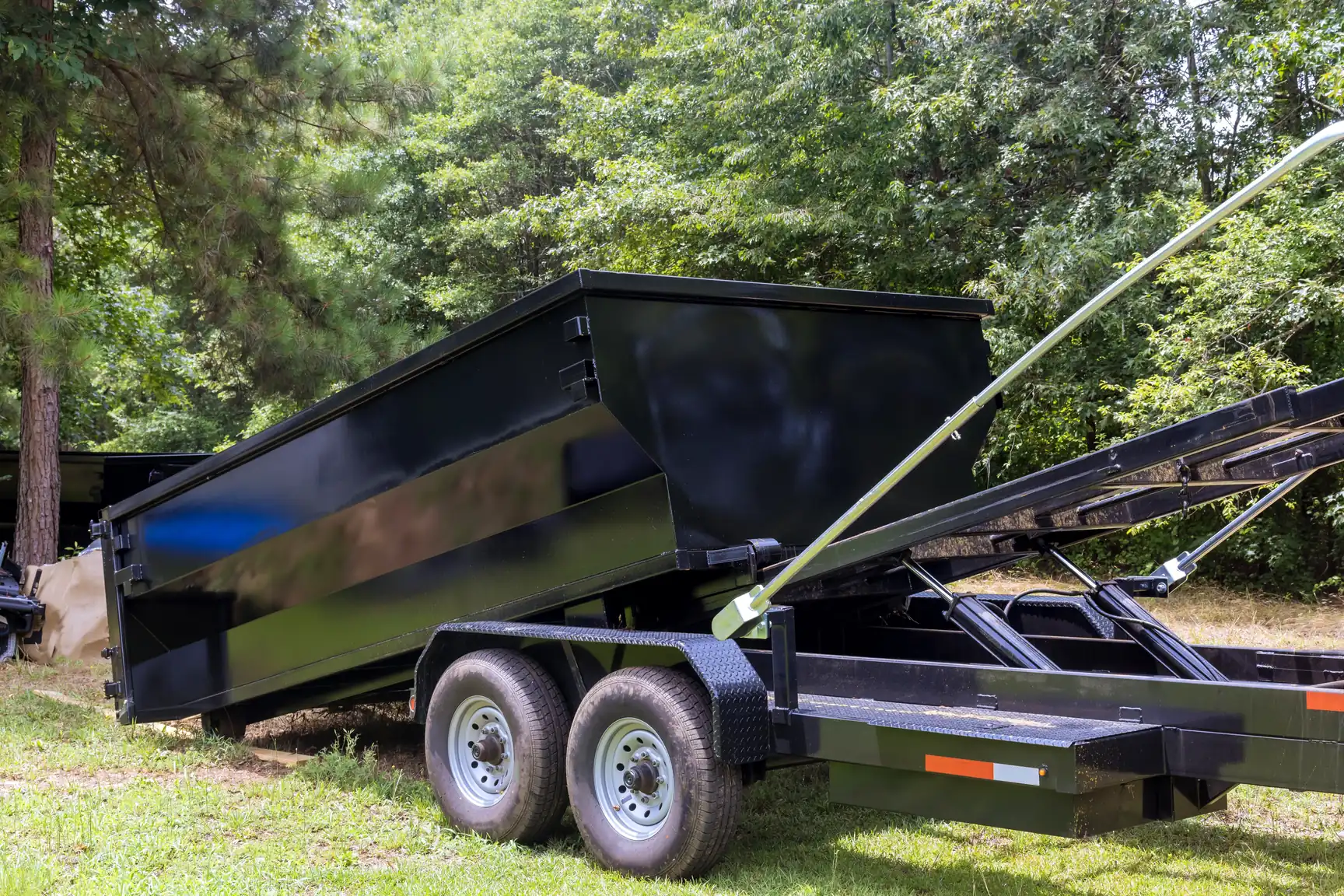
Where an Iowa container drop crosses out of the auto form
Iowa does not license roll-off haulers. Left there, that is close to useless to an owner, because Iowa does three other things instead: it puts a for-hire permit on the business, it puts construction and clean-out duties on the body that carries the waste, and it leaves the question of whether a container may sit on a street to whichever city the job is in. This page works through those layers in the order an owner meets them, starting with the seam that decides which of two liability policies answers when a drop goes wrong.
A dumpster rental business runs two liability policies that both have something to say about a container coming off a truck, and the losses that end up uninsured in this trade tend to live in the space between them. The general liability form uses loading or unloading as a term it defines for itself, and it generally excludes injury and damage arising out of the use of an auto — then tells the reader that use takes in loading or unloading. The standard auto form never uses that phrase. It reaches the same moment by a different route, and the route that matters here turns on whether the device shifting the property is attached to the truck.
The other half of the seam is the customer’s own ground: the driveway that cracks under a loaded can, the curb the wheels score on the way out, the asphalt a hoist gouges on a tight turn. General liability forms typically carry exclusions for property in the insured’s care, custody or control and for that particular part of real property being worked on, and whether a placement loss lands inside or outside those exclusions depends on the exact wording and the exact facts. A web page cannot settle that. What this one can do is show an Iowa owner where the seam runs, so the question is asked while a quote is being built rather than after a hoist has gone through a driveway.
Iowa gives that seam extra work, because Iowa’s own vehicle rules speak directly to the body on the truck — how it is covered, how it is closed, and what happens to whatever falls out of it. In a state like that, a spill on the way to the landfill is a regulatory event before it is a claim.
Iowa regulations and licensing for a roll-off operation
Three separate bodies of Iowa law reach this trade, and not one of them is a waste hauler license. One sits in the environmental rules, one in the motor carrier chapter, and one in whatever ordinance governs the block your container is going on.
No Iowa registration to haul a roll-off, and duties that apply regardless
Iowa does register one class of waste transporter, and this is not it. The registration the state actually operates is for waste tire haulers:
“A waste tire hauler shall register with, and obtain a certificate of registration from, the department before hauling waste tires in this state.”
Subsection (1) reserves that class for someone carrying more than forty waste tires in one load for commercial purposes, and subsection (3) runs the certificate for a year. An operator pulling construction debris, demolition waste or municipal solid waste out of a roll-off box is in a different class, and Iowa issues no equivalent certificate for it.
None of which makes Iowa silent about your truck. The state’s solid waste rules at 567 IAC 101.401 apply by their own terms to transfer stations and to the vehicles that collect and carry solid waste, and 567 IAC 101.410 then sets out what those vehicles owe unless a permit says otherwise: a leak-proof, vector-proof build with a suitable cover; a non-compliant vehicle repaired before it goes out again; openings shut before transport and while stored; cleaning frequently enough that vectors do not establish; wash water handled as wash water; and anything spilled en route picked up as soon as it can be. None of that is a credential. All of it is enforceable every day your drivers work.
You are inside those rules by name rather than by inference. Iowa’s definitions rule describes a solid waste collection vehicle as:
“a vehicle that has the primary purpose of collecting solid waste from a variety of locations, including at curbside and from dumpsters, compactors, and roll-off boxes.”
The same rule separately defines collection as gathering solid waste from public and private places, and transportation as conveying it elsewhere by vehicle, rail car, water vessel, conveyor or otherwise. A roll-off truck is not on the edge of those definitions; it is the example the drafter reached for.
One further thing in that chapter is worth knowing about rather than acting on. 567 IAC 100.3 forbids constructing or operating a sanitary disposal project or a solid waste management activity without a departmental permit — and the phrase solid waste management activity is never defined anywhere in the chapter whose stated job is to supply general definitions. Read literally, a business whose work is collection and transportation is conducting one. In practice the department’s published catalog of solid waste permit types is a catalog of facilities, with no hauler entry in it. This page records the gap and does not resolve it.
The Iowa motor carrier permit, and the exemption that does not cover you
This is the credential an Iowa roll-off operation actually needs. The Iowa Department of Transportation’s Office of Motor Carrier Services issues a motor carrier permit to a person operating a motor vehicle on an Iowa highway to carry property for hire, and Iowa Code § 325A.1(13) defines it in exactly those terms. Notice what is absent: the permit turns on the act of hauling for compensation and carries no weight figure of its own. Section 325A.1(16) is just as broad about what counts as hiring, reaching transportation of property or passengers that someone makes available for compensation.
Under § 325A.3(1) the department issues a permit or a certificate once an application has been filed and the chapter’s terms are satisfied, and the same subsection bars operating until the document has issued. An operator carrying a customer’s waste between two Iowa points is a motor carrier of property under § 325A.1(12), which means the permit rather than the certificate — certificates under § 325A.1(8) go to carriers of passengers.
What travels with the permit is a short list. Section 325A.3(2)(g) wants verification of liability and property damage insurance on the form the department prescribes. Section 325A.6(1) fixes the floor by reference to the federal financial responsibility rules at 49 C.F.R. Part 387 — a federal number Iowa adopts, not an Iowa number. Section 325A.3(6) keeps the permit or a copy in the vehicle for a peace officer who asks, and § 325A.8(1) requires distinctive markings or tags on every motor vehicle. Then § 325A.9 reaches your advertising rather than your equipment: a public advertisement about for-hire transportation has to carry the number of the permit or certificate the chapter issued you. That is the only line in the whole Iowa file that constrains what a hauler may say about itself.
Weight enters Iowa law somewhere else entirely — in the safety rules, not in the permit. The state draws its own line here:
“Notwithstanding other provisions of this section, rules adopted under this section for drivers of commercial vehicles shall not apply to a driver of a commercial vehicle who is engaged exclusively in intrastate commerce, when the commercial vehicle’s gross vehicle weight rating is twenty-six thousand pounds or less, unless the vehicle is used to transport hazardous materials requiring a placard or if the vehicle is designed to transport more than fifteen passengers, including the driver.”
Subsection (7) adds a companion rule for intrastate vehicles run in combination, and § 321.449(1)(a) keeps Iowa’s rules consistent with the federal motor carrier safety regulations. The 10,001-pound figure an owner meets on federal and trade pages belongs to the federal marking and safety threshold in 49 C.F.R. Part 390, administered by the FMCSA, a federal agency; it is not Iowa’s number. Iowa’s own is in the subsection above.
There is also a subsection aimed squarely at this trade, and half of it is a trap. Section 321.449(2) exempts a list of operators from the driver qualification, hours of service and recordkeeping rules — public utility trucks, gravel haulers, construction trucks and equipment, vehicles moving implements of husbandry, and special trucks other than truck tractors, all running intrastate. Then, in the same subsection, it takes it back:
“Except as otherwise provided in this section, trucks for hire on construction projects are not exempt from this section.”
Dropping and pulling a loaded container on a construction site for money is hauling for hire on a construction project. An owner who reads the first half of that subsection and stops will conclude they are exempt when the statute says the opposite — a conclusion that surfaces at a roadside inspection rather than in an office.
Several parts of chapter 325A look relevant and are not. The tariff machinery at §§ 325A.7, 325A.7A and 325A.7B runs to carriers of household goods. The financial statement at § 325A.3(2)(f) and the safety seminar at § 325A.3(5) reach carriers of bulk liquid commodities and of passengers. And § 325A.2(2) stops a local authority regulating motor carrier operation more restrictively than chapter 325A or §§ 321.449 and 321.450 — a rule about truck safety that says nothing about whether a city may license waste collection. That is the next question.
Placement and hauler permits are written city by city in Iowa
Iowa sets no statewide placement permit, no right-of-way rule for containers and no hauler license. What it sets is a duty on local government. Section 455B.302(1) makes every city and county provide for a comprehensive solid waste reduction program and a sanitary disposal project, and § 455B.302(2) lets them contract for collection. The terms are then theirs to write. Hauler permits, placement standards and right-of-way treatment differ from one Iowa city to the next, and the only statewide limit on local rulemaking this research found runs to truck safety rather than to waste collection.
Des Moines appears here as one example and nothing more. Its municipal code carries a hauler permit whose carve-out cuts the same truck in half:
“No person shall engage in the business of removing or hauling residential, commercial or industrial solid waste from the premises of others, other than those resulting from construction or demolition activities, unless such person shall have first applied for and received a permit to do so from the city. Such permits shall be issued and renewed on an annual basis for a fiscal year commencing July 1 of each year.”
Waste arising from construction or demolition sits outside that permit; the same operator’s residential and commercial cleanout loads sit inside it. So a page that says Des Moines licenses roll-off haulers is wrong, and a page that says it does not is wrong too — the answer turns on what is in the box that morning. Under § 98-63 the application goes to the city clerk with the applicant’s name and address, the vehicles, general route and service-area information and an undertaking to keep to the chapter; and nothing issues or renews unless the vehicles are built so that rubbish or bulk material stays contained. Section 98-64 then conditions the permit on cover from an insurer licensed in the state, general liability and automobile liability both, an umbrella form being acceptable, evidenced by a certificate that cannot be canceled or terminated until the city has had thirty days’ notice by registered mail. Section 98-65 exempts vehicles the city or the authority owns or contracts with, as a public service function — which is not an exemption a private hauler can reach.
One number in that ordinance is deliberately not on this page. Section 98-64(a) fixes a combined single limit for each of those two policies, and this page omits the figure rather than print it. It is one city’s minimum, it moves when that city moves it, and on a page like this it would read as advice about how much cover to buy. What your own limits ought to be is an underwriting conversation, not an ordinance.
Two oddities in that chapter are worth carrying into any conversation with the city. Sections 98-63 and 98-64 are headed for a waste hauler’s permit and a waste hauler’s liability insurance, yet the definitions never create a class called a waste hauler at all — the operative text runs to a person, which § 98-26 defines very broadly. And § 98-26 defines solid waste so as to include construction and demolition wastes in its own list, which is precisely the category § 98-62 removes from the permit. The specific carve-out governs; someone who finds only the definition reaches the opposite answer.
One Iowa statute here protects an incumbent and is easy to mistake for a license. Section 455B.306A makes a city that annexes an area, or that plans to run or extend its own collection where a private company is already serving, notify that company by certified mail at least sixty days beforehand, and bars an alternative service there for a year unless the city contracts with the incumbent instead. That is a notice-and-transition protection for a business already on the ground — not a state license, not a franchise, and not a credential anybody can apply for.
How an Iowa employer secures workers compensation
Iowa workers compensation is compulsory and it is bought in the private market. Iowa Code § 87.1(1) requires an employer subject to the compensation chapters, unless relieved, to insure that liability with a corporation, association or organization the commissioner of insurance has approved. Section 87.11(1)(a) is the alternative: an employer that gives the insurance commissioner satisfactory proof of solvency and financial ability, or deposits security the commissioner accepts, is relieved of the requirement to insure. Section 87.4 also allows group and self-insured plans. Two routes, both outside any state fund, which is what a competitive state looks like read off its own statute rather than off its reputation.
Administration and insurance sit with different officials, which matters the moment you are chasing a piece of paper. The Division of Workers’ Compensation inside the Iowa Department of Inspections, Appeals, and Licensing runs the compensation laws under § 10A.302, while approval of insurers and relief from insuring belong to the commissioner of insurance. Section 87.1(3) makes an employer exhibit evidence of compliance on the workers’ compensation commissioner’s demand, and leaves an employer who refuses liable at common law as the statute has modified it.
There is one exception in this chapter a roll-off operator can genuinely stand on, and it concerns owner-operators. Where a motor carrier contracts with an owner-operator acting as an independent contractor under § 85.61(12)(c), the carrier
“shall not be required to insure the motor carrier’s liability for the owner-operator”
The same subsection lets the carrier buy that cover anyway and charge the owner-operator the premiums, requires the carrier to make the owner-operator provide and maintain a certificate covering the owner-operator’s own employees, and leaves responsibility for that coverage with the owner-operator. If you run owner-operators, that is the subsection to read beside your own adviser and your own contracts.
No employee-count floor appears in the chapter this research retrieved, and none is supplied here. Which employers are subject to the compensation chapters is settled in parts of the Iowa Code outside this run, and how you structure a crew is not a question this page is going to answer.
A panel for Iowa in rows. Each row sets one thing the state requires beside the exposure that requirement leaves open and the coverage line that answers it. Hauler registration: State transporter credentials exist, but none reaches roll-off hauling. It leaves open a container placed on a customer’s property, and the driveway or curb it damages, which General Liability and Dumpster and Equipment Coverage answer. Intrastate motor-carrier authority: A state operating credential reaches for-hire hauling. It leaves open the roll-off truck at fault, and the container in transit, which Commercial Auto and Pollution Liability answer. Roll-off placement permits: Municipal — varies by city and town. It leaves open placement on the public right-of-way, and a struck pedestrian or vehicle, which General Liability answers. Workers compensation: Compulsory; bought from private insurers. It leaves open a driver or yard hand hurt on the job, which Workers Compensation answers. Notes: A registration, permit or bond is a condition of operating, not insurance: it answers none of the exposures on the right, so no line is drawn from it. The conclusion reads: The registration is not the coverage — the program is. No figures are shown.
The six coverages, read against an Iowa roll-off operation
Six lines carry this class. Here is what each is asked to do in Iowa specifically.
- General Liability — the third-party half of the seam above: somebody hurt around a container, or property damaged by where it sat and how it got there. In Iowa this is also the policy Des Moines has an opinion about, since § 98-64 conditions its hauler permit on general liability cover from an insurer licensed in the state.
- Commercial Auto — the roll-off or hook-lift truck itself: driving it, hoisting with it, and the loading and unloading the auto form reaches by its own route rather than by that phrase. Iowa Code § 325A.6(1) puts a federal financial responsibility floor underneath this line for a permitted motor carrier, and § 325A.3(2)(g) makes you evidence it on the department’s form.
- Dumpster and Equipment Coverage — inland marine on the cans, because the insured asset stands on somebody else’s ground. In Iowa it is also under the 567 IAC 101.410 duties about covers, closures and clean-out.
- Commercial Property — the yard, the office, the contents, and whatever is parked or stacked there overnight. Iowa’s solid waste permitting is aimed at facilities rather than trucks, which makes the yard the part of your operation nearest that boundary.
- Workers Compensation — driver and helper injury: the hoist, the tarp, the walk-around, the lift. Iowa’s route to it is the approval-and-placement shape at § 87.1(1), with the owner-operator subsection sitting underneath any contractor arrangement you run.
- Pollution Liability — what the load turns out to contain. Iowa’s own rules speak to waste spilled in transit and to how the liquid from cleaning a vehicle is handled, and § 455B.307(1) makes depositing solid waste anywhere but an approved sanitary disposal project a statutory problem before it becomes an insurance one.
For the whole class in one place, the Dumpster Rental Insurance hub is written for that.
The Iowa losses that come back more than once
These are patterns rather than statistics, and no figure is attached to any of them because none was sourced. Placement damage leads: a can set on a residential driveway that was never built for the loaded weight, a curb scored on the way out of a tight lot, a parking surface gouged where the hoist bit. Those losses sit closest to the care, custody and control exclusions, which is why the seam is the first thing on this page.
Then the transit losses, which Iowa’s own rules anticipate. Something leaves the box between the site and the landfill — a sheet of ply, a length of trim — and it is a highway incident and a compliance question at once.
Injuries cluster where the work is physical and repetitive: the tarp, the walk-around in an Iowa winter, the moment a driver puts hands on a container frozen to the ground. None of that changes what a policy says. It changes which questions are worth asking first.
Major Iowa roll-off markets
Five markets, each with the county it sits in. No population, permit-volume or market-size figure is attached to any of them: nothing in this state’s research sourced one, and an invented number would be worth less than the silence.
Des Moines
Polk County. The largest city and metro in the state, and the one municipality whose own solid waste chapter is described on this page.
Cedar Rapids
Linn County. The anchor city of east-central Iowa, with the rehabilitation and clean-out work an older housing stock generates.
Davenport
Scott County. The Iowa side of the Quad Cities, on the Mississippi and hard against the Illinois line.
Sioux City
Woodbury County. Northwest Iowa, at the corner where the Nebraska and South Dakota lines meet.
Iowa City
Johnson County. East-central Iowa, with the seasonal turnover and renovation cycle a university town runs on.
Nearby states we also write
Iowa has six neighbors and three of them are linked below, all inside the licensed footprint. Each answers the hauler question differently enough that nothing on this page should be carried across a state line: the registration answer, the motor carrier answer and the workers compensation shape are decided by that state’s own statute, and Iowa’s were measured against Iowa’s.
Iowa dumpster rental insurance FAQs
Does Iowa make me register before I can haul a roll-off container?
Not as a waste hauler. The one statewide waste transporter registration Iowa operates is the waste tire hauler certificate at Iowa Code § 455D.11I, and hauling construction, demolition or municipal solid waste in a roll-off box is not that class. What Iowa does require of this trade is a motor carrier permit for hauling property for hire, and it requires the truck itself to meet the collection-vehicle rules in 567 IAC 101.410.
What is an Iowa motor carrier permit, and does my roll-off truck need one?
It is the credential the Iowa Department of Transportation issues to a person who moves property for hire on an Iowa highway, defined that way at Iowa Code § 325A.1(13). Hauling a customer’s waste between two points in Iowa for money puts you inside it. Under § 325A.3(1) the department issues the permit on application and compliance, and operating before it has been issued is not allowed.
My truck is under the Iowa weight line. Does that put me outside the safety rules?
It changes which rules reach the driver, and it changes nothing about the permit. The weight figure at Iowa Code § 321.449(4)(a) governs the driver rules adopted under that section for vehicles used exclusively in intrastate commerce, with exceptions for placarded hazardous materials and larger passenger vehicles. The motor carrier permit in chapter 325A has no weight figure attached to it at all.
I pull containers off construction sites. Does the Iowa construction-truck exemption cover me?
Read the whole subsection before relying on it. Iowa Code § 321.449(2) does exempt construction trucks and equipment from the driver-qualification, hours-of-service and recordkeeping rules, and then says in the same subsection that trucks for hire on construction projects are not exempt. Pulling a loaded box off a site for compensation is hauling for hire. Whether a particular job falls inside or outside that sentence is a question for your own adviser.
Does Des Moines require a hauler permit for a load of construction debris?
The carve-out in Des Moines Municipal Code § 98-62 puts waste resulting from construction or demolition activities outside the city permit, while the same operator’s residential and commercial cleanout loads sit inside it. So the same truck can be in and out of the permit on the same day, depending on what is in the box. Every other Iowa city writes its own rule, and Des Moines is an example here rather than a statewide standard.
I use owner-operators. Do I still have to carry workers compensation on them?
Iowa Code § 87.1(2) addresses that arrangement directly: where a motor carrier contracts with an owner-operator who is an independent contractor under § 85.61(12)(c), the carrier is not required to insure its liability for that owner-operator. The same subsection lets the carrier buy the coverage anyway and bill the premium, and requires the owner-operator to carry and keep a certificate covering the owner-operator’s own employees. Iowa workers compensation is otherwise compulsory and bought in the private market.
Who regulates the insurance company that writes my Iowa policy?
The Iowa Insurance Division. It is also the office that approves the insurers an employer may place workers compensation with, under Iowa Code § 87.1(1), and the office that grants relief from insuring on proof of solvency under § 87.11(1)(a). Claims administration sits elsewhere, with the Division of Workers’ Compensation in the Department of Inspections, Appeals, and Licensing.
This page reports Iowa law as our own state research file records it. It is general information rather than legal advice, and it is not an opinion on what any policy covers — the wording you hold controls that, and carriers do not all write it the same way.
Tell us how the Iowa work actually runs
Where the cans go, what the trucks are, who drives them, and how much of the week is construction and demolition rather than cleanout. We will read the forms against the work, and where the answer belongs to a city rather than the state we will say so rather than guess.
Related coverage for dumpster rental operators
- General Liabilitygeneral liability
- Commercial Autocommercial auto
- Dumpster and Equipment Coverageinland marine
- Commercial Propertycommercial property
- Workers Compensationworkers compensation
- Pollution Liabilityenvironmental / pollution liability
What it costs in Iowa · States we serve · Dumpster Rental Insurance · Get a quote · Contact us
Primary sources
- Iowa DNR — Solid Waste Permitting — the state environmental agency’s own account of the solid waste program it runs, which is a program of facility permits
- Iowa DOT — Motor Carrier Services — the office that issues the intrastate travel authority a for-hire property carrier needs
- Des Moines Municipal Code, Chapter 98 — Solid Waste — the one municipal example described on this page, including the construction and demolition carve-out at § 98-62
- Iowa Insurance Division — the office that approves workers compensation insurers under Iowa Code § 87.1(1) and grants relief from insuring under § 87.11(1)(a)