
Dumpster Rental Insurance by State
Dumpster Rental Insurance in North Dakota
North Dakota is one of the few states that permits the hauler and not the truck. Here is the permit, the decals, the city layer the state deliberately left standing, and the seam between two liability forms that decides who pays for a drop.
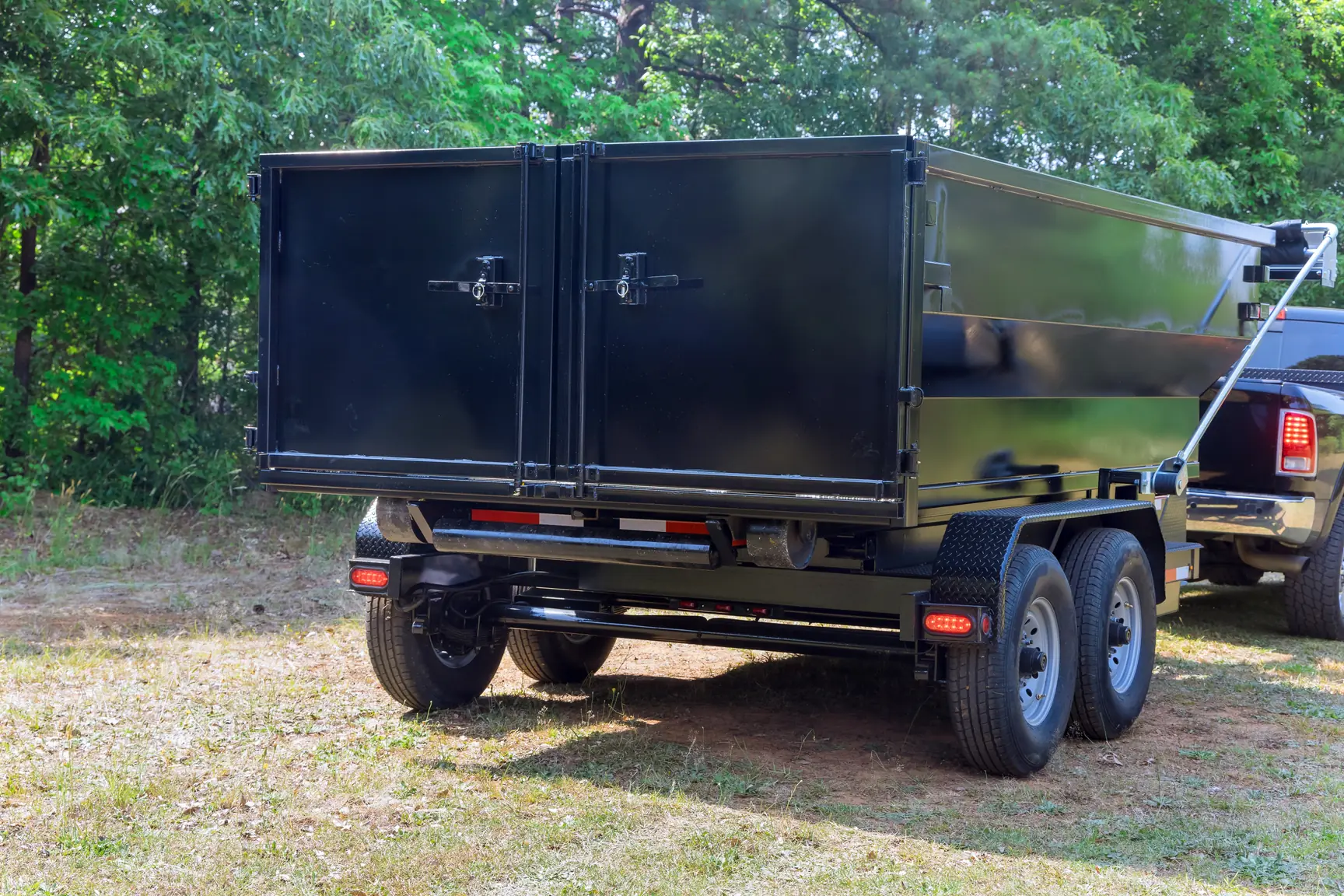
Where the auto form stops and the liability form starts in North Dakota
Which policy pays when a container damages something is a two-policy question, and the two were drafted to hand the risk to each other at a point that sits right in the middle of an ordinary drop.
On the liability side, loading and unloading is a defined term. The form generally excludes injury and damage arising out of the use of an auto, and then explains that using an auto takes in loading and unloading it. The standard auto form never uses the phrase. It reaches the same moment through the ownership, maintenance or use of the vehicle, and for a roll-off the route that matters here turns on whether the mechanism moving the box was attached to the truck when things went wrong. Neither wording is careless. They are two halves of a design, and the join is not always where an operator expects it.
The second half of the seam is different in kind: not a stranger’s injury but the customer’s own property. A slab that cracks. A curb the rails scrape. A frost-heaved approach that gives way in April. General liability forms typically carry exclusions for property in the insured’s care, custody or control and for that particular part of real property being worked on. Whether a placement loss is inside or outside those carve-outs is a question about the words in your policy and the facts of the drop, and it is not one this page can answer for you.
North Dakota adds its own wrinkle, because the state permits the hauler rather than the vehicle. A compliance file here proves you are entitled to carry the waste. It says nothing about which of your two liability forms was speaking at the moment the container touched the ground. Your own policy wording controls, and the forms in use differ between carriers.
The North Dakota paperwork, from the state permit down to the city license
This regulatory answer is clean in an unexpected direction: the state credential you need is environmental rather than transport, and North Dakota runs no general intrastate operating authority for a property carrier.
North Dakota does issue a solid waste transporter permit, and it reaches you
The permit is issued by the state — specifically by the Department of Environmental Quality, Division of Waste Management, on the department’s own forms, with a public register of active holders. Two other state agencies list the permit on their pages, the transportation department and the highway patrol, and both name the environmental agency as the issuer. Neither issues it.
The statute states the duty as a prohibition:
“The department may issue permits for solid waste management facilities and solid waste transporters. A person may not own, operate, or use a facility for solid waste disposal or transport solid wastes without a valid permit.”
Two definitions carry it to a roll-off operator. Transport, at NDCC 23.1-08-02(18), is the offsite movement of solid waste; and solid waste at NDCC 23.1-08-02(14) is drawn widely enough to take in refuse and discarded material from industrial, commercial and community activity, which is what a construction-debris container holds. The implementing rule then restates the same duty in the department’s own voice, requiring a valid permit of anyone who treats or transports solid waste or runs a solid waste unit or facility, subject to what the section allows as an emergency, an exemption or an exception (NDAC 33.1-20-02.1-01).
The whole test of whether it reaches you is two lines long:
“A permit for the transportation of solid waste is not required by persons who: a. Transport solely their own waste to a solid waste management unit or facility; or b. Transport waste entirely within a facility regulated under this article or entirely on their property.”
A roll-off operator carrying a customer’s waste is not carrying solely its own, so the permit applies. The agency publishes the same answer in plain words on its transportation page, and publishes exactly one carve-out beside it: a pass-through movement, meaning no pick-up and no drop-off inside North Dakota, does not need the permit.
What the permit carries is worth knowing before you apply. Decals go on each vehicle showing the permit number and its expiry (NDAC 33.1-20-15-01(1)(a)(2)). The term runs up to five years and ends on the last day of December in the fifth year (NDAC 33.1-20-15-01(1)(a)(1)), which the agency states on its own page as good for up to five years from issuance. The application describes the waste types, the approximate quantities, the anticipated collection sources, the facilities that will receive the waste, and the equipment and spill prevention (NDAC 33.1-20-03.1-02(7)). And it carries a disclosure statement executed under oath under NDCC 23.1-08-17, covering environmental civil and administrative complaints, pending criminal complaints and convictions within five years. That last item is an integrity review, and it is the part that surprises people.
The subcontractor rule is about somebody else’s truck:
“Additional decals may not be purchased for vehicles owned or operated by a subcontractor working for the permittee. A solid waste transportation subcontractor shall apply for and obtain an individual solid waste transporter permit.”
Take on an overflow hauler in a busy month and the permit treats that business as a separate transporter, whatever the contract between you says. It is also a useful underwriting question in the other direction, because a subcontractor without a permit is an exposure you are carrying rather than one you have transferred.
Two further notes, recorded because reading them wrongly produces a false sentence. First, NDCC 23.1-08-09 is served in two versions on the same page, one marked with a contingent expiration date and one with a contingent effective date. They were compared line by line: the transporter sentence is identical in both, and the only operative difference located is whether permits are described as transferable. The permit requirement does not turn on which version is in force. Second, the container construction rule at NDAC 33.1-20-01.1-04.1 opens by governing the storage of household wastes and only then reaches bulk and detachable containers — so it is not a general North Dakota standard for a construction-debris roll-off. The vehicle-side rules in the following section are the ones written against waste classes, and construction and demolition material reaches them through the definition of inert waste at NDAC 33.1-20-01.1-03(46).
There is no North Dakota operating authority for a property carrier
There is no single agency on this axis, and the honest answer is that the state issues nothing of the kind. Safety rules are adopted and enforced by the superintendent of the state highway patrol through its motor carrier command. Registration programs — the international registration plan, the fuel tax agreement, the unified carrier registration — are run by the transportation department. And the USDOT number is federal, obtained from the Federal Motor Carrier Safety Administration, which both state pages say in their own words.
The statutory hook that brings the federal safety regime into a wholly intrastate North Dakota operation is NDCC 39-21-46(3). It directs the superintendent to adopt rules on the safe operation of motor vehicles and on how audits and inspections are conducted, requires those rules to duplicate or stay consistent with the current federal motor carrier safety regulations, and allows adoption by reference including later amendments. The administrative rules made under it were not located in the research behind this page and no sentence here cites them; the statute is what is cited.
North Dakota’s own intrastate weight figure is real and it decides something else entirely. It lives in the chapter on intrastate commercial driver hours of service:
“A driver who operates a motor vehicle in intrastate commerce if the gross vehicle weight, gross vehicle weight rating, gross combination weight, and gross combination weight rating are less than twenty-six thousand one pounds [11793.86 kilograms]”
Read the conjunction as the statute writes it: all four measures must be under the figure, and the statute writes it as twenty-six thousand one rather than twenty-six thousand. The exception is also switched off where the vehicle carries placarded hazardous materials or is built to carry passengers in the numbers the paragraph names. Describing that figure as the weight at which North Dakota requires authority would assert a credential that does not exist.
There is one intrastate operating-authority permit in Title 39 and it is a name collision rather than a near miss. NDCC 39-31-01 defines a common household goods carrier as a person holding itself out to carry the household goods of others for hire, and NDCC 39-31-03 makes it unlawful for such a carrier to work without the permit the chapter creates. The application has to contain proof of registration with the secretary of state and either proof of workers compensation coverage or an affidavit of nonemployment (NDCC 39-31-06). A roll-off operator hauling waste is not a household goods carrier and does not hold this permit. The chapter that would have been the general one is marked repealed, and no live chapter of Title 39 creates a general intrastate property-carrier authority.
The city layer North Dakota deliberately leaves standing
There is no statewide placement or right-of-way permit for a container. What the state does instead is expressly preserve the layer below it: NDCC 23.1-08-06 lets any political subdivision enact and enforce a solid waste ordinance equal to or more stringent than the state chapter and its rules, and the implementing rules say the same thing from the other direction by letting a local unit of government allow larger single-use containers. Placement standards, obstruction rules and municipal hauler licensing are therefore set city by city, and they differ.
The state permit does not displace any of it. An operator can hold a valid transporter permit and still be unable to take a private account in a particular city — which is not a theoretical point in this state.
Fargo is named here as one municipality’s own code and never as North Dakota’s rule. Its ordinance requires a permit from the city auditor before anyone goes into the business of removing, collecting, hauling or disposing of the listed wastes for compensation or hire, and outside a contract with the city (Fargo Municipal Code § 13-0512). The application goes to the auditor on the auditor’s forms and has to name the applicant and residence, describe the vehicles, and list every account the hauler services. The definition reaches this trade: § 13-0501 defines waste to include trash generated by commercial and retail businesses and expressly adds construction and demolition waste.
And then the sentence that makes Fargo different from an ordinary licensing city:
“Such permit shall allow the private hauler only to contract with the City for the collection, transportation or disposal of waste in a manner directed by the City”
The same section bars a private hauler from contracting directly with any person or entity for that work except through a formal waiver granted by the solid waste operations manager, and limits the waiver by its own terms to haulers whose operations are designed to meet the city’s health, safety and environmental requirements through other contracts with the city, for the term of those contracts. Fargo does not merely license private haulers; it channels them.
Three drafting artifacts are recorded rather than tidied. The ordinance uses permit and license for the same instrument — one section requires a permit, the next charges an annual license fee and issues a permit to the licensee, and a third is headed as though permits and licenses were two things. They are not, and an author who treats them as two credentials has invented one. A cross-reference in the same article points at a unit that does not match the code’s own structure. And the defined term for private haulers is circular with the prohibition, because the definition already builds in the city-contract requirement that the prohibition then imposes. Separately, the single occurrence of the word dumpster anywhere in the current Fargo code is a screening standard in the land development code, not a placement permit, so Fargo runs no roll-off placement permit under that name.
One pre-emption in the state chapter looks relevant and is not. NDCC 23.1-08-06.1 bars a political subdivision from regulating, restricting or taxing an auxiliary container — a term the statute defines as a bag, cup, bottle, straw or similar packaging. That is a retail-packaging rule. It has nothing to do with a roll-off container, and carrying the word across produces a false sentence about a city’s powers.
North Dakota workers compensation is paid into the fund, not bought
This line is not placed in the insurance market in North Dakota. Premium is paid into the state fund administered by the state workforce safety agency, and the statute states the duty twice, from opposite sides. NDCC 65-04-04(1) requires each employer subject to the title to pay into the fund the premium and assessment the organization determines, calculated on the classifications and rates it publishes and on a proportion of what the employer spends annually on the services of people the title covers. The other side reads as a prohibition on employing anyone at all:
“An employer may not employ any person, or receive the fruits of the labor of any person, in a hazardous employment as defined in this title, without first applying for workforce safety and insurance coverage”
The application tells the agency about the intended employment, its nature, and the payroll expected over the coming twelve months. Notice the sequence: applying comes before employing, not after the first payroll run.
There is no alternative route inside the title either. A sixteen-chapter sweep behind this page returned nothing at all for self-insurance against a proved search, and NDCC 65-04-28 ties an employer’s immunity from common-law damages to the premiums paid into the fund and to nothing else. The agency states in its own words that state law does not allow private insurers to underwrite the line here.
Two things this page deliberately does not tell you, because the research behind it did not settle them. The coverage gate is hazardous employment as the title defines it, and that definition is not quoted in the record this page is written from, so which employments sit inside it is not resolved here. And the administering agency lists elective coverage and a separate treatment for agricultural and custom operations among its coverage types, and the criteria for neither are carried here. No employee-count floor, no exempt class and no elective-coverage criterion appears on this page, because inventing one would be worse than omitting it. Those are questions for the agency.
The practical consequence for a North Dakota program is that it is assembled in two places. Injury cover for your drivers and helpers goes through the state fund. Everything else below is placed in the ordinary market, and the two are worth reviewing on the same day even though they renew in different ways.
A panel for North Dakota in rows. Each row sets one thing the state requires beside the exposure that requirement leaves open and the coverage line that answers it. Hauler registration: A hauler credential, issued by the state. It leaves open a container placed on a customer’s property, and the driveway or curb it damages, which General Liability and Dumpster and Equipment Coverage answer. Intrastate motor-carrier authority: State motor-carrier rules attach at a vehicle threshold. It leaves open the roll-off truck at fault, and the container in transit, which Commercial Auto and Pollution Liability answer. Roll-off placement permits: Municipal — varies by city and town. It leaves open placement on the public right-of-way, and a struck pedestrian or vehicle, which General Liability answers. Workers compensation: Compulsory; placed only through the state fund. No connector is drawn for this row. Notes: A registration, permit or bond is a condition of operating, not insurance: it answers none of the exposures on the right, so no line is drawn from it. Workers compensation here is placed only through the state fund, outside this program, so no line is drawn to it. The conclusion reads: The registration is not the coverage — the program is. No figures are shown.
How the six coverage pages land on a North Dakota operation
Each page is written for the trade. Here is the North Dakota angle on each.
The dumpster rental insurance overview sets out how the six work together before any state layer is added.
The North Dakota losses that arrive without warning
Patterns, not figures — no loss figure is recorded for this state.
Ground that moves. A container placed on a firm approach in February and collected from a soft one in April. Frost heave and thaw do not damage the box; they damage what is underneath it, and the resulting claim is about the customer’s own surface rather than a stranger’s property. That is exactly where the care, custody or control and particular-part exclusions do their work.
The lift itself. Cable, hoist, tilt and roll. A box that shifts because the load settled unevenly, or swings on an approach with a camber the driver did not notice. Whether the truck counted as in use at that moment is a question two different forms answer in two different vocabularies, and the answer decides the file.
The long interval. Distances here space service visits out, so containers stand unattended longer than they would on a dense route. Weather, scrap theft and uninvited filling all accumulate over that interval, and the steel itself is worth stealing.
The load that was not described. A drum, a solvent, a fraction from a demolition the customer did not mention. In North Dakota this has a second edge: your permit application described the waste types and the receiving facilities, so an undeclared load is a question about your permit as well as about your policy.
The account you were not allowed to take. Where a municipality channels private haulers toward city contracts, as Fargo does, an ordinary commercial arrangement can turn into a municipal problem.
The person. A driver hurt at the tarp, on the walk-around, or stepping down onto ice. That loss goes to the state fund, on its own track, which is why the injury half of a North Dakota program never sits on the same renewal timetable as everything else.
Fargo, Bismarck and North Dakota’s other roll-off markets
The counties below are how a reader here places a city; the transporter permit is statewide and turns on none of them.
Fargo
Cass County. The largest city and the densest construction and property-management demand in the state. It is also the municipal example cited below, and its private-hauler ordinance is unusually restrictive — do not read the license there as a routine formality.
Bismarck
Burleigh County. The capital and the central anchor. Public-sector renovation and institutional work sit alongside ordinary residential remodeling, and the two produce very different loads for the same container size.
Grand Forks
Grand Forks County. Northeast, on the Minnesota line. A route that crosses that line is a route working under two different hauler-credential regimes in one day, and only one of them is described on this page.
Minot
Ward County. North-central North Dakota. Distances between accounts here stretch the interval between service visits, which is a container exposure before it is anything else.
Williston
Williams County. The northwest market. Industrial and commercial cleanout demand here can pull a roll-off operator toward waste streams that answer to rules outside the scope of this page, and the safe habit is to ask what is going in the box before it is dropped.
Nearby states we also write
These three are the whole land set — the fourth boundary is Canadian. Nothing verified here travels across any of them. The hauler credential in particular looks similar from a distance and is not: a license issued where the waste is collected is a different instrument from a permit issued by a state agency, and an anchor that blurs the two states a falsehood about one of them.
North Dakota roll-off permit and insurance FAQs
Do I need a permit to haul roll-off containers in North Dakota?
Yes, if the waste is picked up or dropped off inside North Dakota and it is not your own. The Solid Waste Transporter Permit comes from the Department of Environmental Quality, Division of Waste Management, and decals go on the vehicles. The only carve-out the agency publishes is pass-through traffic: a load that neither originates nor terminates in the state does not need the permit.
My subcontractor has his own truck. Can I just buy him a decal?
No. The rule is explicit that extra decals may not be bought for a vehicle owned or operated by a subcontractor working for the permit holder, and that the subcontractor has to apply for a permit of his own.
Is there a North Dakota operating authority I need for the truck?
Not for hauling property. North Dakota runs no general intrastate operating authority for a property carrier — the one permit of that kind in Title 39 is for common household goods carriers, and a roll-off operator is not one. What does reach you is the federal safety regime: the superintendent of the state highway patrol adopts rules that duplicate or stay consistent with the federal motor carrier safety regulations, and the USDOT number itself comes from the federal agency.
What does the twenty-six thousand one pound figure actually decide?
Hours of service, and nothing else. It sits in NDCC chapter 39-32, which is about intrastate commercial driver hours, and it works as a floor below which an intrastate driver is outside the hours rules. Note the conjunction as the statute writes it: all four weight measures have to be under the figure. It is not an operating-authority threshold, because North Dakota has no operating authority for a property carrier to be above or below.
Does the state permit let me take work in any North Dakota city?
No. NDCC 23.1-08-06 preserves the right of any political subdivision to enact a solid waste ordinance equal to or more stringent than the state chapter. You can hold a valid state transporter permit and still be unable to take a private account in a particular city — Fargo is the example below, and it is one city’s ordinance rather than North Dakota’s rule.
Can I buy workers compensation for my North Dakota drivers?
Not on the open market. Premium is paid into the state fund administered by the state workforce safety agency, and the statute requires an employer to apply for coverage before employing anyone in hazardous employment as the title defines it. The sixteen-chapter sweep behind this page found no self-insurance route in the workers compensation title, and the agency states in its own words that state law does not allow private insurers to underwrite the line here.
Is there a North Dakota rule about how my containers are built?
There is a container construction rule, and reading it as a general one is a mistake worth avoiding. NDAC 33.1-20-01.1-04.1 opens by saying it governs the storage of household wastes, and only then reaches bulk and detachable containers. Applying a household-waste storage standard to a construction-debris roll-off asserts a rule the section does not make. The vehicle-side rules in the following section are the ones written against waste classes that include construction and demolition material.
This page reports North Dakota law as our own state research file records it. It is general information rather than legal advice, and it is not an opinion on what any policy covers — the wording you hold controls that, and carriers do not all write it the same way.
Build a North Dakota roll-off program that matches the permit
Tell us the trucks, the decal count and the cities you take work in, and we will walk the seam and the state layer with you.
Related coverage for dumpster rental operators
- General Liabilitygeneral liability
- Commercial Autocommercial auto
- Dumpster and Equipment Coverageinland marine
- Commercial Propertycommercial property
- Workers Compensationworkers compensation
- Pollution Liabilityenvironmental / pollution liability
What it costs in North Dakota · States we serve · Dumpster Rental Insurance · Get a quote · Contact us
Primary sources
- North Dakota DEQ — Solid Waste Transportation — the issuing agency’s own page for the transporter permit and decals, including the pass-through carve-out it publishes
- North Dakota DEQ — Active Waste Transporters — the public register of permit holders, which is also the quickest way to confirm that a subcontractor holds a permit of its own
- North Dakota Highway Patrol — Motor Carrier Operations — the safety side, adopted under NDCC 39-21-46(3) and enforced by the highway patrol rather than by a transport commission
- Fargo Municipal Code — Chapter 13, Article 13-05 — the one municipal code this page cites, quoted as an example of how far a North Dakota city may go and never as a statement of state law