
Dumpster Rental Insurance by State
Dumpster Rental Insurance in South Dakota
Both of the licenses an operator expects to find here are absent, and each is absent for a different reason. This page sets out what South Dakota does instead, and where the paperwork really lives.
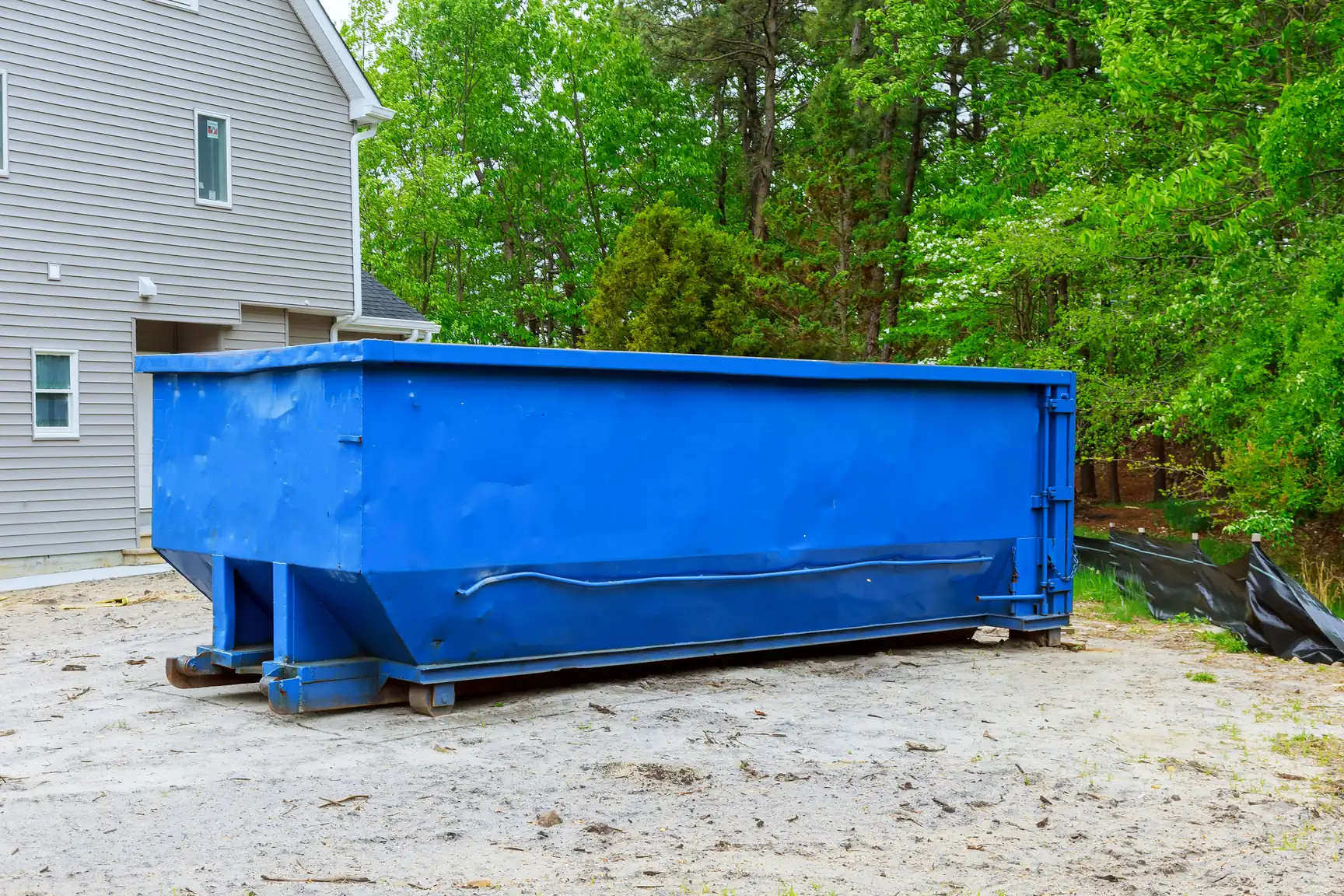
Where the auto policy stops and the liability policy starts in South Dakota
A dumpster rental business runs two liability policies that both have an opinion about the same few seconds: the box swinging off the hoist and settling onto a surface that belongs to somebody else. On the general liability side, the words loading or unloading are the form’s own defined term, and that form generally excludes what arises out of the use of an auto — then tells you that the use includes loading and unloading. The standard auto form never uses the phrase. It arrives at the same seconds by another route, and the route that matters to a roll-off operator turns on whether the device doing the moving is attached to the truck.
The second half of the seam is the surface. A cracked driveway, a scored curb, a lawn flattened under a loaded box, a parking bay gouged by a rail — all of that is damage to property the customer owns. Two familiar general liability exclusions sit over it: one for property the insured has in its care, custody or control, and one for the particular piece of realty under work. Which side of those a given placement loss lands on turns on the wording in force, and this page does not pretend to decide it.
We raise it here because South Dakota gives an operator very little external paperwork to hide behind. There is no state license whose conditions force the question. The seam is therefore the first thing worth reading, not the last, and it should be read at quoting time rather than after a driveway has already failed. Your own policy wording controls, and the forms in use differ between carriers.
South Dakota regulations and licensing for roll-off haulers
Three questions decide what a South Dakota operator must hold: whether the state registers waste haulers, whether it grants intrastate authority to a carrier of property, and who controls the container once it is sitting on a street. The first two answers are negative, for unrelated reasons. The third is where everything that is left has gone.
What South Dakota does not license
South Dakota operates no statewide credential of any kind for a solid waste hauler, collector or transporter, and it directs no city or county to issue one either. The only permit in the state’s solid waste program attaches to a site: SDCL 34A-6-1.4 forbids constructing, altering or operating a disposal site or facility without one, and ARSD 74:27:08:01 says the same thing about building or running a facility. The department states it in plain words on its own solid waste page.
“Individuals, government entities, businesses and industries are required to obtain a permit only if they own or operate a solid waste facility.”
The state does credential hazardous waste transporters, adopting the federal transporter standards at ARSD 74:28:24:01 and assigning identification numbers to generators, transporters and disposal facilities under the definitions at ARSD 74:28:21:01. A roll-off operator moving household rubbish or building debris is not in that class, and the reason is definitional rather than discretionary: SDCL 34A-6-1.3(17) excludes hazardous waste from the meaning of solid waste, so the two programs cannot overlap. Two further classes were checked. Waste tire haulers are defined at ARSD 74:27:22:01(3) and restricted as to where they may take a load by ARSD 74:27:22:02, but no permit or registration is asked of them; and while ARSD 74:53:01:41 governs where septage may go, it is the installers of on-site systems that South Dakota certifies under ARSD 74:53:02, not the haulers.
One statute decides how this axis is typed, and it decides it on a single verb.
“The governing body of a municipality, county, or subdivision may levy and collect fees and charges and require licenses as are necessary to discharge their responsibility.”
A statute ordering every local body to license haulers would make this a positive finding with a local issuer. South Dakota grants the power and commands nothing, so no statewide rule reaches this operator at all. Note the related trap: ARSD chapter 74:27:17 is titled for collection and transportation and creates no credential in any of its three sections. What it actually does is push collection-vehicle and transport standards down to whoever is responsible for waste management locally.
The authority South Dakota repealed
South Dakota grants no intrastate operating authority to a carrier of property, and the honest description of that gap is a repeal rather than an absence. The state regulated carriers of property and then dismantled the program in four moves. SDCL chapter 49-5 went first, repealed in its entirety by SL 1979, ch 307, § 25, and the code still serves its heading as “CARRIERS OF PROPERTY [REPEALED]”. The certificate and permit sections of SDCL chapter 49-28 were repealed in blocks by SL 1995, ch 259 and again by SL 2014, ch 219. On the rules side, ARSD chapter 20:10:02 fell to 28 SDR 92 with effect from 30 December 2001, and chapters 20:10:03 and 20:10:04 fell to 35 SDR 48 with effect from 8 September 2008. Nothing is left running on paper: the repealed rule chapters are served as headings followed by their own repeal lines, so there is no orphan regulation still reciting a dead statute.
Four things survive and none of them is authority. Safety survives, and it reaches this operator. A single-trip permit survives at SDCL 49-28-36.7, secured at a port of entry before the movement begins. Federal interstate registration survives, with SDCL 49-28-69 allowing participation in the federal carrier registration scheme. And vehicle registration and plating remain a county errand; the state trucking portal tells intrastate readers that the forms come from the county, which is registration and not a grant of anything. The safety limb is the one to read closely, and it sits inside a chapter titled for hazardous materials.
“All references to interstate operations must also include intrastate operations except that drivers and motor carriers operating intrastate vehicles and combinations of vehicles with a gross vehicle weight rating, gross combination weight rating, gross vehicle weight, or gross combination weight that does not equal or exceed twenty six thousand one pounds, which are not used to transport hazardous materials requiring placarding under part 177, or designed to transport more than fifteen passengers, including the driver, are not subject to parts 390 to 397, inclusive”
Read that against the chapter title and the danger is obvious. An operator who concludes that South Dakota’s intrastate safety adoption is confined to hazardous loads will have told itself that the federal driver-qualification, hours, inspection and financial responsibility parts do not apply. Over the weight figure, they do. Those parts are federal; South Dakota adopts them, and the adoption expressly carries the federal financial-responsibility part alongside the safety parts. Enforcement rulemaking sits with the director of the Highway Patrol division under SDCL 49-28A-2, while SDCL 49-28-1(1) names the Department of Revenue for the motor carrier chapter. One further pointer on the state’s own portal is stale: it sends readers to a commission whose motor carrier rule chapters have been repealed since 2001 and 2008.
Sioux Falls, and why the city layer is the only layer
In South Dakota the municipal layer is the whole of it. Because the first two answers are negative, an operator’s licensing exposure here is local in its entirety — and the state has said as much twice in its own words, once in the permissive section quoted above and once in ARSD 74:27:17:02, which leaves collection frequency, vehicle standards and transport to permitted facilities in local hands. Municipal variation in South Dakota is not a caveat on the page. It is the subject of the page.
One city is read here as an example and nothing more. Sioux Falls was chosen because its ordinance names this trade outright rather than leaving an operator to argue about scope.
“No commercial garbage hauler or construction and demolition hauler shall use the streets or the sanitary landfill for the collection, removal, or disposal of any garbage, animal waste, rubbish, construction or demolition debris, or recyclable materials without first having obtained a license from the city.”
The license is not the end of it. The city also charges a fee for every hauling unit the licensee runs, under § 57.070; permitted units are open to random inspection at the landfill under § 57.071 and must display their permit under § 57.072; and § 57.067 asks for the hauler’s name on both sides of every vehicle in letters at least six inches high, matching the name on the license, with every container carrying the name or a logo. Two drafting quirks are worth knowing before anyone quotes the code at you. The section headed for hauling unit permits creates only the fee, so the permit itself has to be read out of the two sections that follow it. And the same trade is named three slightly different ways across three adjacent sections, which is a drafting slip rather than three separate credentials.
“No license shall be issued to any commercial garbage hauler or construction and demolition and debris hauler until proof of insurance is furnished to the city, showing the following insurance to be in full force and effect during the entire term of the license.”
What follows in that section is a list an insurance buyer will recognize: workers compensation at the limits state law requires plus employers liability, commercial general liability written on an occurrence basis with products and completed operations aggregated, and automobile liability reaching owned, non-owned and hired units — each at limits the section itself sets, and each capable of being met in part by excess or umbrella cover. The section also disclaims: the city’s acceptance of a certificate is not the city taking responsibility for the policy, and it is not the city saying the limits are enough for anyone. Two cautions. Every figure in that section belongs to one city and is neither a South Dakota requirement nor a benchmark. And the workers compensation limb sends you straight back to state law, which is where the next section starts. No separate street-obstruction or right-of-way permit for placing a container was retrieved for this city, and none is claimed here; the code does carry container and placement sections that were not read in full, and they are not cited.
Workers compensation in South Dakota is an election, not an option
South Dakota’s compensation act is elective in form, and the statute says so from both directions. An employer other than the state or a political subdivision that has not complied with the securing sections is treated as having elected out; and no such employer is treated as having accepted the title until it has complied. Failing to secure cover is therefore a choice the act recognizes rather than a duty the act imposes — which is a statement about drafting, and about nothing else.
“Any employer other than the state, a municipality, or other political subdivision of this state, who has failed to comply with the provisions of §§ 62-5-1 to 62-5-5, inclusive, shall be deemed to have elected not to operate under the provisions of this title.”
The sentence an owner will be tempted to take from that is the one sentence this page will not write. Election has a price and SDCL 62-3-11 sets it: the injured employee may sue at law for damages, or may proceed under the title as though the employer had elected in, and the measure of benefits is then the one at SDCL 62-4-1 plus twice the other compensation the title allows. That is not a technicality for a business whose people work beside a moving hoist. Note also what the record does not find: no employee-count floor was located in the securing provisions and none is asserted, and a sweep of SDCL chapter 62-5 turned up no penalty provision at all.
Placing the cover is ordinary. SDCL 62-5-1 requires an employer inside the compensation provisions to secure payment in one of the ways the next two sections give. SDCL 62-5-2 allows a policy with a stock corporation writing the line, with a mutual employers liability association authorized to transact the business here, or through a reciprocal or interinsurance exchange. SDCL 62-5-5 offers the alternative: an employer that furnishes the Department of Labor and Regulation with annual proof of solvency and financial ability is relieved of the first route, and SDCL 62-5-10 then requires security to be posted on a measure the section sets out. The insurer files with the department when it issues the policy, under SDCL 62-5-9. South Dakota is a competitive state; we describe the bodies involved by their statutory roles and name no insurer.
A panel for South Dakota in rows. Each row sets one thing the state requires beside the exposure that requirement leaves open and the coverage line that answers it. Hauler registration: State transporter credentials exist, but none reaches roll-off hauling. It leaves open a container placed on a customer’s property, and the driveway or curb it damages, which General Liability and Dumpster and Equipment Coverage answer. Intrastate motor-carrier authority: No state intrastate operating authority. It leaves open the roll-off truck at fault, and the container in transit, which Commercial Auto and Pollution Liability answer. Roll-off placement permits: Municipal — varies by city and town. It leaves open placement on the public right-of-way, and a struck pedestrian or vehicle, which General Liability answers. Workers compensation: Coverage is optional; the exposure is not. It leaves open a driver or yard hand hurt on the job, which Workers Compensation answers. Notes: A registration, permit or bond is a condition of operating, not insurance: it answers none of the exposures on the right, so no line is drawn from it. The conclusion reads: The registration is not the coverage — the program is. No figures are shown.
Six coverages, read against a South Dakota job
The state layer decides very little of what an operator here actually needs, so the policy schedule carries more of the weight than it does in a licensing state. One line each:
If you want the whole picture in one place first, start at our dumpster rental insurance overview and come back to the state layer afterwards.
Common South Dakota claims we are asked about
No figures here — the record sources none for this state, and we do not invent severity to make a point. These are the shapes, at pattern level.
The first is the placement loss. A box goes down on a residential drive in Brookings or a paved forecourt in Aberdeen, and the damage appears under the rails rather than at the moment of the drop. Whether that is a general liability matter, an auto matter or neither depends on the exclusions discussed at the top of this page, which is why the seam is worth reading before the quote rather than after the call.
The second is the third party who was never the customer. A delivery van clips a container standing at the edge of a Mitchell street, or a passer-by is hurt around an open box. With no state license conditioning anything, the operator’s own policy schedule is doing the work in that argument.
The third is the load whose contents were not known. Something arrives at the transfer station that should not have, and the conversation moves from a hauling question to a pollution question. South Dakota keeps the two waste programs definitionally apart, which is clean law and no help at all when the contents of a particular box are in dispute.
The fourth is a people claim in a state whose act is elective. A helper is hurt on the tarp or the walk-around, and if payment was never secured the argument is no longer about a benefit schedule — it is about the two routes SDCL 62-3-11 opens for the employee.
The cities and counties inside our South Dakota markets
We write dumpster rental and roll-off operators across South Dakota. These are our named markets, each shown with the county it sits in, and no figure is attached to any of them because the record sources none.
One qualification on the first of those. Part of Sioux Falls lies in Lincoln County as well, so pairing the city with a single county is a convenience for a reader and not a boundary fact. And a reminder about the license: Sioux Falls appears twice on this page, once as a market and once as the municipal example, and those are separate uses. The fact that its ordinance licenses this trade says nothing about Rapid City, Aberdeen, Watertown, Brookings or Mitchell, in either direction.
Nearby states we also write
Every state answers these three questions differently, and none of the findings above travels across a border. Each page below is written from its own record.
South Dakota dumpster rental insurance FAQ
Does South Dakota make me register before I haul roll-off containers?
No — and the reason matters more than the answer. The state runs one permit in its solid waste program and that permit attaches to a facility, not to a truck. The transporter class South Dakota does credential is hazardous waste transporters, under ARSD 74:28:24:01. Because SDCL 34A-6-1.3(17) writes hazardous waste out of the definition of solid waste, the two programs never overlap, and a roll-off box of household rubbish or building debris sits outside the credentialed one.
I read that South Dakota regulates solid waste collection and transportation. Does that chapter license me?
It does not. ARSD chapter 74:27:17 carries a title about collection and transportation and contains three sections, none of which creates a credential. The first is a duty not to handle waste in a way that threatens health or the environment, the second hands collection-vehicle and transport standards to whoever is responsible for waste management locally, and the third requires that a load does not escape on the way to the facility. The title is the trap; the body is the rule.
Do I need intrastate operating authority from the state of South Dakota?
There is none to hold. The program that once regulated carriers of property was taken apart in stages — SDCL chapter 49-5 repealed in 1979, the certificate-and-permit sections of SDCL chapter 49-28 repealed in 1995 and again in 2014, and the last administrative chapters, ARSD 20:10:03 and 20:10:04, repealed effective 8 September 2008. Thirty-nine of the seventy-two section entries in SDCL chapter 49-28 are printed as repealed, and nothing that survives grants a certificate of authority.
So what does the state still enforce against my trucks in South Dakota?
Safety, and it reaches further than the chapter title suggests. SDCL 49-28A-3 sits in a chapter named for hazardous materials, but its adoption of the federal safety parts applies to intrastate carriers generally once the weight figure is met, and it pulls in the federal financial-responsibility part as well. Rulemaking for enforcement sits with the director of the Highway Patrol division under SDCL 49-28A-2, and the Highway Patrol runs four permanent ports of entry.
Does a South Dakota city need to license me, or is that optional for them too?
Optional for them, which is exactly why you have to ask. SDCL 34A-6-29 permits a municipality, county or subdivision to charge fees and require licenses; it does not direct any of them to. Sioux Falls has chosen to, and its license names construction and demolition haulers in the operative sentence. Another South Dakota city may require nothing at all. Neither fact proves anything about the other.
Does a South Dakota license ever depend on my insurance?
In Sioux Falls it does. Section 57.077 of that city’s code makes filed proof of insurance a precondition of issue and requires the cover to stay in force for the whole term of the license, listing workers compensation with employers liability, commercial general liability and automobile liability covering owned, non-owned and hired units. Read the section for the limits it sets and read your own certificates against them before you apply. That is one city’s rule and not South Dakota’s.
Is workers compensation optional in South Dakota because the act is elective?
No. The act is elective in FORM, which is a statement about statutory drafting rather than about your exposure. An employer who does not secure payment is treated by SDCL 62-5-7 as having elected out, and SDCL 62-3-11 then lets the injured employee sue at law or proceed under the title as though the employer had elected in, with benefits measured under SDCL 62-4-1 plus twice the other compensation the title allows. Election has a price, and the statute sets it.
How do I actually place workers compensation cover in South Dakota?
Through the ordinary market or by qualifying to self-insure. SDCL 62-5-2 lets an employer insure with a stock corporation writing the line, a mutual employers liability association authorized here, or a reciprocal or interinsurance exchange. SDCL 62-5-5 lets a solvent employer furnish annual proof to the Department of Labor and Regulation instead, and SDCL 62-5-10 then requires security to be posted. The insurer files with the department when it issues a policy under SDCL 62-5-9.
This page reports South Dakota law as our own state research file records it. It is general information rather than legal advice, and it is not an opinion on what any policy covers — the wording you hold controls that, and carriers do not all write it the same way.
Quote a South Dakota roll-off operation
Send us the trucks, the container count, the payroll and the towns you deliver into. We will read the six lines against the work, and where the answer belongs to a city rather than to the state we will say so plainly. Your own policy wording controls.
Related coverage for dumpster rental operators
- General Liabilitygeneral liability
- Commercial Autocommercial auto
- Dumpster and Equipment Coverageinland marine
- Commercial Propertycommercial property
- Workers Compensationworkers compensation
- Pollution Liabilityenvironmental / pollution liability
What it costs in South Dakota · States we serve · Dumpster Rental Insurance · Get a quote · Contact us
Primary sources
- South Dakota Department of Agriculture and Natural Resources — Solid Waste — the department’s own statement that a solid waste permit is owed by whoever owns or operates a facility
- SDCL chapter 34A-6 — Solid Waste Disposal — the facility permit at 34A-6-1.4, the definition at 34A-6-1.3(17), and the permissive local section at 34A-6-29
- SDCL chapter 49-28 — Motor Carrier Regulation — the chapter whose certificate and permit sections were repealed in blocks; the single-trip permit survives at 49-28-36.7
- SDCL chapter 62-5 — Insurance of Employers — the securing provisions, the self-insurance route at 62-5-5 and the election-out rule at 62-5-7
- Sioux Falls Code of Ordinances, §§ 57.065 to 57.077 — the one municipal example on this page — the hauler license, the per-unit permits and the insurance condition
- South Dakota Division of Insurance — the state insurance regulator; it sits inside the Department of Labor and Regulation and is a division, not a department