
Dumpster Rental Insurance by State
Dumpster Rental Insurance in Vermont
Three tiers of Vermont law reach a roll-off operator, and they use the same words for different things. This page separates them and says what each one can actually do to you.
The moment Vermont policies argue about
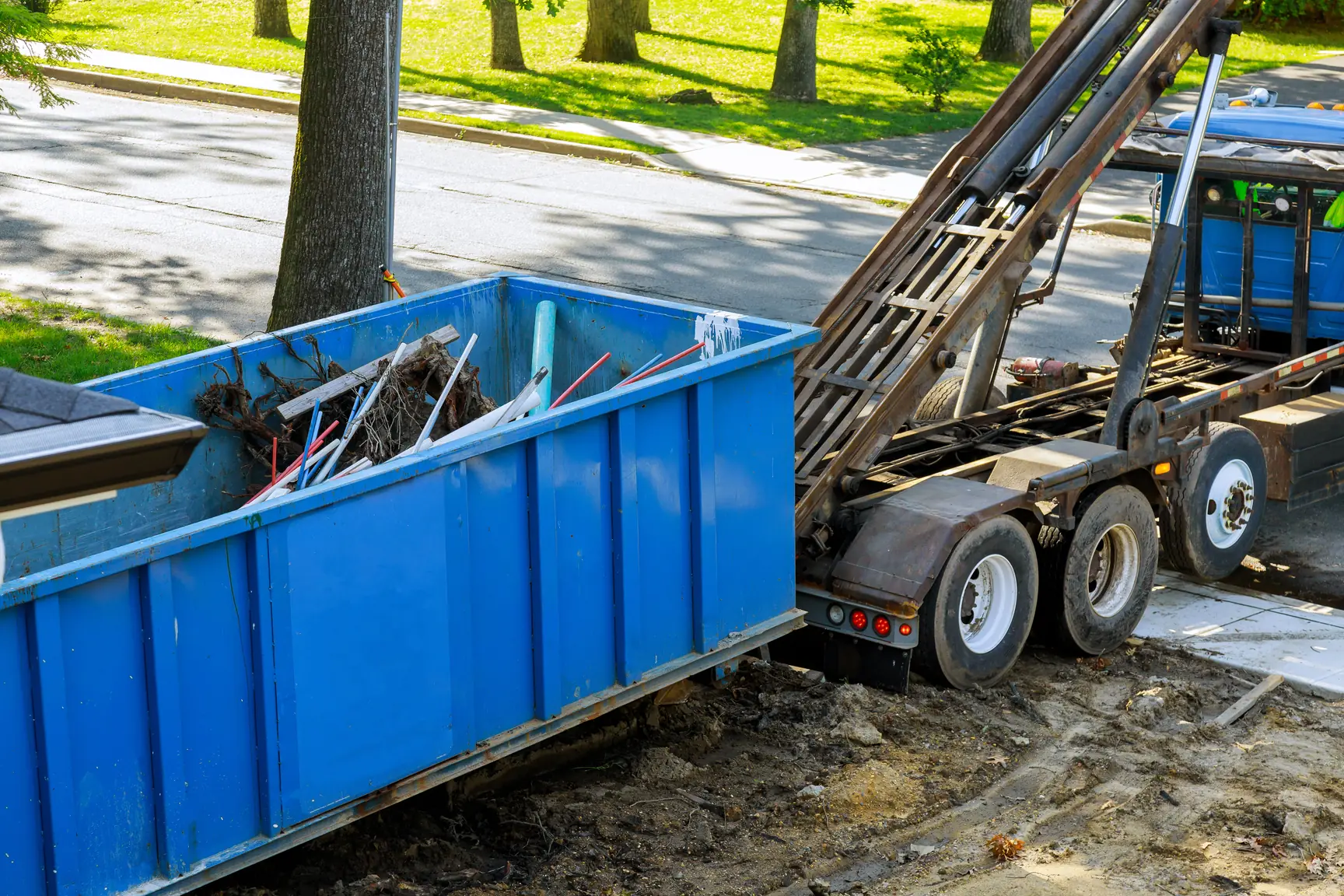
Between the hoist letting go and the container settling, two liability policies both have a claim to the same few seconds. The general liability form uses loading or unloading as a defined term of its own; it generally excludes what arises out of the use of an auto, then tells the reader that such use takes in loading and unloading. The auto form never uses that phrase. It reaches the same moment along another path, and the fork in that path — for this trade — is whether the thing moving the property is attached to the truck.
The other half of the seam is what the box lands on. Split tarmac, a scored curb, a lawn pressed flat, a gouged parking surface: all of it damage to property belonging to the person who booked the container. General liability forms typically carry exclusions for property in the insured’s care, custody or control and for that particular part of real property being worked on. Which of them, if either, catches a particular placement loss is a matter of the form in force and the facts of the day, and this page does not try to resolve it.
Vermont sharpens the point in an unexpected way. Because the state permit is an operating prohibition enforced at the roadside, a Vermont operator already thinks in terms of what is carried in the cab. The insurance question deserves the same treatment: know where the seam runs before the first drop of a contract, not after a driveway has failed. Your own policy wording controls, and the forms in use differ between carriers.
Vermont regulations and licensing across three tiers
Vermont has three tiers, and its layers are genuinely different instruments rather than repetitions of one. The state permits the hauler. A solid waste management district may license on top. A municipality may regulate, and may go as far as franchising exclusively. The three use overlapping vocabulary, which is the first thing to get straight.
Vermont’s commercial hauler permit
Vermont requires this credential and the state issues it. The statute puts it in the hands of the Secretary of Natural Resources, whose office 10 V.S.A. § 6602(1) defines, and the environmental department’s waste program processes the applications. The definition that decides whether a roll-off business is inside is short and leaves little room.
“‘Commercial hauler’ means: (A) any person that transports regulated quantities of hazardous waste; and (B) any person that transports solid waste for compensation in a motor vehicle.”
Transporting for compensation is the whole of limb (B), and 10 V.S.A. § 6607a(a) then requires the hauler to apply to the Secretary on the Secretary’s own form, submit the disclosure statement that 10 V.S.A. § 6605f describes, and say what kind of waste it intends to carry. Whether the waste stream is inside was checked rather than assumed: 10 V.S.A. § 6602(2) defines solid waste widely and excludes exactly three things — manure and the bedding beneath it where the pair is put to enriching soil, carbon-rich bulking agents used in composting, and materials dissolved or solid in an industrial discharge that is a point source under the water pollution chapter. Construction and demolition debris is none of those.
Who holds the permit is settled by 10 V.S.A. § 6607a(b)(2): the holder is the legal or commercial entity doing the transporting, not the individual employees or subcontractors it uses, and in a sole proprietorship it is the proprietor. And what makes this a credential rather than a filing is the prohibition attached to it.
“It shall be unlawful for any person to operate a motor vehicle subject to the provisions of this section upon any public highway in the State without first obtaining the permit from the Secretary, or to so operate without having in the vehicle a permit issued under this section.”
Two duties there, not one: hold it, and carry it. Section 6607a(e) classes a breach as a traffic violation, under 23 V.S.A. chapter 24, so it is enforced at the roadside, and § 6607a(c) allows any duly authorized law enforcement officer to act as well as an agent of the Secretary. There is exactly one way out of the permit, and both of its limbs must be met at once.
“The Secretary shall not require a commercial hauler to obtain a permit under this section ... if: (A) the commercial hauler does not transport more than four cubic yards of solid waste at any time; and (B) the solid waste transportation services performed are incidental to other nonwaste services performed by the commercial hauler.”
A roll-off operator fails both. The containers are many times four cubic yards, and moving waste is the enterprise rather than something attached to a different one. The agency puts the same test in ordinary language on its own hauler page: if hauling waste is your business or your side job you need the permit, the former one-ton exemption no longer exists, and the incidental route is meant for a property manager or a handyperson moving small loads. Self-hauling needs no permit only because it is not for compensation.
Then the term, which contradicts itself inside a single sentence and has to be carried in both halves.
“These permits shall have a duration of five years and shall be renewed annually.”
One more piece of Vermont vocabulary to disarm before it costs somebody a duplicate application. The same section later refers to a commercial hauler certified under it; the cross-referencing section at 10 V.S.A. § 6605f(m) calls the same thing a waste transporter permit; and the agency’s page heading talks about hauler licensing while its body says waste hauling permit. Permit, certification and license here are one credential wearing four labels, not three separate Vermont requirements. The record also notes an unresolved wrinkle rather than tidying it away: § 6607a(a) sends the applicant to the disclosure statement at § 6605f, but the disqualification list at § 6605f(a) names certifications under other sections and not this one, while § 6605f(m) expressly names the § 6607a permit. The disclosure duty attaches; the list on its face does not reach it.
Why Vermont issues no property-carrier authority
Vermont grants no intrastate operating authority to a carrier of property, and the reason is not an oversight. The Transportation Board does issue one motor carrier certificate and it belongs to a different trade entirely: 5 V.S.A. § 1820 defines a motor bus as a vehicle worked along a regular route, receiving, discharging and carrying passengers for hire; 5 V.S.A. § 1821 declares the operator of such a vehicle a common carrier, under a heading that would otherwise suggest Vermont licenses carriers of freight; and 5 V.S.A. § 1823 forbids operating a motor bus until the owner holds a certificate specifying the route, the number of passengers, the service and a finding that the operation promotes the general good of the state. A roll-off truck is not a motor bus and runs no fixed route. The intrastate class Vermont certificates is the fixed-route bus operator, and roll-off hauling is not among the classes it certificates. An older transport-company chapter at 5 V.S.A. §§ 1701 to 1711 is carried in the code as repealed.
The safety half of the axis is real and sits with the Secretary of Transportation under 5 V.S.A. § 2101. Subsection (a)(1) authorizes rules on motor carrier safety standards for the carriage of passengers and goods by commercial motor vehicles, requires those rules to identify violations and possible penalties by category, and holds them to a floor: no less protective of public safety than the federal government’s own motor carrier safety rules. Those federal rules are federal; what reaches a wholly Vermont operation is the state rulemaking that must match or exceed them, plus the hook at 5 V.S.A. § 2101(b) making it unlawful to break any rule the Secretary adopts under the section. The rules themselves were not retrieved for this page, so nothing here cites one. Subsections (a)(2) and (a)(3) add enforcement by agency staff or cooperative agreement, including with other states and the federal government.
Vermont’s own weight figure lives in the driver-licensing chapter, not in anything about authority. 23 V.S.A. § 4103(4)(A) defines a commercial motor vehicle by a gross vehicle weight rating or weight of “at least 26,001 or more pounds” — the redundancy is the statute’s own — or such lesser rating as federal regulation determines, or by a design capacity above 15 passengers including the driver, or by carrying placarded hazardous materials. An operator who reads that as an authority threshold will have invented a Vermont credential. There is one genuinely intrastate-specific number on this axis and it is an age rather than a weight: § 2101(a)(1) forbids a rule that would stop a person between 18 and 21 driving in intrastate commerce.
Three Vermont layers: state, district, town
Vermont sets no statewide placement or right-of-way rule, and the state permit above displaces nothing beneath it. What sits beneath it is two tiers rather than one.
Vermont organizes part of its waste system through solid waste management districts, which are unions of municipalities, and 24 V.S.A. § 2202a(c)(1) requires each municipality either to join or take part in one, or else to join a regional planning commission’s solid waste planning effort. The state agency points haulers there itself, telling them to check with their local solid waste management entity for any additional permit requirements. One district is named here as an example and nothing more. The Chittenden Solid Waste District states on its own page for haulers that anyone collecting, transferring or transporting solid waste generated or delivered within Chittenden County must hold a current license from it, and that all haulers must be licensed to use its facilities. It also publishes an insurance condition — a certificate evidencing liability cover at stated levels for injury, death and property damage, with the district named as an additional insured. That is a real underwriting fact and it is exactly the kind of local condition a statewide page must not generalize. The district’s own ordinance could not be retrieved in this run, so nothing above is cited to a section of it; the requirement rests on the district’s published statement about its own program.
24 V.S.A. § 2291 gives every town, city and incorporated village a list of powers that includes regulating or prohibiting the storage or dumping of solid waste as that term is defined in 10 V.S.A. § 6602. A second provision reads as follows.
“Municipalities may issue exclusive local franchises and may make, amend, or repeal rules necessary to manage the storage, collection, processing, and disposal of solid waste materials within their limits and impose penalties for violations thereof”
Read plainly, a Vermont municipality may lawfully shut a fully permitted hauler out of its territory. Whether any particular town has done so was not established here and this page implies nothing either way. Behind the ordinance there are teeth: 24 V.S.A. § 2297a(a) lets a municipal legislative body issue and enforce a solid waste order, including a directive to come into compliance, abate hazards caused by non-compliance or restore the environment to its previous condition, with civil penalties the section quantifies.
One city is read as an example, and its lesson is an absence. The City of South Burlington’s solid waste chapter is headed for the subject and its entire body, as served, is a reservation followed by a cross-reference to the state statutes and to the municipal power at 24 V.S.A. § 2291(12). Vermont’s second city holds the power to license haulers, cites it in its own code, and has not used it — which is precisely why the operative credential in Vermont is the state permit. Placement, though, is genuinely unresolved on the face of that code. Section 32-97 forbids placing, erecting or maintaining any structure in a public right-of-way, sidewalk, street or public space without a permit from the city manager, with the fee set by council resolution, and section 32-95(a) states the article’s purpose as regulating private structures on streets, sidewalks and other public spaces. The definition at section 32-96 is the whole test and it does not settle the question: the term takes in any collection of goods and materials meant to be used or occupied, whether briefly or for good, and it is illustrated by six items of street furniture — bicycle racks, tables, chairs, access ramps, rails, vending machines — none of which is a container. The list is expressly not exhaustive, so a roll-off box may be inside it and may not. The honest sentence is that the city permits structures in the right-of-way, that its definition names street furniture and not waste containers, and that an operator should ask the city rather than assume either way.
Four statutory routes to Vermont workers compensation
Vermont is compulsory and its market is competitive. The securing section opens by excluding state, county and municipal bodies as employers — a class that plainly does not contain a private roll-off business — and then sets out four ways of discharging the duty, expressly permitting a combination of them, which several states’ equivalents do not. The first is an ordinary market placement: insuring and keeping insured with any corporation, reciprocal or interinsurance exchange authorized to transact the line in Vermont. The second is guarantee insurance with a company authorized to do that business here. The third is satisfying the Commissioner as to the employer’s own financial responsibility for paying compensation under the chapter. The fourth is participating, to the Commissioner of Labor’s satisfaction, in a non-profit self-insurance corporation that the Commissioner of Financial Regulation has approved. Route one is what makes Vermont a competitive state rather than a monopolistic one.
Two bodies share the ground and neither is an insurer. The labor commissioner decides; the financial regulation department supplies technical assistance and a recommendation on each self-insurance application, approves the non-profit corporations, and is consulted on the rules, terms and conditions — surety bonds, cash deposits, reserves, excess risk insurance — that secure the same protection a policy would give. We name no insurer here, and we describe every body by its statutory role.
What failing to secure costs in Vermont is personal.
“(1) If the employer is a corporation, the officers and majority stockholders of the corporation shall be personally liable for any benefits owed to the injured employee under this chapter. (2) If the employer is a partnership, the partners shall be personally liable”
One limit stated rather than hidden: this run read the securing section and its subsections and did not retrieve a Vermont coverage-scope or exclusions provision. So this page records that no exemption reaching this operator was found, and does not claim that the chapter contains none. No headcount floor is asserted either.
A panel for Vermont in rows. Each row sets one thing the state requires beside the exposure that requirement leaves open and the coverage line that answers it. Hauler registration: A hauler credential, issued by the state. It leaves open a container placed on a customer’s property, and the driveway or curb it damages, which General Liability and Dumpster and Equipment Coverage answer. Intrastate motor-carrier authority: State motor-carrier rules attach at a vehicle threshold. It leaves open the roll-off truck at fault, and the container in transit, which Commercial Auto and Pollution Liability answer. Roll-off placement permits: Municipal — varies by city and town. It leaves open placement on the public right-of-way, and a struck pedestrian or vehicle, which General Liability answers. Workers compensation: Compulsory; bought from private insurers. It leaves open a driver or yard hand hurt on the job, which Workers Compensation answers. Notes: A registration, permit or bond is a condition of operating, not insurance: it answers none of the exposures on the right, so no line is drawn from it. The conclusion reads: The registration is not the coverage — the program is. No figures are shown.
What the six coverages carry for a Vermont operator
With a state permit, a possible district license and a municipality that may franchise, a Vermont schedule gets read by more than one set of eyes. Briefly, each in turn:
For the whole picture before the state detail, begin with our dumpster rental insurance overview.
Common Vermont claims worth planning for
No figures below. The record sources no severity or frequency data for this state, and §14 forbids supplying any. These are the shapes we are asked about.
Vermont cities we name as markets
We write dumpster rental and roll-off operators across Vermont. The markets below are written with their tier, because Vermont place names repeat across tiers — there is a town and a city of Rutland in one county, a town and a city of Barre in another, and a town called Chittenden that is not in Chittenden County. The county shown is a geographic anchor only and says nothing about who issues anything. No figure is attached to any of these, because the record sources none.
Two fences carried over from the sections above. South Burlington does double duty here, as a market and as the city whose code is read further up, and the two mentions are independent of one another — its empty waste chapter is that city’s own choice and never Vermont’s position. Burlington is a market only: its own ordinances were not retrievable in this run, so nothing here describes them.
Nearby states we also write
Vermont borders exactly three states and all three are below. Its fourth border is with Quebec, outside the footprint entirely. Nothing established on this page travels across any of those lines — Vermont’s state-issued permit is unusual in this neighborhood, and each page below is written from that state’s own record.
Vermont commercial hauler FAQ
Do I need a Vermont permit to haul containers for paying customers?
Yes. Under 10 V.S.A. § 6607a(b)(1)(B) a commercial hauler includes any person moving solid waste for compensation in a motor vehicle, and § 6607a(a) requires that person to apply to the Secretary for a permit, with a disclosure statement, stating the nature of the waste to be hauled. The permit is issued by the state — the statute names the Secretary of Natural Resources, and 10 V.S.A. § 6602(1) defines who that is. The environmental department administers the application; it is not the issuer.
Who holds the Vermont permit — the driver or the business?
The business. 10 V.S.A. § 6607a(b)(2) is explicit that the permit holder is the legal or commercial entity doing the transporting, rather than its individual employees and subcontractors, and that in a sole proprietorship the proprietor is that entity. So a subcontracted driver does not need one of their own, and a firm cannot rely on a subcontractor’s.
Is there a small-load exemption I can use in Vermont?
There is one exemption and both of its limbs have to be satisfied together. Under 10 V.S.A. § 6607a(b)(3) the Secretary does not require a permit where the hauler never carries more than four cubic yards at a time AND the waste transport is incidental to other non-waste services it performs. A roll-off container is many times four cubic yards, and hauling is the business rather than a sideline to one, so the exemption is unavailable on both limbs. The agency says the same thing plainly, and notes that the old one-ton exemption is gone.
How long does the Vermont hauler permit last?
Both answers are in the same statutory sentence, and an operator needs both. 10 V.S.A. § 6607a(a) gives the permit a duration of five years and requires annual renewal. Writing down only the five years, or only the annual step, is writing down a different rule from the one Vermont has.
What happens if a Vermont truck is stopped without the permit aboard?
It is enforced at the roadside. 10 V.S.A. § 6607a(d) makes it unlawful both to operate without having obtained the permit and to operate without having it in the vehicle, and § 6607a(e) makes a breach a traffic violation under 23 V.S.A. chapter 24. Under § 6607a(c) an agent of the Secretary is not the only person who can act on it — any duly authorized law enforcement officer can.
Does Vermont issue intrastate operating authority to a carrier of property?
No. The one motor carrier certificate the Transportation Board issues is a motor bus certificate: 5 V.S.A. § 1820 defines a motor bus as a vehicle running a regular route and carrying passengers for hire, § 1821 ties the common carrier class to that vehicle, and § 1823 makes the certificate specify the route, the passenger capacity and the service. The intrastate class Vermont certificates is the fixed-route bus operator, and roll-off hauling is not among the classes it certificates.
Which Vermont weight figure applies to my trucks, then?
The one at 23 V.S.A. § 4103(4)(A), and it is a driver-licensing figure rather than an authority figure. It defines a commercial motor vehicle partly by a gross vehicle weight rating or weight of at least 26,001 or more pounds — the redundancy is the statute’s own — or such lesser rating as federal regulation determines, partly by capacity above 15 passengers including the driver, and partly by placarded hazardous materials. Vermont issues no intrastate operating authority to a carrier of property, so this figure is not a threshold of any such credential.
Can a Vermont town or district add requirements on top of the state permit?
Both can. 24 V.S.A. § 2291(12) lets a town, city or incorporated village regulate or prohibit the storage or dumping of solid waste, and 24 V.S.A. § 2202a(a) lets municipalities issue exclusive local franchises. Districts sit in between: the state agency itself tells haulers to ask their local solid waste management entity about additional permit requirements, and 24 V.S.A. § 2202a(c)(1) requires each municipality to join a district or take part in regional planning for solid waste.
This page reports Vermont law as our own state research file records it. It is general information rather than legal advice, and it is not an opinion on what any policy covers — the wording you hold controls that, and carriers do not all write it the same way.
Put a Vermont hauling operation in front of us
Tell us the fleet, the container sizes, the districts and towns you work in, and who is on the payroll. We will read the six coverages against the permit, any district condition, and the municipality’s own posture. Your own policy wording controls.
Related coverage for dumpster rental operators
- General Liabilitygeneral liability
- Commercial Autocommercial auto
- Dumpster and Equipment Coverageinland marine
- Commercial Propertycommercial property
- Workers Compensationworkers compensation
- Pollution Liabilityenvironmental / pollution liability
What it costs in Vermont · States we serve · Dumpster Rental Insurance · Get a quote · Contact us
Primary sources
- 10 V.S.A. § 6607a — Commercial haulers — the definition, the permit, the operating prohibition, the roadside enforcement and the one conjunctive exemption
- Vermont DEC — Waste Haulers — the department that administers the application, and its own plain-English statement of who needs the permit
- 5 V.S.A. § 2101 — Motor carrier safety — the rulemaking that reaches an intrastate operation, with the no-less-protective-than-federal standard on its face
- 24 V.S.A. § 2202a — Municipal responsibility for solid waste — the municipal power to issue exclusive local franchises, and the duty to join a district or a regional planning effort
- Chittenden Solid Waste District — help for haulers — the district example on this page: its own published license requirement and its own insurance condition
- 21 V.S.A. § 687 — Employer to secure compensation — the four routes, the permission to combine them, and the personal liability that follows a failure to secure