
Dumpster Rental Insurance by State
Dumpster Rental Insurance in Wyoming
Wyoming asks nothing of a waste hauler on paper and a great deal of the truck it drives. Here is the regulatory layer, the workers compensation route, and the seam between two liability forms that decides who pays for the drop.
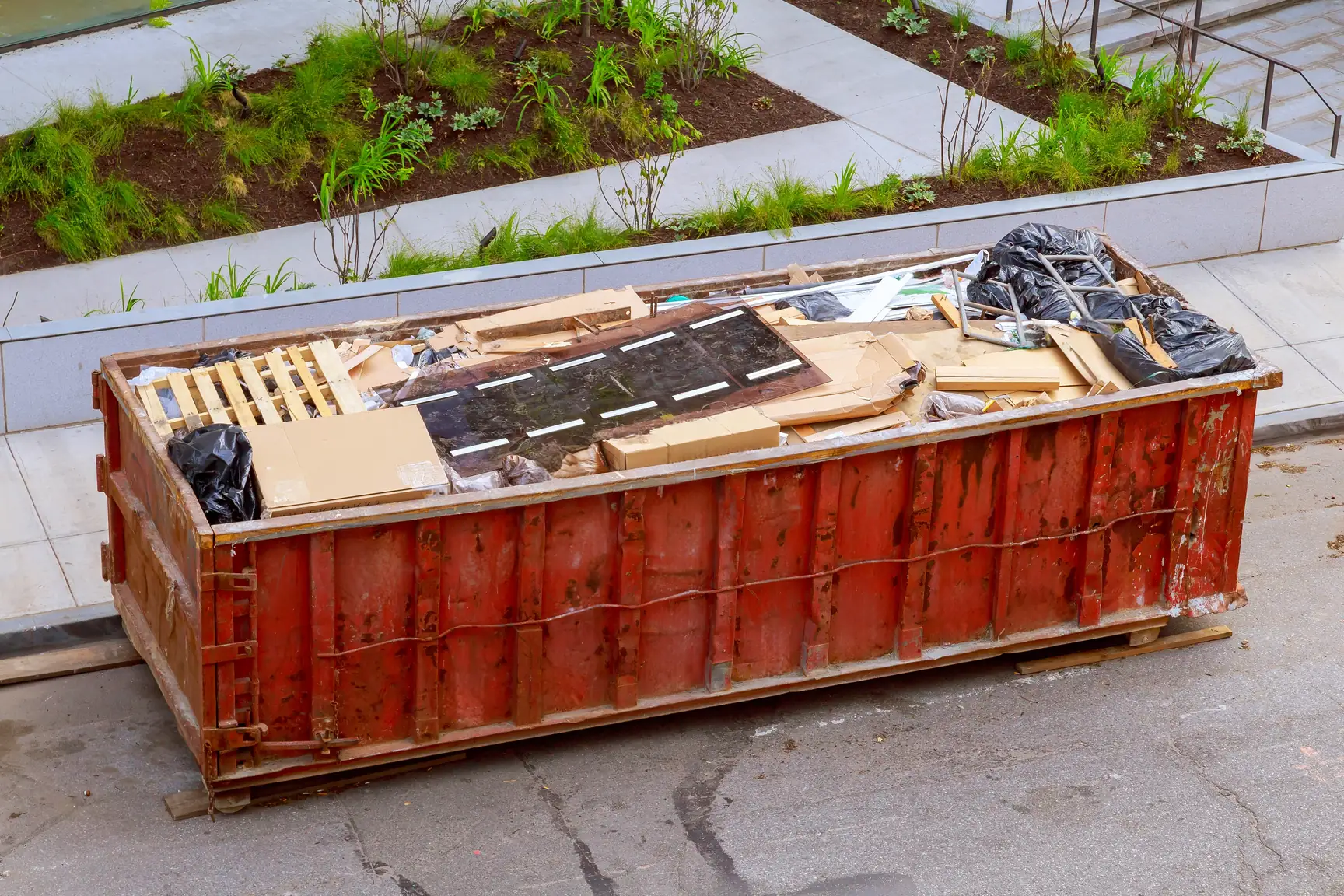
The thirty seconds a Wyoming drop turns on
A dumpster rental operation carries two liability policies that both have something to say about the same short moment: the box coming down the rails and settling onto a customer’s ground.
The general liability form treats loading and unloading as a defined term of its own. It generally excludes injury and damage arising out of the use of an auto, then tells the reader that using an auto includes loading and unloading it. The standard auto form never uses that phrase. It arrives at the same instant along a different road, and the part that decides a roll-off claim turns on whether the device doing the moving was attached to the truck. Two forms drafted to meet, and the meeting point is not always where an operator expects it.
Then the second half of the seam: damage to the customer’s own property rather than to a stranger’s. The cracked apron, the scored curb, the gouged parking surface. A general liability wording typically carries exclusions for property the insured has in its care, custody or control and for the specific piece of real property under work. Whether a placement loss falls inside or outside them depends on the exact wording in front of you and the exact facts of the drop, which no web page can settle.
What this page can do is show a Wyoming owner where the seam runs, so the question gets asked while the policies are being built rather than after a container has moved. Your own policy language controls, and the forms in use differ between carriers.
Three regulatory layers reach a Wyoming roll-off operation, and only one issues paper
Wyoming answers the hauler-credential question by not really having one, puts a real and enforceable credential on the vehicle instead, and leaves the ground rules to the town. Taking the three layers in order is the only way to end up with a true sentence about any of them.
No Wyoming waste-hauler credential exists to be held
There is no state license, registration or permit in Wyoming for moving nonhazardous construction and demolition debris or municipal solid waste. That is a verified finding rather than an assumption: the Environmental Quality Act at W.S. 35-11-101 and following was swept in full for every licensing, registration, permit and certification term, and every hit read for a transport context. What survives is mine reclamation, air quality, geologic sequestration, nuclear references, battery delivery rules and the hazardous-waste duties below — none of which creates a Wyoming document for a person who carries somebody else’s waste.
Wyoming permits the place the waste ends up, not the truck that brings it, and the trigger reads as a prohibition on operating the site:
“No person, except when authorized under the permit system established pursuant to this act, shall: (i) Locate, construct, operate or close a solid waste management facility; or (ii) Modify the design, construction or operation of a solid waste management facility.”
Both paragraphs are about a facility, and the defining term at W.S. 35-11-103(d)(ii) keeps them there: such a facility is a place for transferring, treating, processing, storing or disposing of waste. A truck is not one.
There is one near-miss worth naming, because an operator who joins two true things together here ends up with a false one. W.S. 35-11-532 carries a catchline about municipal solid waste facility operator financial responsibility, and the environmental agency separately advertises landfill and transfer-station management examinations that end in a certificate. Read together they look like a state operator credential. The statute is a solvency rule addressed to the owner of a landfill, and the agency is explicit about the training:
“this training and testing is not mandatory by rule, it may be required because it has been specified as a training requirement in a landfill’s permit application”
The closest thing Wyoming has to a transporter rule sits in the hazardous-waste provisions, and it issues nothing at all. A person carrying hazardous waste in the quantities the federal subtitle governs must keep records of what was carried, where it came from and where it went; must move it only once it is properly labeled and manifested; and must take it only to the facility the shipper names on the manifest (W.S. 35-11-516(a)(ii)). A roll-off load of building debris or household refuse is outside even that, and an operator who is inside it still receives no Wyoming paper.
So the honest sentence is not that Wyoming asks nothing. It is that Wyoming asks nothing of the hauler as a hauler — and asks a good deal of the same person as the operator of a commercial vehicle, which is the next heading.
The Wyoming credential that attaches to the truck
Intrastate operating authority is issued by the Wyoming Department of Transportation. W.S. 31-18-101(a)(v) makes it the department for these purposes, and W.S. 31-18-104(a)(iii) gives it the power to issue, refuse or suspend both that authority and the commercial vehicle registration beside it.
Whether a truck is inside the chapter is decided by the definition of a commercial vehicle, which splits between interstate and intrastate work. The intrastate limb runs to seven clauses; two matter to a roll-off operator:
“(I) Any vehicle engaged in transporting of persons or property, having a gross vehicle weight rating, gross combination weight rating, gross vehicle weight or gross combination weight of twenty-six thousand one (26,001) pounds or more” … “(VI) A power unit having three (3) or more axles regardless of weight”
The weight figure is the one everybody quotes and it is not the whole rule. A roll-off truck that is a power unit having three or more axles falls under the axle limb, which puts the vehicle inside the chapter at any weight — the weight clause never has to be reached. An owner who hands a driver the weight number as though it were the test has handed over a third of the rule.
Which class does a for-hire operator fall into? The contract motor carrier class, which reaches anyone moving property by vehicle on the highways in return for compensation — and compensation is defined broadly enough to take in money or anything else given for the carriage, directly or not (W.S. 31-18-101(a)(x)(A) and (a)(iv)). The private carrier route is not open here: it is written for someone hauling property they own, lease or hold as bailee, without compensation, in furtherance of their own enterprise (W.S. 31-18-101(a)(x)(D)). Carrying a customer’s waste for a fee fails both halves of that.
The department is required to issue authority to qualified motor carriers, and once issued it stays in force unless it is revoked or suspended for good cause or canceled at the holder’s own request (W.S. 31-18-209(a)). The authority is conditioned on filed insurance. An intrastate contract carrier has to deposit with the department policies written by insurers authorized to do business here — or by others the insurance commissioner accepts as lawfully able to transact insurance in the state — or security the department finds adequate instead, reaching cargo, damage to property and liability to the public. The filing has to be continuous, and here is what happens when it is not:
“shall, upon its effective date, suspend the operating authority of the affected carrier and no operations shall be conducted on any highway until the insurance, bond or other adequate security, in the form and amount required, becomes effective and is approved by the department.”
That is an operating credential conditioned on insurance, which is a different thing from an insurance requirement sitting beside one. A lapse does not merely expose the business; it takes the trucks off the road until the filing is restored.
Two more duties travel with the authority and both are easy to fail at the roadside. A copy of the current authority rides in each power unit and is produced on demand, with the vehicle submitted for inspection at a port of entry (W.S. 31-18-301(b) and (c)); and the carrier’s name or trade name is displayed, legible at fifty feet in daylight while the vehicle stands still (W.S. 31-18-304(a) and (b)).
Two things this layer is not. Registration is a separate act, routed to the department for a vehicle worked in more than one jurisdiction and to a county treasurer for a Wyoming-only vehicle or fleet (W.S. 31-18-201(b)). Mobile machinery is a different regime again, written for heavy equipment used in road, bridge, ditch, building or reclamation work (W.S. 31-18-203(b)). A roll-off truck is neither.
The federal layer is federal and this page says so plainly. The USDOT number comes from the Federal Motor Carrier Safety Administration, not from Wyoming, and the state transportation department’s own page tells applicants exactly that. Wyoming’s rules on driver hours, equipment and hazardous materials must stay consistent with the comparable federal ones (W.S. 31-18-303(a) and (c)).
Where a Wyoming container may sit is a town-by-town question
Wyoming sets no statewide placement rule, no right-of-way obstruction permit and no hauler licensing scheme. What it does is hand the power downward and stop. A city or town may take land inside or outside its limits for depositing refuse, control how that land is used, and set reasonable rules for the hauling of refuse (W.S. 15-1-103(a)(xxi)). Cities and towns may also make ordinances governing and protecting liquid and solid waste disposal facilities, fix rates, and provide for collection and for disposal (W.S. 15-7-101(a)(xi)). A power to make rules is not a rule, and Wyoming never converts the one into the other.
The state environmental agency reinforces the point: waste goes to designated facilities approved both by the state program and by the governing body of the county, city or town where the facility sits.
One municipality is named here as an example and for no other purpose. Casper Municipal Code chapter 8.32 claims for the city the exclusive authority and responsibility within the city limits over rules, standards and minimum guidelines for collecting and disposing of solid waste, and goes further on the residential side, reserving residential collection to the city with named subdivision exceptions and preserving private service in an annexed developed subdivision only where a private contractor already provides it (§ 8.32.020 and § 8.32.025). Commercial work is where a private operator lives: the chapter contemplates a container furnished either by the city’s own solid waste division or by a contractor offering that service (§ 8.32.040(B)(3)).
The placement rules in the same chapter are the kind an operator learns the hard way. A container serving a commercial account goes on private property beside the alley where one exists, or at the curb on lots that touch an alley, positioned so a collection vehicle can reach it; a vehicle blocking that access may be ticketed; and collection vehicles are to be given access between four in the morning and six in the evening, Monday through Saturday (§ 8.32.050(A)). Separate paragraphs require safety wording on the container itself (§ 8.32.040(B)(6)).
And then the paragraph that sits directly on this operator’s market:
“The city will not be responsible for the removal and disposal of rock, stone, brick, concrete, dirt and other building materials or mineral wastes from curbside, alleys and construction sites. It is the responsibility of the owner to remove and dispose of such articles at the city solid waste facility.”
The city puts construction debris outside its own service and onto the property owner. That is the demand a roll-off operator exists to meet, written into an ordinance.
Casper’s code was searched in full for a refuse or solid-waste hauler license and there is none: its licensing title reaches taxicabs, buses, itinerant merchants, alcoholic beverages and building contractors. A Wyoming municipality can run detailed container rules while running no hauler license at all — which is why this layer is recorded as varying rather than as a settled yes.
One limit on what this page knows: the research behind it swept the municipal enabling statutes in Title 15 and one city’s code, not Title 18, so whether a Wyoming county may license a hauler is an open question nothing here answers. Read the ordinance where you are dropping, every time.
Wyoming workers compensation has one door, and the statute names it
Wyoming does not place this line in the open market for an employer the Act reaches. Coverage comes from the state system, administered by the Workers’ Compensation Division of the Department of Workforce Services, and the statute states the sequence as a prohibition on starting work:
“Any employer subject to this act shall not commence business or engage in work in this state without applying for coverage under this act and receiving a statement of coverage from the division.”
Applying is the beginning, not the end. The continuing duty runs through payroll: a certified true copy goes to the division on its own forms for employees in extrahazardous employment, with reports and payments due by the last day of the month after the earnings are paid (W.S. 27-14-202(a)).
Does the Act reach a dumpster rental business? Twice, and independently of each other. The extrahazardous list at W.S. 27-14-108(a) is built on standard industry classifications, and a roll-off operation answers to two of them: subsector 562, waste management and remediation services, and subsector 484, truck transportation. Either one alone would be enough.
That matters because the exemption in this Act is real and easy to misread. An employer whose work is not on the enumerated list sits outside the Act unless it elects to come in, with parallel elections for corporate officers, limited liability company members, partners and sole proprietors (W.S. 27-14-108(j) and (k)). That is the population the state insurance regulator has in mind when it writes that certain employers are exempt and may buy this cover privately. It is an accurate description of somebody. It is not a description of a roll-off hauler.
There is also no second route inside the Act. A covered Wyoming employer has one method available to it — apply to the division, receive the statement of coverage — and this record found no self-insurance alternative in the chapter.
One edge is recorded here rather than resolved. The Act also removes individuals excluded from its own definition of employee at W.S. 27-14-102(a)(vii), and those subparagraphs were not read in the research behind this page, so no individual-level exclusion is claimed in either direction. A question about a named person rather than the business is one for the division.
Practically, this splits a Wyoming program in two. Injury cover for your drivers and helpers is arranged with the state; everything else below is placed in the ordinary insurance market, and the halves are worth reviewing together rather than as one renewal.
A panel for Wyoming in rows. Each row sets one thing the state requires beside the exposure that requirement leaves open and the coverage line that answers it. Hauler registration: No state hauler registration. It leaves open a container placed on a customer’s property, and the driveway or curb it damages, which General Liability and Dumpster and Equipment Coverage answer. Intrastate motor-carrier authority: A state operating credential reaches for-hire hauling. It leaves open the roll-off truck at fault, and the container in transit, which Commercial Auto and Pollution Liability answer. Roll-off placement permits: Municipal — varies by city and town. It leaves open placement on the public right-of-way, and a struck pedestrian or vehicle, which General Liability answers. Workers compensation: Compulsory; placed only through the state fund. No connector is drawn for this row. Notes: A registration, permit or bond is a condition of operating, not insurance: it answers none of the exposures on the right, so no line is drawn from it. Workers compensation here is placed only through the state fund, outside this program, so no line is drawn to it. The conclusion reads: The registration is not the coverage — the program is. No figures are shown.
Six coverage pages, read against Wyoming facts
Each is written for the trade generally. Here is what changes when the operation is a Wyoming one.
The dumpster rental insurance overview sets out how the six fit together before any state layer is added.
What actually goes wrong on a Wyoming route
Patterns rather than statistics — no figure is recorded for this state — grouped by policy.
The surface under the box. A concrete apron that cracks under the rails. Ruts across a gravel turnaround the owner wants regraded. These are placement losses against the customer’s own property, and they are where the care, custody or control and the particular-part exclusions do their work.
The box in motion. The hoist, the cable, the tilt, the roll. A container that swings on an uneven approach, or shifts when a load has settled badly. The first question on a file like this is rarely who was careless; it is whether the truck was in use, within the meaning of two different forms, at the moment the damage happened.
The container standing still. A can left on a site for weeks is exposed to weather, to theft of the steel itself, and to people who did not rent it. That is an inland marine conversation, not a property one.
What was in the load. The exposure begins at the transfer station gate and works back to whoever filled the container. Wyoming licenses nothing at the hauler end of that chain, which puts the burden on your own terms and driver checks.
The person, not the property. A driver hurt at the tarp, on the walk-around, or stepping off the deck onto frozen ground. In Wyoming that loss goes to the state system rather than to a policy you shopped, which is why the injury side of the program runs on a different track from everything else.
Cheyenne, Casper and the rest of Wyoming’s roll-off markets
Wyoming is a small number of real markets separated by a large amount of road, and that geometry shows up in a program before anything else does. The counties are given because they are how a Wyoming reader places a city, not because any credential turns on them.
Cheyenne
Laramie County. The capital and the largest city, on the Colorado line, with the densest run of construction, demolition and property-management work in the state. It is also the address of the state insurance regulator.
Casper
Natrona County. Central Wyoming, and the one municipality whose ordinance this page cites. Naming it as a market and citing its code are two different acts: what the Casper chapter says binds Casper and nowhere else.
Gillette
Campbell County. The northeast energy anchor. Industrial cleanouts and plant work sit beside ordinary renovation demand here.
Laramie
Albany County. Southeast Wyoming on the Interstate 80 corridor, a university town whose turnover is seasonal.
Rock Springs
Sweetwater County. The southwest industrial anchor of the same corridor. Long empty runs between drops are the ordinary shape of a route here, which is a driving exposure before it is a container exposure.
Nearby states we also write
A Wyoming operator crossing a state line crosses more than one rule at once. Every border here is a workers compensation boundary, and the hauler-credential answer flips sign across several of them. Nothing on this page transfers to a neighbor: each state has its own record, and the sentence that is true in Wyoming is the one not to carry with you.
Wyoming roll-off and dumpster insurance FAQs
Do I need a Wyoming license to haul roll-off containers?
Not from the environmental side. Wyoming operates no state license, registration or permit for carrying nonhazardous construction and demolition debris or municipal solid waste, and its solid-waste permit system attaches to facilities rather than to the people who drive to them. The credential you do need is on the vehicle: intrastate operating authority from the state transportation department under Title 31, chapter 18.
Is my roll-off truck under the Wyoming weight line?
Possibly not, and the weight may never be the question. W.S. 31-18-101(a)(iii)(E) defines a commercial vehicle for intrastate purposes through seven separate limbs, and one of them catches a power unit with three or more axles whatever it weighs. A three-axle roll-off truck is inside on that limb alone, so an operator who measures only the gross weight has read a third of the rule.
What happens to my Wyoming authority if my insurance lapses?
It stops. W.S. 31-18-209(f) conditions an intrastate contract carrier’s authority on a continuous filing — insurance, or security the department accepts instead — covering cargo, damage to property and liability to the public, and a cancellation notice suspends the authority on its effective date. Nothing may run on the highway again until an acceptable filing is back in force and the department has approved it.
Can I buy Wyoming workers compensation from an insurance company?
Not for this business. Wyoming runs a monopolistic system: an employer the Act reaches applies to the Workers’ Compensation Division of the Department of Workforce Services and receives a statement of coverage before it starts work. A dumpster rental and roll-off operation sits inside the statute’s extrahazardous list twice over, under waste management and remediation services and again under truck transportation, so the exemption that lets some employers buy privately is not describing you.
Does a Wyoming city get to tell me where the container sits?
It can. Wyoming hands cities and towns the power to set rules for the hauling of refuse and to provide for collection and disposal, and it places no bar on their doing so. That means placement, access windows and sometimes the right to service a residential account are decided one municipality at a time. Read the ordinance for the town you are dropping in rather than a rule you learned in the next one.
Casper says it has exclusive control of residential collection. Does that end my business there?
It shapes it rather than ending it. The Casper chapter reserves residential collection to the city with named subdivision exceptions, while its commercial provisions contemplate a container furnished either by the city’s own solid waste division or by a contractor offering that service. That is one city’s allocation of one part of the market, recorded here as an example of how far a Wyoming municipality can go, and it may not be stated of any other Wyoming city or town.
Who covers the cracked driveway when the container comes off?
That is the question this page exists to raise before it is asked at claim time. General liability forms typically carry exclusions for property in the insured’s care, custody or control and for the particular part of real property being worked on, while the auto form reaches the same moment through the use of a vehicle. Which one answers turns on the exact wording in front of you and the exact facts of the drop, so the seam is worth walking through at quoting time.
This page reports Wyoming law as our own state research file records it. It is general information rather than legal advice, and it is not an opinion on what any policy covers — the wording you hold controls that, and carriers do not all write it the same way.
Talk through a Wyoming roll-off program
Send us the trucks, the container count and the counties you run, and we will walk the seam and the state layer with you before anything is priced.
Related coverage for dumpster rental operators
- General Liabilitygeneral liability
- Commercial Autocommercial auto
- Dumpster and Equipment Coverageinland marine
- Commercial Propertycommercial property
- Workers Compensationworkers compensation
- Pollution Liabilityenvironmental / pollution liability
What it costs in Wyoming · States we serve · Dumpster Rental Insurance · Get a quote · Contact us
Primary sources
- WYDOT — Intrastate Operating Authority — the transportation department’s own page for the credential that attaches to the truck, and the page that sends an applicant to the federal agency for a USDOT number
- Wyoming DEQ — Solid and Hazardous Waste Division, Solid Waste — the environmental agency’s own statement of what its solid-waste permits cover — landfills, transfer facilities and treatment units, and not a hauler
- Wyoming Department of Workforce Services — Workers’ Compensation — the division an employer applies to for coverage and a statement of coverage before it commences work in the state
- Casper Municipal Code — Chapter 8.32, Solid Waste Collection and Disposal — the one municipal code this page cites, quoted as an example of how far a Wyoming city may go and never as a statement of Wyoming law