
Dumpster Rental Insurance by State
Dumpster Rental Insurance in Maine
Maine is one of the states where the paperwork travels with the vehicle rather than with the business. That changes what an operator has to track, and what an underwriter has to see.
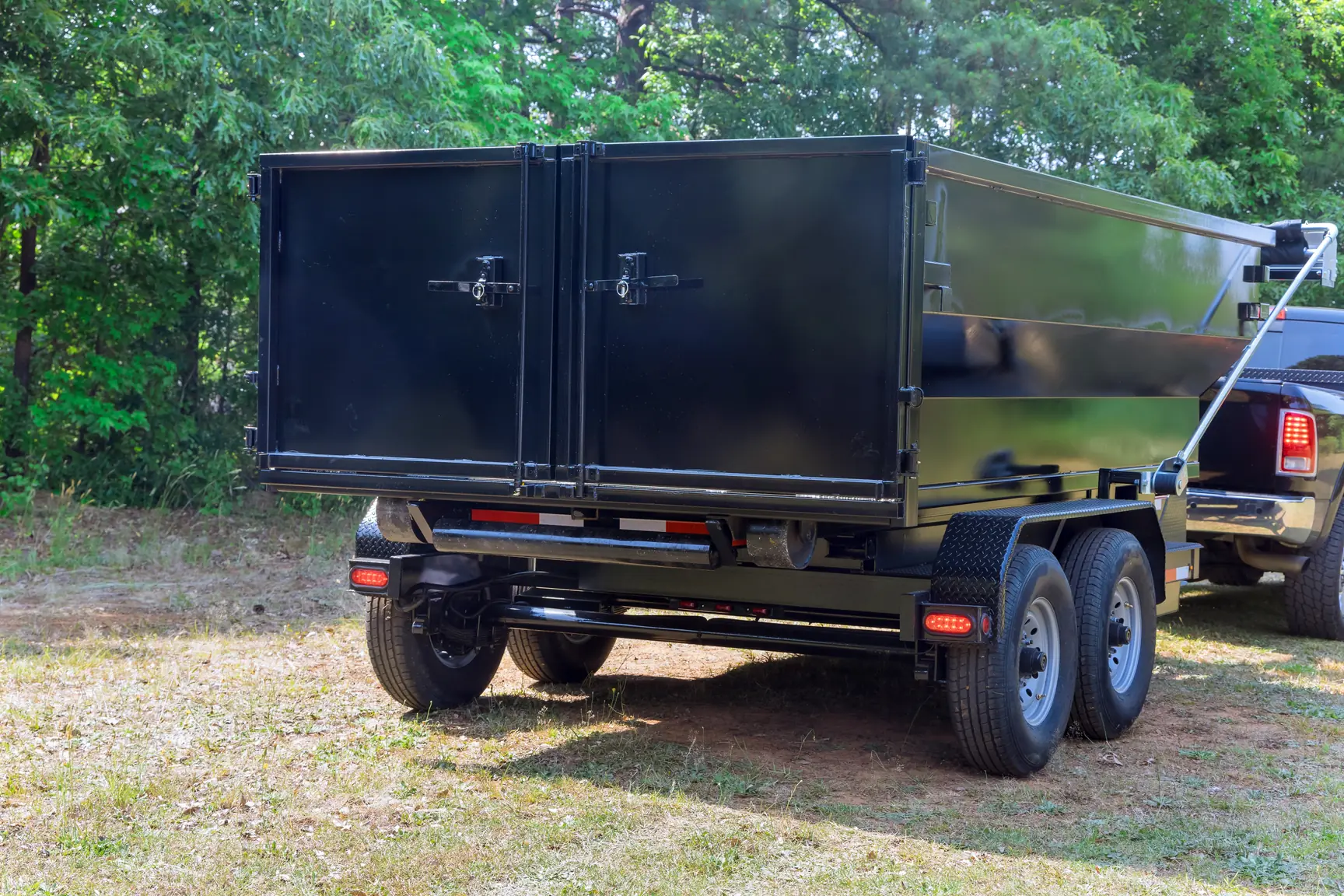
Two forms, one container: the Maine handover
There is a handover on every job that no contract describes, and both of a dumpster rental operator’s liability policies have something to say about it. The general liability form treats loading or unloading as its own defined term. It generally excludes what arises out of the use of an auto, and then tells the reader that such use includes loading and unloading. The auto form does not use the phrase. It arrives at the same seconds by a different route, and the one that matters here turns on whether the equipment moving the box is attached to the truck.
The second half of the seam is the ground beneath the container. A driveway that cracks under a loaded box, a lawn pressed into ruts, a curb scraped by a rail, a parking surface scored on collection — all of it is damage to property belonging to the customer who hired you. Standard general liability wording carries an exclusion for property the insured has in its care, custody or control, and another for the very part of the realty under work. Where a given placement loss lands between them depends on the form in force and on the facts, and this page does not claim to know in advance.
Maine gives that question an unusual angle. Because the state license here follows the conveyance rather than the company, an operator’s fleet paperwork, its schedule of vehicles and its insurance evidence all line up on the same axis — vehicle by vehicle. That makes it easier to keep straight, and it makes a gap more visible when one appears. The seam question is worth asking at quoting time, while the policy can still be shaped around the fleet. Your own policy wording controls, and forms differ between carriers.
Maine regulations and licensing, conveyance by conveyance
Three questions decide a Maine operator’s position: does the state license the hauling, does the state grant authority to carry property for hire, and who controls the street. Maine answers the first with a clear yes, the second with a dated repeal, and the third by handing every municipality a duty of its own.
The Maine transporter license, issued by the state, per conveyance
Maine law requires this license and the state issues it. The environmental department’s remediation and waste bureau runs the program under 06-096 C.M.R. ch. 411, a rule whose own footer records the sections of 38 M.R.S. §1304 it was made under — so this is a regulation with a live statutory parent, not an orphan. The statute puts this trade in by name: the board is directed to write licensing rules for the haulers of three named wastes — septage, scrap tires, and construction or demolition debris — reaching the vehicles they use and the operators driving them.
“No transporter shall transport non-hazardous waste into, out of, or within the State of Maine without the conveyance having a valid non-hazardous waste transporter license issued by the Department, unless the transporter or conveyance is exempted under Section 2(D) of this rule.”
Note where the license sits in that sentence. It is the conveyance that must have one, and section 2(B) says so directly: the owner of any conveyance used for this work obtains a license for each conveyance used. The rule then names the licensable unit.
“For the purposes of this rule, either the power unit, trailer, semi-trailer, or the container being transported shall be licensed.”
Which category applies is the next question, and a roll-off operator is usually in the first one.
“(1) Category A: Special Waste, Scrap Tires, and Construction/Demolition Debris. (2) Category B: Municipal Solid Waste other than Category A waste. (3) Category C: Septage. A combination license may be obtained for any single conveyance hauling more than one of the above categories of non-hazardous waste.”
Two exemptions are worth reading carefully, because each one traps somebody. The first is in the definition at section 1(G): a transporter is anyone carrying non-hazardous waste in the state, apart from a person moving household waste for five households or fewer, and apart from a commercial establishment shifting only its own municipal solid waste to a licensed disposal facility, on three trips a week or fewer with one conveyance. Those two words — only its own — carry the entire distinction. The department’s plain-English page omits them and renders the second limb as a trip count that applies to anybody, which would put a hauler serving a commercial customer three times a week outside the license. Read as written, that is a self-haul carve-out.
The second exemption is about size.
“Conveyances with a Gross Vehicle Weight (GVW) of less than 10,001 pounds transporting municipal solid waste; and conveyances with a GVW less than 26,001 pounds transporting construction/demolition debris to licensed disposal facilities.”
What the license carries is straightforward once you are in it. It runs two years from issue under section 2(F). The department issues a decal for each licensed vehicle, to be displayed on the driver’s side window. The application states the waste category, the conveyance registration or serial number, the applicant’s liability insurer and the coverage limit, and a five-year disclosure statement under section 3(A)(4) covering civil and criminal violations, convictions, ongoing court proceedings, and administrative consent agreements or consent decrees. Section 7(A) asks for proof of motor vehicle insurance, and Category A transporters file a quarterly manifest under section 6.
One date to disbelieve. The rule is served as a file whose name carries a 2025 month and whose document properties were created that year, but the rule’s own footer records its board approval in February 1991 and its effect from 13 March 1991, with an electronic conversion in 1996 and an accessibility conversion in 2025. The recent date is a format conversion. Nothing in this run found an amendment to the rule itself. And one credential to keep separate: 38 M.R.S. §1310-N licenses solid waste facilities. A roll-off operator holds transporter licenses on its conveyances and does not hold a facility license.
The Maine operating authority that was repealed in 2010
Maine grants no intrastate operating authority to a carrier of property, and the correct description of that is a repeal with a date on it, not an absence. The legislature repealed the authority license outright, and the code still serves the section under its old heading with the repeal noted.
“Sec. 9. 29-A MRSA §552, as amended by PL 2009, c. 435, §6, is repealed.”
The neighboring sections went the same way: the identification device at 29-A M.R.S. §553 and the lapse provision at 29-A M.R.S. §554 are both carried as repealed. What survives is safety and registration rather than authority. The State Police safety rule, 16-222 C.M.R. ch. 4, is made under 29-A M.R.S. §555 and applies to interstate and intrastate common, contract and private carriers moving passengers or property in Maine, and the bureau is empowered to incorporate named parts of the federal motor carrier regulations by reference. Those parts are federal law adopted into Maine practice, and nothing on this page presents a federal duty as a state credential.
Two weight figures live on this axis and neither is a threshold for anything Maine issues to a property carrier. For motor vehicle purposes, 29-A M.R.S. §101(17) defines a commercial motor vehicle partly by a gross combination weight rating of 26,001 pounds or more with a towed unit rated above 10,000 pounds, and partly by a gross vehicle weight rating or weight of 26,001 pounds or more. The State Police rule sets its own scope lower, at 16-222 C.M.R. ch. 4 §1(A)(1), using 10,001 pounds. Two instruments, two figures, and a sentence that names one without naming its instrument will be wrong about the other.
Auburn, and a prohibition with no permit attached
Maine sets no statewide rule for placing a container or occupying a public way, and the state transporter license does not displace anything a municipality does. What Maine does instead is unusual and worth saying plainly: 38 M.R.S. §1305(1) requires each municipality to provide solid waste disposal services for domestic and commercial waste generated inside it, and permits it to extend those services to industrial waste and treatment plant sludge. Every Maine municipality therefore has a posture of its own, and those postures genuinely differ.
Auburn is read here as an example, chosen because its code could be read rather than because it is typical. Its code excludes commercial activity and property from city collection in one sentence, and defines commercial activity broadly — hotels, restaurants, warehouses, markets, manufacturing and industrial sites, business offices, a business adjoining or inside a residential structure, trailer and manufactured home parks, condominiums. The residential service is bounded too, and even there section 44-26 limits what the city will take to household waste, with construction repair waste or oversized items needing the public works director’s specific permission. That exclusion is what creates the private market in that city.
“nor shall such a conveyance or containers be left standing in any street or any public place”
An operator reading that heading and moving on would never find the clause, which is precisely why it is quoted. Disposal is channeled as well: section 44-84 has the city manager designate a public waste facility and forbids depositing the listed materials anywhere else, and section 44-87 sets non-residential disposal fees by a schedule adopted by a named regional waste corporation. That schedule was not retrieved and no fee figure is stated here. Two further honest limits. Auburn’s excavation and obstruction rules sit in a different chapter, which was not read in full, so nothing here describes what its permits cover or whether any of them reaches a container. And this run found no private hauler licensing section anywhere in Auburn’s solid waste chapter, which was read whole — the city’s business licenses chapter was not read, so the absence is stated about that chapter and not about the entire code. A search of the current Auburn code for the word every operator would try first returns nothing at all: the equipment has no name in that city’s law.
Securing the payment of compensation in Maine
Maine is compulsory for a private employer and its market is competitive. The duty and the two ways of discharging it sit in a single statutory sentence at 39-A M.R.S. §401(1): the Act binds any private employer — an independent contractor who takes on and pays staff counts as one — and requires payment to be secured for every employee, either by buying a policy or by self-insuring under section 403. The two statutory carve-outs at §401(1)(A) to (C) cover domestic service and agricultural or aquacultural work, and a roll-off operation is in neither. No employee-count floor is recorded: the duty is stated in terms of all employees, with no number attached, and this page adds none.
The consequence of not securing is specific rather than vague. The second paragraph of the same subsection removes a defense: a private employer that has neither bought a policy nor self-insured is not entitled, in a civil action brought by an employee or the employee’s representative for injury or death arising out of and in the course of employment, to the defense set out at section 103 — and the employee may claim compensation under the Act instead of suing. Two agencies share the ground and neither of them is an insurer: the Workers’ Compensation Board administers the system and runs the coverage verification and independent contractor machinery, while the insurance bureau inside the state’s professional and financial regulation department regulates the insurers.
In practice the routes are the ones the regulator describes in its own employers’ guide: buy through a licensed producer selling property and casualty business, ideally one who knows commercial risks, or qualify to self-insure. The guide is candid that the market rewards a clean loss record and that a first-time owner, a smaller business or an operation with frequency or severity problems can find placement harder. Self-insurance under section 403 is a route rather than an exemption, and because that section was not retrieved in this run no qualifying test, security amount or financial criterion from it appears here. We name no insurer, quote no rate, and do not describe the residual market as a state fund.
A panel for Maine in rows. Each row sets one thing the state requires beside the exposure that requirement leaves open and the coverage line that answers it. Hauler registration: A hauler credential, issued by the state. It leaves open a container placed on a customer’s property, and the driveway or curb it damages, which General Liability and Dumpster and Equipment Coverage answer. Intrastate motor-carrier authority: No state intrastate operating authority. It leaves open the roll-off truck at fault, and the container in transit, which Commercial Auto and Pollution Liability answer. Roll-off placement permits: Municipal — varies by city and town. It leaves open placement on the public right-of-way, and a struck pedestrian or vehicle, which General Liability answers. Workers compensation: Compulsory; bought from private insurers. It leaves open a driver or yard hand hurt on the job, which Workers Compensation answers. Notes: A registration, permit or bond is a condition of operating, not insurance: it answers none of the exposures on the right, so no line is drawn from it. The conclusion reads: The registration is not the coverage — the program is. No figures are shown.
Each coverage, against the Maine operation it answers
Maine asks for insurance evidence at the license application, and asks for it per conveyance. That makes the schedule a working document rather than a filing. Line by line:
For the picture before the state detail, start with our dumpster rental insurance overview.
Common Maine claims this class produces
No figures appear below. The record sources no severity or frequency data for this state and §14 forbids inventing any. These are the recurring shapes.
Placement damage comes first, as it does everywhere. A box goes onto a Bangor driveway that looked sound, or onto a Biddeford verge softened by a wet spring, and the damage is visible only when the box comes off. Which policy responds depends on the exclusions described at the top of this page.
Second is the container in the public way. Maine municipalities set their own street rules and at least one of them prohibits a container standing in a street outright, with no permit available to cure it. A third party hurt around a box in that position is a liability claim with a regulatory complication attached.
Third is a licensing exposure that is peculiar to a per-conveyance state. A truck or a container whose license lapsed, a unit added to the fleet before its paperwork caught up, a decal that is not on the glass. Nothing about that is an insurance claim on its own, but it shows up in the aftermath of one, and it is the reason a Maine fleet schedule and a Maine license list should be reconciled rather than filed separately.
Fourth is the contents question — something in the load that belonged in a different category or a different facility — and fifth is the injury on the tarp or the walk-around, where the compensation duty above is the whole answer and has to have been in force beforehand.
Counties behind our Maine markets
We write dumpster rental and roll-off operators across Maine. The markets below are listed, each with its county. No population, household, container or volume figure is attached to any of them, because the record sources none.
Two notes on that list. Auburn is named in two places here — as a market above, and as the example read in the local-rules section — and each mention stands on its own footing; its commercial collection exclusion is that city’s own choice. Portland is a market here and deliberately not the example — its own ordinances were not retrievable in this run, so nothing on this page describes them. South Portland is a separate municipality from Portland with its own code and its own posture, which follows directly from the duty 38 M.R.S. §1305(1) places on each municipality individually.
Nearby states we also write
Maine has exactly one land border with another state, and this page says so rather than padding the list. The other two below are New England, not neighbors. Nothing established here travels to any of them; each page is written from that state’s own record.
Maine roll-off insurance FAQ
Does Maine require a license before I haul construction debris?
Yes, and it is issued by the state. The environmental department licenses non-hazardous waste transporters under 06-096 C.M.R. ch. 411, made under 38 M.R.S. §1304(1-A). The statute names construction or demolition debris in the rule-making mandate itself, and the rule then places that stream in Category A. The motor vehicle authority does not issue it — its own commercial vehicle pages send waste carriers to the environmental department for the licenses they need.
Is the Maine license held by my company or by each truck?
By the conveyance. Section 2(B) of the rule requires the owner of any conveyance used for this work to get a license for each one, and section 1(B) says which unit is licensable — the power unit, a trailer or semi-trailer, or the container being carried. That means a fleet answer, not a single company document.
I only run a few trips a week for one commercial customer. Am I carved out?
No. The carve-out in section 1(G) reaches a commercial establishment moving only its own municipal solid waste, on no more than three trips a week with a single conveyance. Those two words — only its own — are the whole test. The department’s plain-English summary drops those words and reads as though the trip count applies to everyone; the rule governs, not the summary.
Is there a weight below which no Maine waste license is needed?
There are two figures and they do different jobs. Section 2(D)(5) of the rule exempts conveyances under 10,001 pounds gross vehicle weight carrying municipal solid waste, and conveyances under 26,001 pounds carrying construction or demolition debris to licensed disposal facilities. Do not confuse the second figure with the identically numbered commercial vehicle definition at 29-A M.R.S. §101(17) — that one is about motor vehicle law and not about this license.
What is involved in getting and keeping the Maine transporter license?
The license runs two years from issue under section 2(F). The application names the waste category, identifies the conveyance by its registration or serial number, gives the liability insurer and the coverage limit, and carries a five-year disclosure statement under section 3(A)(4) covering civil and criminal matters, ongoing proceedings and any administrative consent agreements or decrees. Proof of motor vehicle insurance is required by section 7(A). Category A transporters file a quarterly manifest under section 6, and the department issues a decal for each licensed vehicle.
Do I need Maine operating authority as a motor carrier of property?
Not any more, and the reason is a repeal rather than a gap. The operating authority license at 29-A M.R.S. §552 was repealed by the legislature in 2010, along with its identification device and lapse sections. What remains is safety: 16-222 C.M.R. ch. 4, made under 29-A M.R.S. §555, applies to interstate and intrastate carriers of passengers or property in Maine and incorporates named parts of the federal motor carrier regulations by reference.
Does my Maine town collect commercial waste, or is that my market?
That varies municipality by municipality, and 38 M.R.S. §1305(1) is why: it puts the disposal duty on every municipality individually. Some run collection, some contract it, some operate transfer stations, and some refuse commercial work outright. Auburn is explicit — its code excludes commercial activity and property from city collection — and that exclusion is what defines the private market there. It is that city’s decision and not Maine’s rule.
Can I leave a container standing in an Auburn street?
That city’s code contains an absolute prohibition with no permit attached, and it is easy to miss because the heading is about something else. Section 44-33, headed for transporting offensive substances, ends with a clause reaching a conveyance or containers left standing in any street or public place — and the section offers no waiver or exception mechanism. Auburn’s excavation and obstruction rules sit in a different chapter that was not read here, so nothing on this page describes what those permits cover.
This page reports Maine law as our own state research file records it. It is general information rather than legal advice, and it is not an opinion on what any policy covers — the wording you hold controls that, and carriers do not all write it the same way.
Ask us about a Maine roll-off program
Send the vehicle list, the container count, the categories you haul and the towns you serve. Because Maine licenses by conveyance, the fleet schedule is where we start, and we will line the six coverages up against it. Your own policy wording controls.
Related coverage for dumpster rental operators
- General Liabilitygeneral liability
- Commercial Autocommercial auto
- Dumpster and Equipment Coverageinland marine
- Commercial Propertycommercial property
- Workers Compensationworkers compensation
- Pollution Liabilityenvironmental / pollution liability
What it costs in Maine · States we serve · Dumpster Rental Insurance · Get a quote · Contact us
Primary sources
- Maine DEP — Non Hazardous Waste Transporter Program — the issuing program; read its plain-English summary against the rule itself, which governs
- 38 M.R.S. §1304 — Rules of the board — subsection (1-A)(A), the mandate that names construction or demolition debris among the licensed categories
- 29-A M.R.S. §552 — Operating authority license required (repealed) — the section the code still serves under a repeal notation; the repealing act is PL 2009, c. 598, §9
- 38 M.R.S. §1305 — Municipal responsibility — the duty that gives every Maine municipality a waste posture of its own, and makes the local layer vary
- Auburn Code of Ordinances, Chapter 44 — Solid Waste — the one municipal example on this page — the commercial exclusion, the street prohibition and the designated facility
- 39-A M.R.S. §401 — Insurance and self-insurance — the securing duty on every private employer, the two routes, and the defense lost by failing to secure